• Skip to primary navigation
  • Skip to main content
Danny Brown

Danny Brown

podcaster - author - creator

  • About
  • Podcasts
  • Journal

Business

Choosing Bus Stops

B65 bus stop
Image by threecee via Flickr

Yesterday I mentioned that I see myself as a chartered bus driver, and this blog as the bus with you as the passengers. I wanted to let you know that without passengers, buses don’t really have a need for existence, so your travels with me are important.

I want to expand on that a little and look at you and the buses you drive, and how you can help your own passengers.

Everyone Is On a Journey.

Some will always be passengers, happy to be along for the ride and meeting new passengers along the way.

There’s absolutely nothing wrong with this, and the interaction you gain from fellow passengers makes the journey even more interesting. Yet for every passenger, there’s also a bus driver – so how can you make your bus the one people want to travel on?

Be a Sales Person.

It might seem that a bus driver only has the one job – getting you to your destination – but there’s a lot more going on behind the scenes. He (or she, although I’ll use “he” just for easier use, if that’s okay) has to be the public face of the company he works for. He has to offer a positive view of the company at all times, and ensure that passengers stay with his service and not try someone else.

Be the sales person for your company. It doesn’t matter what your role in the business is – CEO, director, customer service or mail-room guy, every single thing you do reflects on your employers. If you give off a positive vibe, that will come across to the people you deal with every day, either in public or cross-company.

Times are hard enough as it is, without businesses crumbling from within – help make it the place you’d buy from and the positive knock-on effects can be long-term.

Safety First.

A bus driver has to make sure his passengers arrive safely. While they are on his bus, their well-being is paramount. He may have had a crappy day so far, or he may be going through personal issues, but they have to take a back seat while his passengers are traveling with him.

If you’re a business owner, look after your employees. Not just their physical well-being (although this is important) but their mental well-being as well. Be the approachable boss that really cares about how his workers are feeling, and have an open-door policy at all times. If you’re too busy at a given time, make the time later to speak with someone – and stick to it.

Time you have plenty of – happy employees are harder to come by. Make yourself available and keep an eye in your mirror at all times.

Be a Mind Reader.

To ensure his passengers are safely delivered to their destination, a bus driver has to be aware of his surroundings, both inside the bus and on the roads it’s traveling on. Other vehicles pulling out suddenly; red lights being jumped; pedestrians stepping off the sidewalk; how his passengers are interacting with each other – a bus driver needs to be aware of all this and more as he goes about his job. Mind reading becomes second nature.

Learn to read minds as well. If you’re running a business, monitor the tactics of your competitors and learn to gauge what their next move will be. Converse with your customers to plan ahead for the next three months, six months, a year even – keep abreast of what they want to help you get to where you want to be.

If you’re an employee, learn how your company works and what makes your leaders tick. Be pro-active at making their job easier, which in turn makes your job easier, which in itself makes the company more attractive and encourages success. Even in your personal life, be aware of those around you and where they want to be – knowing that will let you help then get there sooner, and you with it.

There are many kinds of bus drivers, just as there are many kinds of passengers. Which one you want to be is up to you, and there truly is no right or wrong.The one thing that does connect everyone is the journey itself.

How will you travel this year?

Learning from Cats

Cat Conspiracy
Image by Tjflex2 via Flickr

Cats can teach us a lot. I’ll admit to a slight bias here, having always been a cat man over a dog man (though my wife is trying her best to rectify that and we now have two dogs alongside our three cats). I just think cats offer more than dogs while looking for less in return. But I digress – as I say, they can teach us a lot.

Cats are extremely independent creatures. They will show you love and sit on your lap for hours, but on the same token they will also disappear for hours at a time as well. They offer and receive love but they can also make their own entertainment.

They’re fastidiously clean. Grooming and appearance is important to them and they’ll happily spend hours cleaning and re-cleaning the same spot, making sure they’re at their most attractive. They’ll also ensure they don’t leave a mess behind them when using a litter box.

The majority of the time, they won’t pick a favourite. The odd cat might choose one owner over the other, but generally they share their time with as many people as possible – owners, friends of owners, family members of owners and strangers outside. They’re not fussy, they’ll talk to everyone.

Be A Cat.

Be independent. Offer a view that’s uniquely your own while staying open to those of others. It’s easy to fall into line and just accept what’s being said or done, because it’s always been that way. But who’s to say that way is right? Think for yourself, question the status quo and never accept something for acceptance sake.

Stay clean. Be transparent about all you do and don’t keep secrets that can come back and bite you in a painful way. If you’re doing something that will affect those around you, be they friends and family or employees or bosses at your business, be open and honest. You might need help later on and that can be hard to come by without the trust of your closest allies.

Keep an open mind. Everyone has their favourites – movies, bands, bosses, employees, bloggers and more. Yet staying within that comfort bubble does nothing for your personal growth. Knowledge is power – knowledge gained with wide-scale insight is almost unstoppable. Keep your options open, never close a door completely and converse with everyone – you never know what you might discover.

How will you be a cat?

If you enjoyed this post, please consider leaving a comment and subscribe to my RSS feed or via email to ensure you can enjoy the latest post(s).

Reblog this post [with Zemanta]

How to Sell Twitter to a Client (Or Even Your Own Boss)

Sell, Sell, Sell album cover
Image via Wikipedia

It’s one of the current axioms doing the rounds online – “I love Twitter but how do I sell it to my client or boss?”.

You can see the benefits because you use it every day, but just how do you transfer that message to those who wonder where the benefit of 140-character conversations are found?

Perhaps that’s not the question to ask – instead, how about asking why you even have to justify it at all.

Think about it for just a moment – your client or your boss’s success has probably had a lot to do with business relationships built up over the years.

Additionally, being aware of the business market around their industry will also have played a large part in their success. And you can be pretty sure that both these reasons are continuously worked on and monitored to sustain that success.

Now think of why Twitter is so beneficial to you.

Are you building relationships with great contacts? Are you keeping abreast of the latest news in the industry because people are talking about it in their Twitter stream? Are you finding content and advice that helps you grow both personally and professionally because of the information you’re a part of through your Twitter contacts and the information from their contacts?

I’d hazard a guess that the answer to all of these questions is a fairly comprehensive “Yes.” So why should it be any different for your client, boss or anyone else you’re trying to extol the virtues of Twitter to?

The next time you want to get your client involved in Twitter, or your boss dismisses it as nothing more than a fad for people having banal conversations, ask them a couple of simple questions:

  • How do the majority of your customers find you?
  • How do they then communicate with you?

You’ll probably find that the majority of the answers to the first question are “Via Google” and the majority of the answers to the second question will be, “They’ll call us or email us an inquiry.”

In short, they’re looking for specific goods or services and want to open up a dialogue with the hope of fulfilling that need.

The next step is usually a customer service representative calling back, or perhaps even a member of the sales team calling to discuss the (potential) client’s needs. Then, with a bit of luck (and sometimes depending on the skills and motivation of the person calling them back), that potential client may turn into a physical one.

But that’s the NORMAL practice.

What if it wasn’t down to luck? What if it was down to the interaction and genuine interest you showed in conversing with that client? Instead of just seeing them as another dollar bill through the business doors, they actually felt important to your business? That’s what Twitter offers.

Finding a company on Google (or any other search engine) is no different from finding that same company using the search feature on Twitter. And the inward communication regarding their needs? Imagine if the (potential) client could open up a two-way dialogue that was instantaneous and could cover everything in one conversation?

Instead of the customer service representative putting the caller on hold to ask sales a question, or check marketing’s latest offer, that department could be instantly engaged in the conversation with a Twitter “@ message”. And with the functionality of Twitter, even getting hold of someone out of the office is easy enough with Twitter alerts by cellphone.

Of course, there might be an argument that this is too simple a suggestion – there would still be the problem of the caller in question not being on Twitter. If so, put yourself in their shoes for a moment.

If you were a potential customer of a company and you were faced with a customer service line that may be engaged or a Twitter stream that costs nothing and is always open, which would you prefer? I know which I’d go for.

Of course, this is for the future – the immediate need is to convince your client or boss of Twitter’s value. So just ask them what offers more value than knowing what your customer base is thinking. What offers more value than answering concerns or questions that their customer base may have?

And perhaps most importantly of all, what offers more value than being able to answer these questions before your competitors answer for you?

The answer(s) should be simple.

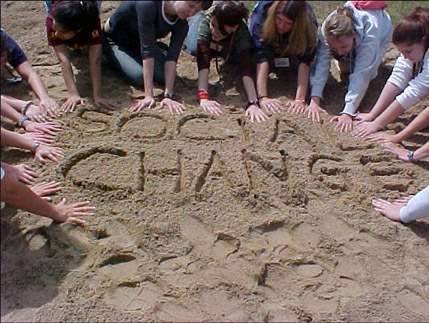
Using Social Media for Change

Description unavailable
Image by danish. via Flickr

Talk about social media and many people automatically think of its business uses. While it’s as good a tool for individuals as it is for business, most social media talk at the moment is how it can benefit businesses. I’m as guilty as the next person for this, as it’s an area I always recommend clients both new and existing take a serious look at.

Yet there’s another area of social media that’s often overlooked, even though it’s quite possibly the most important use of all – using social media for social change.

There’s no end of advice around the web on how to use social media for business change, yet try and find information on how it’s being used for society and the results are less impressive.

Thankfully, there are some great organizations and influential blogs that are using social media to encourage change worldwide.

Social Media for Social Change, for example, is the brainchild of Michelle Riggen-Ransom, co-founder and Communications Director of BatchBlue Software. Michelle and guest writer T.J. Sondermann use the blog to show how technology can change the world for the better. Topics include Education, Non-Profit and Family Action Plans. There’s some great information on there and is well worth your time.

Change.org is also making headway since its inception in 2005. Its core message is about effecting change both social and environmental. Excellent use of their blog and interaction with their readers and visitors, as well as various projects using social media outlets, has seen Change.org become a leading light in social change.

One company that I have a lot of time for is Kiva, whose aim is to eradicate poverty through micro-lending. Individuals or groups can offer micro-loans to entrepreneurs in developing countries, offering a more viable way to escape poverty than charity handouts that may never get past the ruling Government. Kiva uses the Internet and social networking to great effect and is making a difference to those that really need it.

With these companies and the likes of Max Gladwell, Pop! Tech and more, social media is maturing into a medium that is much more than a business marketing tool. If we really want to encourage the “social” part of social media, then these sites and others like them are leading the way.

How will you make change?

Starbucks – A Lesson in Social Media Branding

Venti Mocha!Ask anyone what one of the biggest stumbling blocks for businesses and social media is and the over-riding answer will probably be understanding. Or lack of it.
With so many businesses questioning why they would enter a medium that doesn’t offer the same kind of return on investment (ROI) than traditional marketing, why bother?

One look at Starbucks could offer some answers. The Seattle-based coffee giant has embraced social media with some great initiatives that any business could learn from.

For instance, while other brands are deciding whether micro-blogging site Twitter is for them, Starbucks has tackled it head on. Better still, they’re actually engaging their customers into the bargain. Instead of simply using Twitter as a broadcasting tool, Starbucks is actively conversing with its 17,000 followers (although weekends seem strangely quiet).

By helping people buy Starbucks-related products to sharing information on various charity projects the company is involved in, the Starbucks Twitter account is the perfect example of great brand usage.

On top of that, Starbucks has also set up an interesting project over at My Starbucks Idea. Here customers of the company are invited to share their ideas on how Starbucks can improve. An open forum approach sees users post their ideas and other members vote for the best. These are then looked at by Starbucks for viability.

As an idea in improving a company through the people that matter – the customers – it’s brilliant common sense. As an example of interactive social media at work, it’s perfect.

Perhaps it shouldn’t be surprising that Starbucks is embracing social media as well as it is. After all, the company has long been an advocate of social responsibility with their eco-friendly projects. With My Starbucks Idea and their Twitter account, they’re merely transferring their offline ethos into the social media world. And a fine job they’re doing too.

How does your brand compare?

Creative Commons License photo credit:?betsyjean79

  • « Go to Previous Page
  • Page 1
  • Interim pages omitted …
  • Page 22
  • Page 23
  • Page 24
  • Page 25
  • Go to Next Page »
© 2026 Danny Brown - Made with ♥ on Genesis