• Skip to primary navigation
  • Skip to main content
Danny Brown

Danny Brown

podcaster - author - creator

  • About
  • Podcasts
  • Journal

blogging

Why You Don’t Need to Blog Daily

Keep up and blog onThere’s a bit of a debate as to how often you should blog if you want to have a successful blog and grow the community around it.

Some folks will say you need to blog every day, or every other day.

Others will say once a week.

Others will say only blog when you have something useful to say (I’m not too sold on the last one – one person’s definition of useful is another’s definition of crap).

To be honest, there’s no right or wrong answer. Or at least, no standard right or wrong answer.

There is a right answer for you, however, and that’s the one you need to look at.

Questions and Answers

Blogging’s a funny beast. It can be personal; it can be corporate. It can be funny; it can be sad. It can be a sales tool; it can be a simple connection tool. It can be written; it can be media.

Simply put, blogging is in a world of its own when it comes to set parameters. You can’t say what works for one blogger will work for another; it just doesn’t roll that way.

What it does do, however, is make it easy to choose how often you’ll blog by asking two must-know questions before you start.

  • Are you passionate about the topic?
  • What time can you realistically allocate?

These are just two questions, but they offer the best idea for you as to how often you’ll blog. If you’re not passionate about your topic, blogging will soon become a chore, and once something becomes a chore… Well, we all hate chores, right?

If you can only allocate a few hours a week (and this includes promoting your blog and responding to comments on the post), then you’re probably only going to post once or twice a week. An hour a day would see you post daily; a couple of hours a month, you’d probably only be able to blog bi-weekly. (These are just rough stats – they don’t necessarily relate to your timescales).

So these questions kind of dictate how often you might blog.

It’s Not Worth It Then, Is It?

Now, depending on who you read and who you listen to, if you’re posting infrequently then you’re never going to grow your blog or get the readers/subscribers you’re after. Out of sight, out of mind, right?

Not necessarily.

I blog pretty much every day. I don’t do it just to “get more readers” – I’ve never had a subscription run here and I don’t plan on having one, ever. I’d rather grow my readership and subscribers organically as opposed to giving faux reasons why you should subscribe.

Instead, I blog as frequently because I genuinely love blogging. I love the interaction with you; I love being able to bounce ideas off each other; I love being able to offer an alternative take on something and then invite you to offer yours.

My friend John Haydon blogs a little less frequently, but still pretty regularly. Chris Garrett, co-author of the ProBlogger book and owner of the popular new media site ChrisG.com, has been posting fairly irregularly over the last few months.

Now. Take a look at this chart from Compete.com, which shows the monthly traffic for all three sites over the last 12 months.

As you can see, while there have been dips and gains, Chris has the most traffic, while John and I have swapped it back and forth as to where the higher traffic has been on a given month.

The blog that posts less is more “popular” than ones that post either daily, or more frequently. Kind of blows the whole “post every day” argument out the water.

So.

Listen to you, and write for you. Everything else is a bonus – readers, commenters, community, subscribers. Get what feels right for you, and that comfort will come across in your blog.

And that’s when it starts being fun. And when others see it’s fun? Well, there might just be no stopping you then…

Creative Commons License photo credit: markhillary

Why Arkayne is Good for Your Blog and Business

For any blogger (especially if you’re using your blog for your business), Arkayne is a pretty solid platform that you might want to check out.

I’ve been using Arkayne on my blog for the last month or so, and I gotta say, I’m enjoying the experience so far. I’ve not used all the features to their full advantage yet, but that’s more to do with me than the tool itself.

So what is Arkayne and why should you be bothered?

Simple. Two of the most asked questions by bloggers is how to get more traffic and how to monetize it. To grow and monetize your blog you need readers but, as any blogger will tell you, finding those readers initially can be tough.

It takes a combination of content worth reading, strong search engine visibility and social network sharing and relevance. Arkayne can help with all three.

Search Engine Optimization

Arkayne’s built-in SEO Analyzer helps you increase the visibility of a page or post to the various search engines. Once your post is written and saved to draft mode, you can use the analyzer to test how well it’s optimized.

Danny Brown 52 cool facts about social media SEO

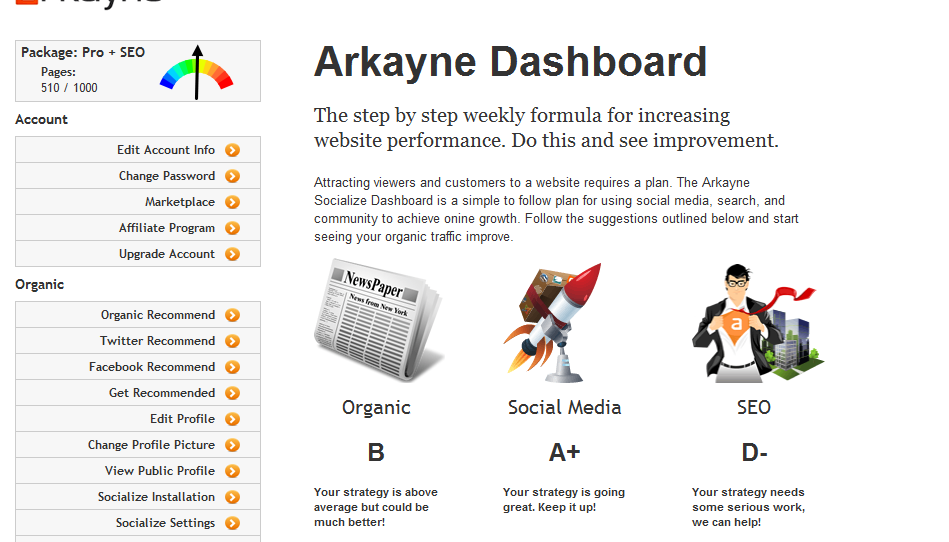
The Arkayne SEO analyzer scores the post according to title, meta description and content. It then tells you where you’re going wrong and how to improve. You can make the changes and then re-analyze until you get that magic 100% (or A rating).

It’s similar to the Scribe SEO system with one main difference. With Scribe, you’re allocated credits depending on which package you buy. Each analysis uses a credit, as does each re-analysis when fixing your content, which means your credits can soon be eaten up and you have to buy more.

Arkayne’s SEO analyzer allows as many analysis checks and corrections as you need without charging extra – a nice touch.

  • Update – Arkayne has just published a comparison chart between Arkayne SEO Analyzer and Scribe SEO, which shows Arkayne’s offering ahead in most comparisons.

Network Sharing

Another nice feature from Arkayne is the social sharing and network syndication options it offers. There are a few ways it does this and each one offers a great way to increase your traffic by building relevance into each post and share.

For example, if you link your Twitter and/or Facebook account to Arkayne, you can post an update from within your dashboard to your profile. Arkayne then posts this link as a status update on Facebook, or a tweet on Twitter. So what – just like any other content sharing platform, right?

Not quite. Where Arkayne differs is that the link goes back to your publisher page on Arkayne, and offers your profile along with related links to more content you’ve written on a similar topic. But that’s not all.

By searching your content and providing even more relevant links, Arkayne is constantly figuring out how to connect to your site from the link you provided, and increase its traffic and relevance every time.

Arkayne also offers the option to show related posts at the end of your own blog post (both from your blog and content across the web), which again helps decrease bounce rate on your blog while sharing content with and from others.

What I like about Arkayne’s approach is they take the time to find the most relevant links and then add to your post, so it’s not just a bunch of links grabbed by keywords only. It does mean that related posts don’t appear immediately, but when they do you know they will be relevant.

Another way Arkayne helps your blog grow is by its own social network of bloggers and publishers. You can use Arkayne’s recommendation engine to either recommend blogs or publications you read, or help find ones that would be useful to you. And of course this works in reverse.

Each recommendation or connection you make appears on your publisher profile, offering more visibility to that blog. So if you connect to other publishers and they find you relevant, your blog will then appear in their feed, increasing your visibility again.

Using Arkayne for Business

So far, I’ve looked at some of the features that make Arkayne a very cool platform for bloggers, but it doesn’t stop there. It can also help you with your business goals, regardless the size of you and/or your campaign(s).

For example, you can use Arkayne to examine your existing content (web, publisher strategies and relationships) and the social relevance options of Arkayne, and make sure you’re using the right approach (and amend if you’re not).

Additionally, you can also use Arkayne’s engine to find those that can help you spread your message more, as well as manage any syndicated news and content and adapt if any updates about your business are made.

Then there’s the analytics integration with Google Analytics, Omniture and Core Metrics to manage your campaign and click-throughs or tracking codes; traffic metrics to see who’s the best partner for your campaign; and white label branding to make Arkayne part of your client offering.

And that’s just brushing the surface – depending on your needs, you can really get deep into how you manage Arkayne for your business or enterprise goals.

Is Arkayne Worth It?

From my own (still limited) use so far, hell yes. As a blogger, the SEO Analyzer, as well as the RSS syndication and social integration options, makes it worthwhile to me.

And as a business owner, I can see where the various publisher and campaign solutions would be useful as well.

From a price standpoint, Arkayne also makes a lot of sense. As well as a free account, you can also purchase plans for Pro, Pro + SEO (the one I have), Business and Enterprise.

I’m still playing with all the features that Arkayne has, but I can already see the benefits. My bounce rates have dropped since I activated a related posts option, and my SEO visibility has improved too.

Would I recommend Arkayne? Yes – especially since you can test a lot of the features with a free account. Though to really benefit, I’d recommend the Pro + SEO package.

What about you – is Arkayne something you can see benefit from? Or if you’ve checked it out already, I’d love to hear your thoughts – as always, the comments are yours.

Why I’m Loving BlogOnCloud9

First, I just want to say none of the BlogOnCloud9 links in this post are affiliate, in case you thought this was just a blatant sales pitch…

About a couple of months ago, I noticed that my site was having loading issues. I ran it through a load time analyzer and was shocked at how long it could take to load.

Especially with it being reported that Google would look less favourably on slow-loading sites.

My host at the time was Hostgator, and while they’re a great host, my concern was that by sharing bandwidth with other sites, mine would eventually suffer. Step up the search for a new web host.

One of the blogs I read a lot is that of Mark Jaquith, and he had a post about WordPress and how certain hosts weren’t really set up for it (and I’m not saying this is the case with Hostgator, just to be clear).

In the comments of that post, Ronald Huereca mentioned a host called BlogOnCloud9. What caught my eye was the mention that they use Rackspace, who I’d been looking at, and how they seemed perfect for WordPress and were very security-conscious. So I decided to look into BlogOnCloud9. And was very pleasantly surprised.

The guys at BlogOnCloud9 set the service up because they were also WordPress lovers frustrated at how the platform wasn’t always taken seriously by web hosts. They have a rich history with WordPress, with their involvement with ContentRobot, and so decided to set up their own dedicated service just for WordPress blogs.

Reading up some more on them, I contacted the BlogOnCloud9 guys with some questions about moving servers, their service, and just general questions on hosting, etc. They replied the same day, with a great personal touch (something that continues today), and really made me feel like their most important customer. Something that every business should do.

So I decided to go ahead with it and the move was smooth as marble. There was no downtime; the guys had me up on a dummy site to ensure I was happy with everything; and the transfer from Hostgator to BlogOnCloud9 was completed with no drama at all.

Since then, the performance and support continues to convince me I made the right move, and it’s the reason I recommend BlogOnCloud9 for any WordPress blog or site, and for clients that are overhauling their web presence.

Should you check out BlogOnCloud9? Well, here are some features if you’re interested:

  • Custom installation tailored to your needs.
  • Configuration and plug-in installation for security, SEO, performance and analytics.
  • One-to-one support and forum support for all WordPress questions (not just your blog).
  • Nightly back-ups emailed to you in case your blog goes down for any reason (using the awesome Back-Up Buddy plug-in).
  • Easy upgrade options to different plans, depending on your growth/new domains.

Because I have a few domains, I chose the Expert Plan that also gives me five development areas. This is where I can essentially create a clone of my blog to redesign, mess with template, try new features, etc, without damaging my live blog. Then I just flip the switch to set live.

If this post comes across as a bit promotional for BlogOnCloud9, I make no apologies for that. Just like you, I believe in sharing great products and service, and BlogOnCloud9 falls into both these categories and then some.

And like I said at the start, none of the links here are affiliate links (though BlogOnCloud9 does offer that if you’re interested) so I’m not even posting just to make a fast buck…

Anyhoo… this is why I’m loving BlogOnCloud9 and if you’re serious about WordPress and blogging/site host, you could do a lot worse than check them out.

Cheers!

Blog Awards, Recognition, And Your Part in It

Young Entrepreneur Top 10 Marketing Blog

Teamwork?When I first started this blog just under two years ago, I had one clear goal – fostering thought connections.

Sure, I’d be using it to offer my views on the still-emerging (at the time) social media platform, as well as ideas and solutions on how you could get the most out of the new networks and tools that seemed to be popping up all over the place.

But the overriding factor would be to have my blog as a focal point where ideas could be shared; viewpoints could be discussed; friendships and connections made; and a community built that wasn’t afraid to challenge thinking to help each other grow.

What I didn’t expect was how the blog would grow in that timescale.

Today I found out that this blog was one of the recipients of Young Entrepreneur’s Top 10 Marketing Blogs Award. While I was uber-happy to be recognized by such an organization to start with, my jaw literally dropped on the floor when I saw the company I was keeping – Seth Godin, Andy Beal, John Jantsch and Valeria Maltoni among others.

These are marketers and bloggers that I look up to immensely, so to be sitting alongside them is pretty mind-blowing. What’s even more mind-blowing is how the Young Entrepreneur award is part of what’s been an incredible first half of the year for this blog.

  • In January, it was voted PostRank’s Top Marketing and Social Media Blog.
  • In February, it came in at number three as one of the Top 50 Canadian Marketing Blogs.
  • In March, it received the Hive Award for Best Social Media Blog at South by Southwest.
  • In April, it came in at number six as one of Cision’s Top 100 Social Media and Internet Marketing Blogs.

Couple that with its syndication across the Social Media Today, WebProNews and Newstex business networks as well as its inclusion on the AdAge Power 150 list, and this blog has taken on a life that I could never have foreseen back in September 2008.

Now, while I could lay claim to having done it all myself and how the content has spoken, blah-de-blah-de-blah, even it if were true it’d only tell half the story.

As I mentioned at the start, the aim of this blog has always been to foster a community that would not only question and offer views, but would help the blog grow because of that questioning and view sharing. And these awards and recognition are proof that’s exactly what has happened.

If you didn’t come here and read my thoughts; if you didn’t come here and offer yours; if you didn’t question my viewpoint and make me think differently and strive to be the best I can every time, none of the recognition or award-winning would have happened. I’m not that dumb.

So.

From the bottom of my heart, thank you. Thank you for giving me the time from your life to make me think better. To make me question my thoughts. To make me learn and improve daily.

And thank you even more for helping foster what is, without question, one of the best resources of knowledge, expertise, thought leadership and more – our community.

Your community.

Here’s to you.

Creative Commons License photo credit: blentley

Community, Loyalty and the Power of Give

DSC_0641Last night on Twitter, I was part of the?#sbt10 chat, part of the Start Blogging Today project (disclosure – I’m a partner in the project). As usual, there were a ton of great topics discussed on how to make your blog work better for you.

One of the conversations that arose was how to reward loyalty – i.e., how to make sure that your blog community knows you appreciate them.

Michael Schechter asked how you’d go about that, and I suggested exclusive content as one option (similar to what I did with my free Facebook marketing ebook).

Of course, that approach on a blog would mean that to really benefit from exclusive content, your readers/community would have to be subscribed to a newsletter or email subscription. Which would then negate the rest of your readers that don’t subscribe this way, but still show loyalty by coming back time and again.

So what ways could you reward on your blog, for both subscribers and everyday visitors/readers?

Loving Your Blog Community

Face it, without a community a blog is nothing more than a broadcast platform. Your community nurtures the growth of your blog; it helps share with others; it defends if needed; and it keeps you growing as a blogger by sharing great insights in the comments.

It doesn’t matter if it’s a personal blog or more business-oriented – community is the real king (sorry, content lovers). For business blogs, community is the relationship to the sale – look after it and look after your business.

So what are some of the ways to reward a loyal blog community?

Exclusive Content

As I mentioned earlier in the post, this would normally be via a newsletter or email subscription, so may negate some of your readers (although it’s a great way to build an even more loyal community on subscription too). Some of the things you could offer could be:

  • A free ebook;
  • White papers;
  • Solid business advice not normally seen on your blog;
  • Discounted offers on affiliate programs.

There’s a lot you can make exclusive to really say “thanks for being part of my community”. You’ll have a better idea of what would appeal to yours – all you need to do is put that into action.

The Freemium Model

Because exclusive content needs an exclusive outlet to really make it work, you run the risk of excluding the readers that visit every day, comment and are as just as important a part of your community as subscribers.

7/365
So how do you make sure that you’re not ignoring them and focusing on your exclusive content?

  • Episodic content. This can work in two ways. You can either write a series of educational posts on topics your readers would find useful, or you can offer the first chapter of any ebooks that exclusive content subscribers receive. That way, “normal readers” still receive value and can decide whether to expand into the subscription option.
  • Actionable content. Want to be seen as a thought leader or serious blogger in your space? Then offer action points that anyone visiting your blog can take away and make work for them.?John Haydon does this all the time for Facebook strategies, while CopyBlogger offers solid tips on writing for search engines. Help others; help you.
  • Highlight your community. Another way to reward your community is to give them some reader love. By coming to your blog every day and commenting or sharing you, your community is helping you grow awareness of you. So do the same for them. Have them guest post on your blog, or post about someone from your community frequently. We all like to feel appreciated; make sure your blog community knows you appreciate them.

Protecting Your Community

Growing your blog community is the first part; but it doesn’t stop there. Just as your community nurtures you and helps you, so you need to do the same in return, but take it to an extra level – by protecting them.

Think about it – if someone’s taking the time out of their life and schedule to read and share their thoughts on your blog, the very least you should be doing is making sure it’s somewhere that they want to hang out, and feel comfortable doing so.

  • Make it clear you won’t tolerate abuse to your community. One of the best things about any blog is the comments section – so many great thoughts and ideas can come from here, and new friendships can be made. So making it a safe haven is paramount – protect your commenters, protect your blog.
  • Have a comment policy. Currently I don’t have one, purely because I’ve been really fortunate in having commenters who pretty much respect each other’s point of view. But it’s an idea I’m thinking of, and it can help you set both guidelines for new visitors, as well as assure your current community you have their best interests at heart.?Ari Herzog has an excellent example of how a blog comment policy could look.

These are just some examples of how you can use your blog to reward the people that make it what it is. There are a ton of other things you could do (and we discuss a bunch of them over in the Start Blogging Today forums).

You could use some of them; you could use all of them – the main thing is you’re at least doing something to reward your blog community.

After all, they reward you just by stopping by each time – thanking and looking after them is the least you can do, no?

Creative Commons License photo credit:?jammcm
Creative Commons License photo credit:?Kelly Schott

  • « Go to Previous Page
  • Page 1
  • Interim pages omitted …
  • Page 6
  • Page 7
  • Page 8
  • Page 9
  • Page 10
  • Interim pages omitted …
  • Page 13
  • Go to Next Page »
© 2026 Danny Brown - Made with ♥ on Genesis