• Skip to primary navigation
  • Skip to main content
Danny Brown

Danny Brown

podcaster - author - creator

  • About
  • Podcasts
  • Journal

blogging tips

Quit Treating Your Blog Readers Like Second Class Chumps

Blog readers and chump bloggers

Blog readers and chump bloggers

Bloggers are a breed apart from many other online outlets. That?s not meant in a grand or condescending way ? just that it takes a very different mindset to be a blogger, and one that stays the course.

Of course, a large part of this success comes from the readers a blogger attracts. These readers turn into subscribers, turn into loyal members of your community, turn into ?brand advocates? for your blog.

Essentially, your readers dictate much of how your blog is viewed by the interactions both on your domain and on their own networks. So why would you want to treat them like chumps?

You?re not treating your readers like chumps? You?re looking after them? Are you sure? Let?s take a quick check.

You?re Killing Their Eyes

Content is King. It?s the rallying cry of many bloggers ? and, for the most part, it can be true. After all, without content, you have no readers, right? But what good is content when it?s surrounded by a craptastic design?

For those of you that were born before 1990, I have one thing to say to you ? GeoCities! Yeah, you know what I?m talking about. For the benefit of our readers who?re not as ancient as me, GeoCities was Yahoo?s website building platform. It was meant to offer an easy option for non-technical people to be able to build their own sites.

The problem was, once you give a non-technical person the key to tech tools, chaos ensues. Cue some of the ugliest pieces of crud ever seen online!

Jump forward to today. With tools like WordPress and Genesis (affiliate link), it?s never been easier to get a professional-looking website or blog up-and-running quickly and without too much hard work.

If you want to encourage readers to enjoy your site and stick around for more, then make your place welcoming. After all, would you go back to a dayglo pink website with yellow font and dancing pixel people? Exactly.

  • Takeaway. You want to encourage readers to come back? Make your offering an attractive one.

You?re Acting Like a Cheapskate

One of the big trends in blog reader behaviour is the rise of mobile browsing. With the popularity of iPhone, Android and tablets, web browsing behaviour has shifted dramatically in the last 12 months and will continue to move towards mobile.

So why aren?t you looking after your mobile visitors?

If you?re using WordPress, for example, there are a host of themes that are built with a responsive design.

This means no matter what browser display your visitor comes in on, the site will adapt (check For Bloggers By Bloggers out on a tablet or smartphone, and then compare it to the web version). Again, Genesis offers several themes in this area ? check out their Theme Chooser tool and select Mobile Responsive.

If you?re happy with your existing theme, you might be using something like WPtouch to offer a mobile version of your site. But here?s the thing ? why are you using the free version?

As useful as it is, it?s actually very limited ? it doesn?t even support threaded conversations on the comments, for example. Which, if your blog has a lot of comments, can soon lead to an unholy mess where replies to comments aren?t in context, and the conversation can soon become messy and convoluted.

For as little as $49, you can add a whole host of features by upgrading to WPtouch Pro. Dedicated iPad styling, retina support, theme styling, threaded comments and much, much more. That?s got to be worth $49, no?

  • Takeaway. Your readers add value to your blog. Are you treating them as valuable?

You?ve Joined the Mail Service

Remember when you first started blogging, and your passion was burning to be the best blogger out there? You were going to write the most amazing posts, start the most intense conversations around them, and attract the coolest audience.

And, you kinda achieved that. So you got lazy, and started posting any old stuff. You?d take a picture and write some nonsense about the hidden meaning behind it for small business owners.

Or you?d write a Top 10 list that offered absolutely nothing new to the topic of that list, or the people/services on it.

Or you?d write a post about how awful it is to be you, and that you should be able to write what you want because it?s your blog and your readers should be grateful you?re still churning out content.

Stop this. STOP THIS NOW.

No one cares about bloggers that feel they?ve conquered the market and can do what they want. Readers came to you for a reason ? they don?t want a diluted version of that, because you want to get fat off your affiliate ads and crappy ebooks.

You want to be an awesome blogger that everyone wants to read? Then write epic shit ? every time!

Sure, share your ebooks and premium courses and affiliate ads ? but make sure they offer value to your readers just as much as they offer dollars to your pocket.

Don?t sacrifice what made you great by attaching it to the mundane. Be great the way you aspired to be great.

  • Takeaway ? the minute you start mailing your content in, stop blogging. It benefits no-one.

These are just three of the ways you?re short-changing your readers. You might not like being told this, especially if you?re guilty of any of the points above.

Then again, doing the right thing doesn?t always come easy. But the results are more than worth the effort.

This post originally appeared on For Bloggers By Bloggers.

Read, Savour, Comment, Share ? Your Four Step Guide to Blogging Success

Blurred lines

Four steps to blogging success

You start blogging because you want to do something. Be someone. Be a part of something.

It doesn?t matter what your goals are ? thought leader, business leads, brand awareness, monetization, or even just a place to post thought ? you blog because of a particular reason.

The problem is, no matter how good the reason may seem to you, the traction isn?t coming fast enough for you. Which is okay, actually ? successful blogging is a marathon, not a sprint (damn these cheesy quotes!).

But for anyone that?s looking to try and speed up the success process, stop looking too deep into why you might be lagging, and instead think about adopting these four approaches that every blogger should aim toward, if they want to be successful.

1. Read

This might seem like common sense, but read other blog posts as much as you write you own. Look at the best writers in the literary world ? do you think they just read their own books and become great because of that?

No. Instead, they?re reading other authors in their niche, as well as up-and-coming authors in other niches but who have interesting approaches to storytelling. Mimic this.

Think about the blogs and bloggers you?d like to emulate, and see what sets them apart. It could be language, tone, formatting, etc. If you want to be the best, learn from who you feel are the best.

2. Savour

So many bloggers rush to get the next post ready to go. They feel that the more frequent their content, the more search engine value they?ll receive, and the more visitors they?ll get.

The thing is, though, your readers aren?t superhero ninja reading robots. Like the rest of us, they only have a finite amount of time every day to allocate to reading a blog.

So, instead of blasting out content left, right and centre and hoping the SEO benefits will come, take the time to sit back and let your readers savour your posts.

Let the content sink in, and the comments around the post end naturally. You can usually tell when a post has reached its zenith ? don?t force the issue, let it happen and then post the next update.

You don?t have to do this, especially if you have a schedule that works for you ? but wouldn?t it be nice to treat a blog post like a vintage wine instead of a tequila shot once in a while?

3. Comment

One of the most popular questions we get asked here is, ?How do I get more comments?? ? it?s easily in the top five questions for most bloggers.

And, unfortunately, there isn?t any real right or wrong answer, because every reader is different. Oftentimes, the most amazing blog posts get a few comments, while the most inane get hundreds. And vice versa, before you think, ?A-Ha! Let?s write an inane post!?

So, instead of telling you how to get more comments ? although that is covered here ? my piece of advice here is simple: make it easy to comment.

  • Use a friendly comment system. This can be your native option (the one that comes with your blog?s design), or a third-party option like Disqus, Livefyre or IntenseDebate (but allow guests to post when using third-party options).
  • Have an open comment policy. Unless your business dictates you absolutely must moderate all comments (which breaks up the flow), allow anything to be posted, as long as it adheres to your comment policy.
  • Encourage discussion. If someone leaves a comment, reply (where a reply makes sense). Make the reader feel welcome and they?ll come back (especially if you encourage discourse with respect and boot off comment bullies).
  • Kill the captchas. Seriously. Captchas used to be used as an excuse for stopping spam, but with the amount of anti-spam filters have now, this is a lame excuse. Captchas are the birth control of blog commenting ? if you want to propogate, drop the barrier to entry.

Make it easy to comment and guess what? People will generally comment.

4. Share

You?re the greatest blogger the world has ever seen and your content is amazing ? so why the heck are you making it so difficult to share with others?

The amount of times I?ve landed on a blog post, loved it, then went to share it with my networks only to find there were no social sharing options? GAH!

This isn?t 1999, folks ? we have hundreds (if not thousands) of ways to share a blog post without just relying on optimized copy for search engines (though, please, don?t forget that either).

You want your blog to grow? Make it easy for folks to help you in that goal.

It?s pretty easy to add sharing options to your blog, no matter what platform you?re on (though if you?re on self-hosted WordPress, even better with the amount of plugins available).

So why would you write the best stuff to keep hidden from the world? Your blog isn?t Rapunzel ? come out of your tower and let it be shared.

It?s pretty straightforward ? whatever your goal is in blogging, you?re not going to get there by making it hard to be found and interacted with.

The good news is, you don?t have to do a heck of a lot to get the cogs moving ? ready to get started?

This post originally appeared on our blog resource centre For Bloggers By Bloggers.

Your 10 Point Checklist to Help You Grow Your Blog

Grow your blog

Grow your blog

For many bloggers, there are a variety of blogging goals ? growing your blog, monetizing your blog, attracting more readers and more.

While the intent of setting goals is always a good one, often it can be easier said than done. Things get in the way, like life, work and more, and even the most intent blogger can soon let their goal slide.

Yet it doesn?t need to be this way. Just like any commitment, it just takes willpower and stamina. The good news for bloggers is that stamina can be replaced by a blog schedule or maintenance calendar.

With that in mind, here are 10 steps you can take to help you grow your blog .

1. Evaluate Your Blog

Every blogger has goals when they first start out. These vary depending on the blogger. It can be traffic and readers/subscribers; making money; raising awareness of your expertise; or many other reasons.

So check how you?re doing on your goals, and make a list of what you haven?t (yet) achieved.

2. Prioritize Your List

Once you have a list drawn up, start to prioritize from top to bottom in order of the things you want to achieve first.

If there are some that you feel have equal priority, think which one you could leave for another day versus one that?s really bothering you with its absence. Make that one your very top priority, or Want.

3. Build a Reverse Schedule

Now that you have your most important Want as a priority, you need to build a schedule that defines how you?re going to meet this goal. The easiest way to do this is to make it a reverse schedule.

This involves starting as if you?ve succeeded, and then work your way backwards from there to see what pain points you might meet along the way.

These could include vacations, work schedules, family events, etc ? anything that takes?time away from your blogging and therefore your?goal. Then, adjust your goal?s finish date accordingly and make it more realistic based on the pain points.

By making?something realistic, you?ll have a far better chance of achieving it.

4. ?Gather the Tools

Now that you know what goal you?re going to work on first, and the time it?s going to take you, you?ll have a better idea of the tools you need to make it happen. So, for example, if it?s monetizing your blog, you may want to look at affiliate products.

If it?s gaining readers, consider an email list tool. If it?s a redesign of your blog, start looking at themes and frameworks to help you in this.

My preferred choice is the Genesis framework (affiliate link) purely because they make it easy to get going, and provide a rock-solid basis to start your blogging journey. Tools maketh the artist; choose yours wisely.

5. Set Your Success Metrics

Now that you have your Wants and Goals in mind, and the tools needed to get there, you need to set some success metrics. The reason for this is simple ? if you?re not measuring your progress, you don?t know how successful you?re being. This will stop you from making necessary adjustments.

So, if your goal is to monetize, aim for X amount by month 1, then month 2, then month 3, and so on. Same for readers, subscribers, email list members, percentage of visitors from search results and more.

Keep monthly comparisons as these will help you plan an Exit Strategy.

6. Plan an Exit Strategy for Your Blogging Goals

In business, there?s an option called an Exit Strategy. This can be knowing when it?s time to sell a business, or leave?a failing one. But you can also use this for your blog.

If your goals aren?t being met, sit down and ask yourself why.

  • Is your subscription box not prominent enough?
  • Have you picked the wrong affiliates?
  • Are you passionate about your topic?

Knowing where you?re failing ? and why ? will help you either switch paths on the fly, or cull altogether and start afresh.

7. Leave Your Blog Alone

While this might sound crazy ? after all, how can you grow your blog if you leave it alone? ? it?s not. When I say ?Leave your blog?, I mean spend around 70-80% away from it. You should only be there when writing content and replying to comments.

The rest of the time? Promote, promote, promote.

Share on social networks; take part in #BlogChat; comment on other blogs; join communities like BlogEngage and ComLuv; and present at local and national blogging events.

Simply put, the more you get out and about and get to know other people, the more you?ll find those people come to your blog and begin to share it.

8. Have a Locked Down Hard Stop

The biggest mistake many bloggers make when trying to achieve their goals is letting them drag on for?too long when they?re not working. Don?t make this mistake too.

When you have the date you want to achieve something by ? the realistic one we spoke about earlier ? stick to it. If it doesn?t work, it probably wasn?t meant to be, so try something new.

There?s nothing wrong with failing ? failure is just another path to success. Remember this, and you?ll understand what it means to be successful.

9. Re-Evaluate and Redefine

Depending on how you prioritized your goals, you should have a good idea of how many are realistic throughout the timescale you set out to measure your success. Don?t take on too much ? remember, grow your blog in one area and solidify that success, then move onto the next area.

At the end of 12 months, look back at what worked, what didn?t, and then start the process again. Remember, this is a marathon, not a sprint ? true success comes from longevity, not a fast burn.

10. Read For Bloggers By Bloggers

Okay, hands up, this is kind of a cheeky one. Kind of. Yes, I?m biased, but I really feel we have a great collection of some of the best tips around when it comes to growing your blog, and both our core authors and contributors offer something different in how they present their tips.

We know the pain points you?re experiencing, because we?ve been through them and overcome them.

Yet we?re still learning too ? and that shared experience will help you grow your blog the way you want it to. So keep on dropping by and subscribe to get the latest posts ? you know it makes sense. ;-)

Why I’m Loving expo-MAX Analytics

If you run any kind of online business presence – blog, website, e-commerce store – then one of the key things to have in place is an analytics system for measuring your metrics.

This can be to gauge traffic, time spent on site, hot spots and much, much more. If you don’t have any kind of analytics in place, then you’re not seeing the bigger picture and missing out on valuable information that can take your site or business to the next level.

There are a ton of great measuring platforms available, some free, some premium, some of which I’ve spoken about before.?While I use a mix of?Quantcast and Google Analytics for this site currently, over the last few days I’ve been messing around with expo-MAX analytics.

And I have to say, I’ve been pretty damned impressed.

Who is expo-MAX?

Primarily an advertising solutions company, expo-MAX helps both advertisers and publishers to gain a larger share of their target audience.

For advertisers, they help you identify your strengths and eliminate your weaknesses, and tie it in with a fully monitored fraud prevention system so your ad spend can’t be gamed by fraudulent clicks.

On the publisher front, expo-MAX helps put you in touch with advertisers that are relevant to your blog or website. No generic Google Ads or similar – and by doing so, it should help you earn a decent return from any advertising you offer on your site.

But it’s the analytics package that interests me, and might do the same for you too when you see some of the cool stuff it does.

expo-MAX Analytics

While Google Analytics is a great free platform to measure the traffic, bounce rate and more to your site, often it doesn’t give you the information you really want (something Mack Collier points out in a recent post). So, good but not ideal.

expo-MAX, on the other hand, delivers a bunch of extra information with real-time metrics and then some.

For example, say I want to gauge when the busiest time on my blog normally is. While I can get this with Google, it’s a bit of a pain to go through the process of correlating that with other information relevant to that time.

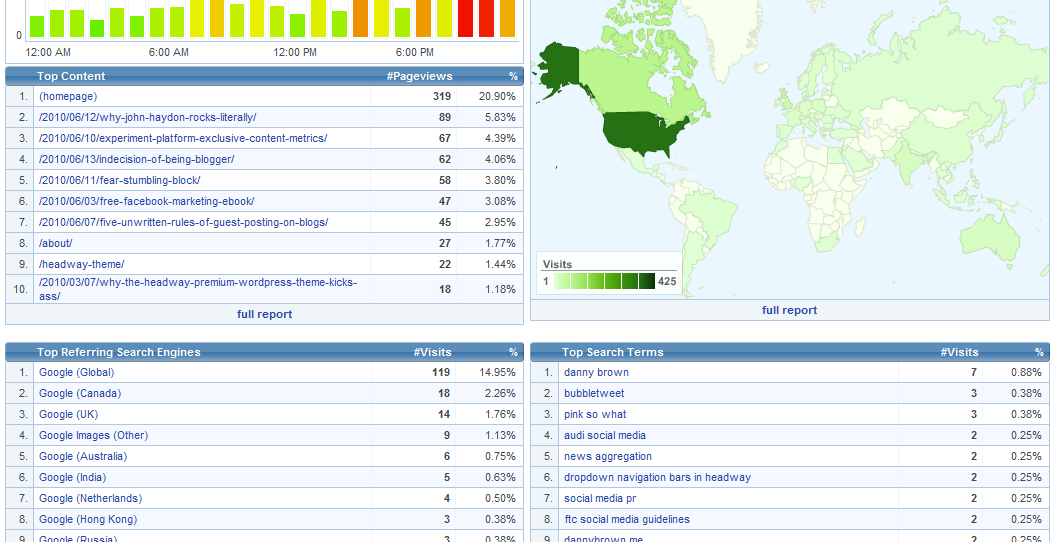
With expo-MAX, however, I can see the time of day that gets peak traffic, as well as the country that traffic comes from at any given time. I can also see referring sites, the most popular content and the top search terms that brought traffic to me – all on the same page. You can then dig deep into this information for even more metrics.

You can see how this would benefit you as a blogger or business owner. Say you have a promotion for North American audiences – you can then tailor publishing that offer to the busiest time of the day for that audience. You can also look at the titles of the posts that gained most traction, and work that into your promotion as well (titles can have a huge sway on visits).

Social Media Analytics

So far, much like Google and pretty much most other decent analytics platforms. And for the most part, that amount of information will be all many bloggers need. But if you really want to get into where your traffic comes from, expo-MAX has a pretty cool trump up its sleeve with social analytics.

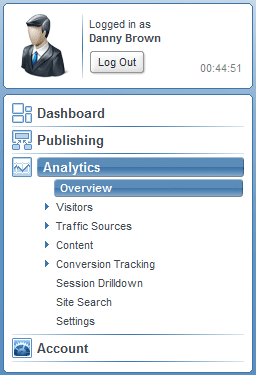
When you’re in your dashboard area, you can delve into your traffic sources and get a feel for who’s sending you the most traffic. Normally you’ll get some of this information on other platforms. But where expo-MAX differs (as far as I’m aware of from other platforms I’ve used) is by showing you the most prolific users.

For instance, once I’m in the traffic sources area, I can click on Referring Sources. This shows me the top 20 referring sites. Currently, Twitter is the site that provides most traffic to my blog, accounting for 19% of my traffic. If I click on the Twitter link, though, I can then see which Twitter user sends the most traffic my way (thanks,?Jim Connolly!).

Click on any of the other top 20, and you get more information again about that site’s top “providers”, if you like.

My current top 5 traffic sources are Twitter, Headway Themes (affiliate link), Google,?Networked Blogs and PR Daily – by clicking each of these, I can see what kind of audience I’m attracting and the type of link that saw them come here in the first place.

Let’s say you wanted to offer a customer appreciation promotion – you can see how having the information that expo-MAX offers in its social analytics would be of use.

Does expo-MAX Replace Google?

For me, yes. While Google Analytics is an excellent platform, it still doesn’t quite offer the amount of information that I’d personally want to use.

As well as the features I’ve highlighted here, you have a huge amount of information at your fingertips with expo-MAX. It even tells you what page of Google you’re on for the search term that brought your traffic (I found out I was on page one for the search term ftc social media guidelines, for instance, and saw how much traffic came to my blog for that term). Then you have conversion tracking, bounce rates, detailed drill down into information…. you need it, you pretty much got it.

I’ve only been messing with the tool over the weekend, and I’m already sold on it. For a free platform, it offers an incredible amount of information, and when I complement it with Quantcast for more detailed demographics, I’ve got all the information I could possibly want on my blog traffic.

From a blogger or business point of view, it’s pretty clear to see the benefits expo-MAX offers. Couple that with the very clean and user-friendly interface and support documentation,?the ability to track multiple sites?and the fact you can choose from a free or premium account, and I can see expo-MAX gaining a huge chunk of the web analytics market.

How about you? Will you be trying it, and what platforms do you currently use to track your metrics?

Note: This blog no longer runs on the Headway framework. Instead, it’s a custom WordPress design by Lisa Kalandjian of SceneStealer Graphics.

Ten for 10 in 2010 – Blog Marketing

Nishiki Shotengai, Kyoto, JapanAs we approach the end of the year, I thought it might be fun to share Ten for 10 in 2010 ? a list of people, blogs, apps, platforms and more that I think you might enjoy checking out in 2010.

These are just personal takes and, as with any list, this is subjective so please feel free to leave your own thoughts in the comments after the post.

Today I look at ten ways to use your blog as a marketing tool in 2010 ? I hope you enjoy.

  1. Secure Your Domain. This might seem obvious, but having your own domain tied into your business or service is so important. You can even do this on free blogging platforms, so there’s no excuse. Not only does it make your blog appear more authoritative but it helps with search engine visibility.
  2. Update Your Signatures, Digital and Otherwise. One of the things many people forget to do is let others know they have a blog, so make sure you’re not one of them. Add the URL to your email signature, online profiles, company stationary, etc.
  3. Define Your Voice. You don’t have to be a great writer, but you do need to be a passionate one. Love what you’re talking about; don’t be afraid to sound off; don’t just go with the flow of other bloggers in your niche. Simply put – be you.
  4. Make Your Blog Porous. One of the best ways to market yourself is to open up your knowledge. Too many bloggers don’t really share (even though they say they do). So open up your blog to sharing some of your best practices, and empower your readers – trust me, it works.
  5. Create Great Ideas. Any business thrives on how creative it is to a solution and how that benefits customers. Make your blog the same – use your readers as testers for ongoing new products and services, and incorporate some of their ideas. It’s the best focus group you’ll ever have.
  6. Soap Boxes. People read your blog because they’re interested in the topic(s) you write about. It’s why they’re your customers, or customers of your industry – use that. Invite manufacturers or service providers to share their news and stories on your blog. In return, you’ll have an “in” to their audience – it’s a win-win.
  7. Be Visible. While the social space has made business transactions easier, we still prefer face-to-face contact. It helps build trust between partners we find out more about each other, and we can see what we’re buying – your blog can do the same. Use video to offer a more personal approach, as well as offering first views of cool new products or services.
  8. Share the Wealth. You don’t have to be the only voice in town – the online space means there’s much more opportunity for business, and you don’t have to be so protective of your “customers” (readers). Encourage them to visit other “stores” – for instance, Jim Connolly has one of the best marketing blogs around, and Michael Martine offers excellent blogging advice. Share your peers and build your customer knowledge base, and they’ll appreciate you more for it, and share you with their peers.
  9. Community Spirit. One of the best ways to use your blog as a marketing tool is to encourage an interactive community. This could be via a forum, member list or email list. Give your customers somewhere to share views, ideas, issues, and be the host with the most and act on their suggestions. Again, you’re building brand loyalty and showing you really do care.
  10. Sell Yourself. You have a blog; it’s for marketing your business; so why not sell directly from it? There are a host of e-commerce solutions available to suit your needs, and they’re pretty easy to set up. Use your blog for exclusives – buy one on your blog, get one half-price on your main site. It builds connection to your main business and offers loyal customers an incentive to shop with you.

These are just ten ways that you can use your blog to market yourself or business/service more in 2010. There are many more, and please feel free to leave your favourite methods in the comments below.

I hope you can join me tomorrow when I share ten bloggers to look out for in 2010 (and there may even be a special video message to lead into the New Year with!).

Cheers!

Creative Commons License photo credit: yeowatzup

  • Page 1
  • Page 2
  • Go to Next Page »
© 2026 Danny Brown - Made with ♥ on Genesis