• Skip to primary navigation
  • Skip to main content
Danny Brown

Danny Brown

podcaster - author - creator

  • About
  • Podcasts
  • Journal

blog subscribers

What Turns a Blog Reader Into a Blog Subscriber?

Social media speakers

There are many success metrics when it comes to blogging – number of comments, social shares, visitors, etc.

Yet one that comes at the top of most blogger’s lists is subscribers – not just the amount of subscribers, but actually turning readers and visitors into subscribers.

After all, anyone can read or share or comment on a post. Subscribing, though, is another level of commitment by a reader, and validation for a blogger that their content is meaningful.

But what turns a blog reader into a blog subscriber? Instead of offering my own take, I decided to open up the question amongst my Facebook friends, to see what the tipping point was for them.

Given they have multiple tastes and preferences when it comes to content, I thought it’d be interesting to see what the collective reasoning was, as well as individual reasoning.

Their answers are below.

The Value Proposition

Everyone talks about blogs and bloggers needing to offer value. Yet value is defined in different ways – what may be valuable to me may be the biggest waste of time for you.

That being said, a blog’s value remains key in turning readers into subscribers.
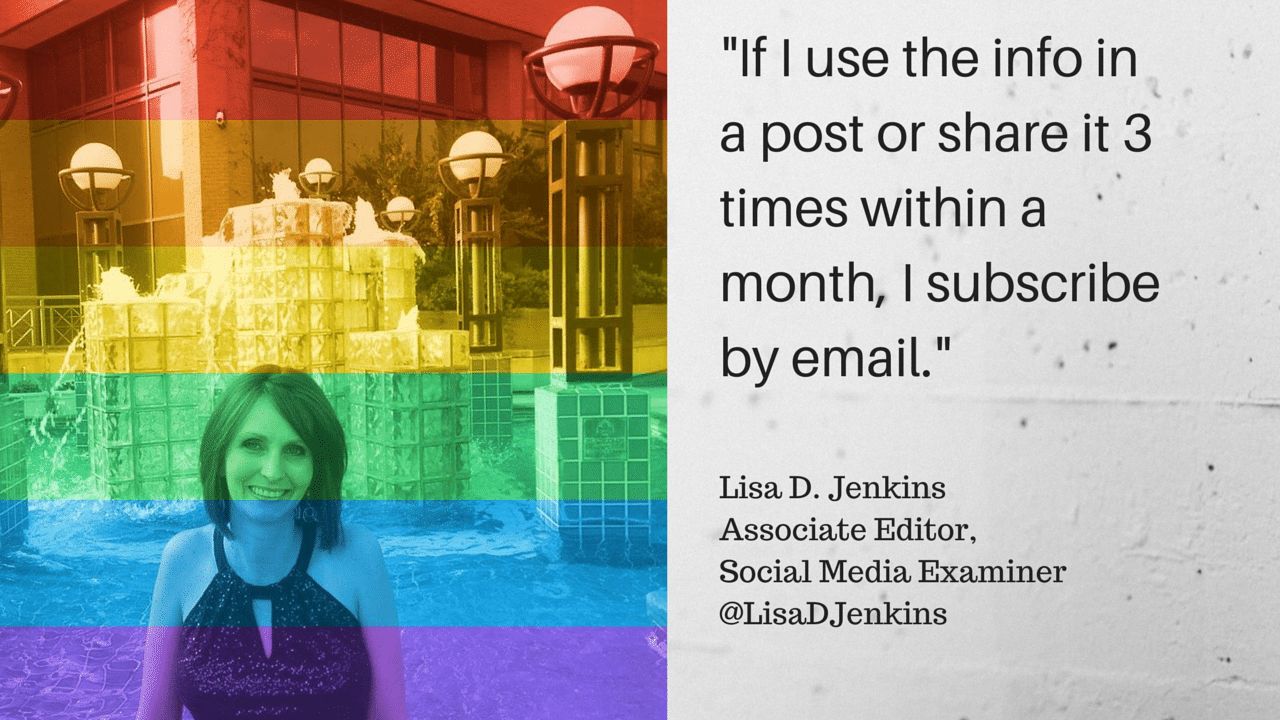
Lisa D Jenkins quote

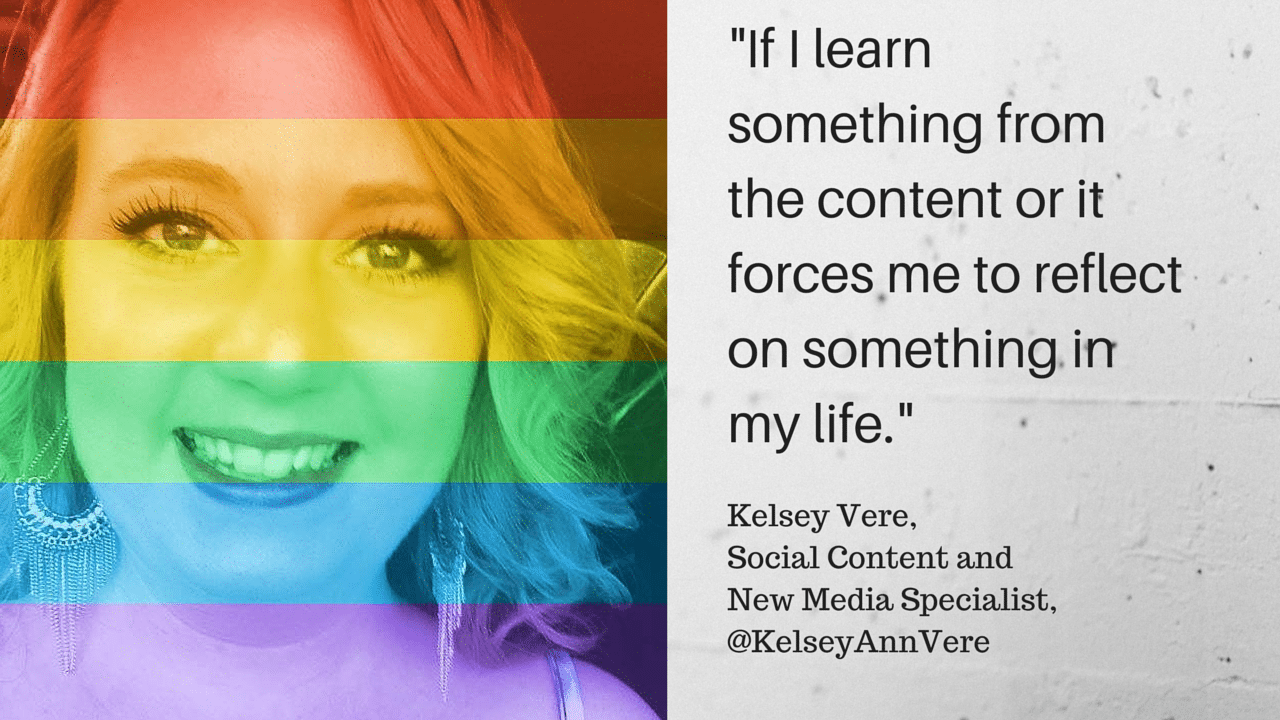
Kelsey Vere quote

Frank Strong quote

Three different people, but the definition of value remains the same – the info shared within the content needs to instill action, and be consistent in that action.

The Relationship Proposition

As someone whose moved more into personal blogging over business blogging (though I will still tie the two together), I often talk about how the relationship between blogger and reader is key for that type of content.

Yet relationships are so much more than like and/or love. They’re intrinsic to making the switch from reader to subscriber.

Amy Tobin quote

Nancy Davis quote

Paula Kiger quote

In the past, I’ve spoken about the “relationship to the sale” – it’s clear if you want to “sell” your content to a subscriber, the relationship with that content is core when it comes to a reader jumping into the subscriber boat.

The Voice Proposition

We’ve all heard it – “you need to find your voice”, “your voice matters”, “why you need to have a strong blogging voice”, etc. We hear it so much, the importance of what exactly your blog voice is, and why it matters, is lost.

But if you want more subscribers, having a voice is essential.
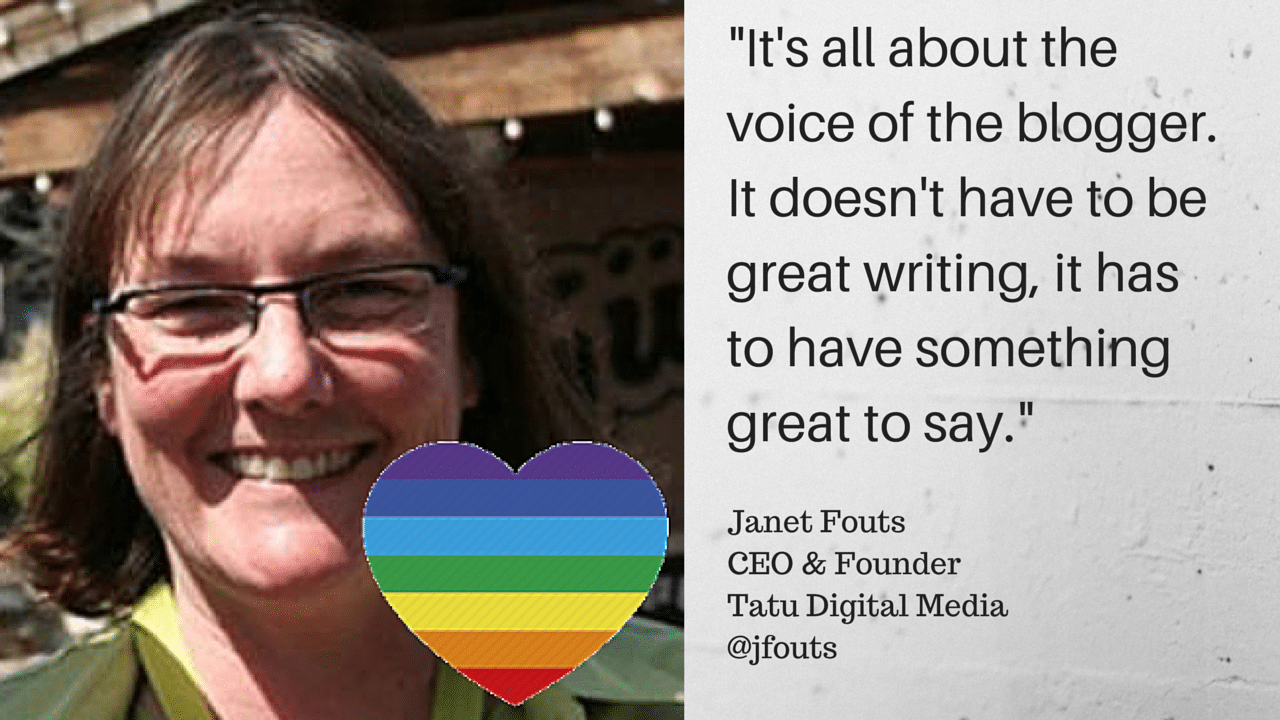
Janet Fouts quote

Brian Meeks quote

Liz Scherer quoteWhether it’s the way the blogger “speaks” to us, or the way they describe something in a way no-one else really does, that “voice” is an important piece of the reader-to-subscriber puzzle.

The Variables Proposition

Of course, if it were as easy as getting three things “right”, we’d all have tens of thousands (if not hundreds of thousands) of subscribers, whether by email or RSS, right?

But there will always be the variables – the subscribers who decided to make the jump after finding something to their liking that others may not have considered.

While not as clear-cut as style, originality and voice and how they sway a subscriber’s decision, these variables still play an important role in making a reader a subscriber.
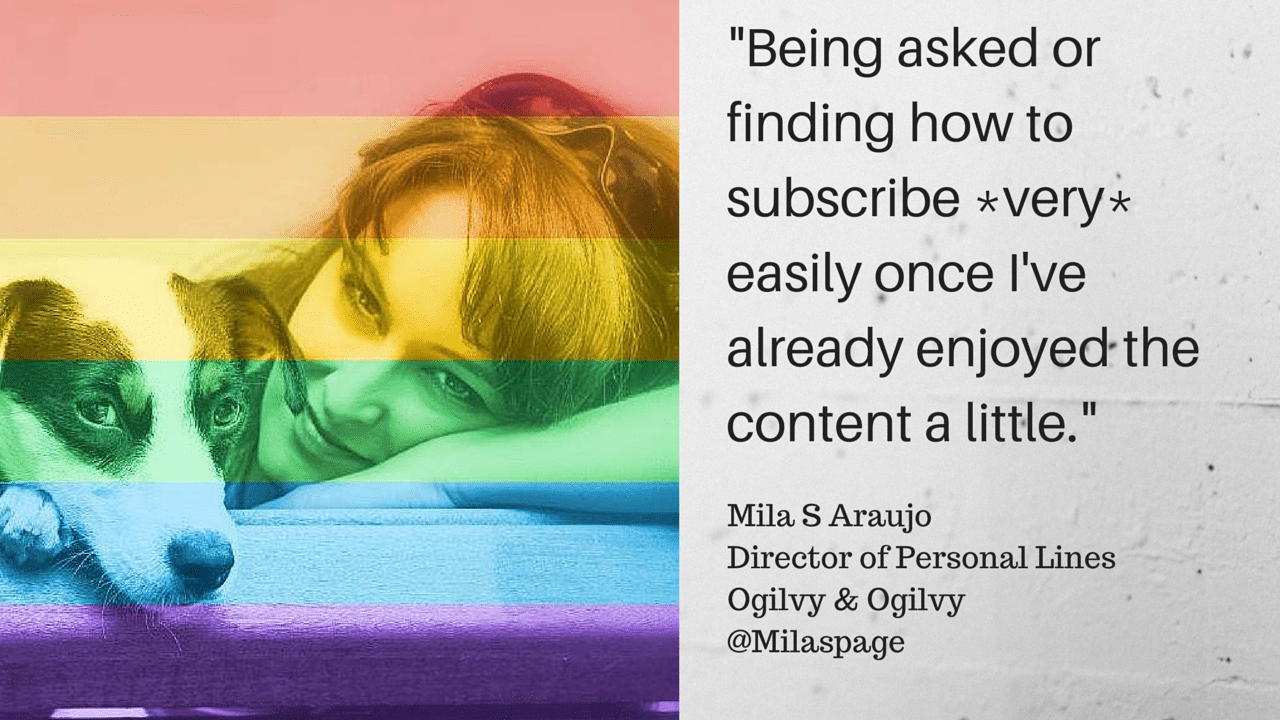
Mila Araujo quote

Clay Morgan quote

Tinu quoteThe three quotes above are quite telling, in that you’d think they’d be so obvious that every blogger is already doing them. But you’d be surprised.

To Mila’s point, I can’t tell you how many times I’ve landed on a post, really enjoyed the content, and only found an RSS option to subscribe (I’m an email guy).

Or to Clay’s point, while you don’t need to be specific about one topic, do be specific about the content, its goals, and how it will help the reader once subscribed.

And to?Tinu’s point – a quest for blogging greatness is impossible, no? After all, we can’t publish greatness every time, can we? Except we can – make every post something you’d want to subscribe to, and that will come over to your reader.

Make Them Want to Subscribe

I’ve shared 12 examples here of what my friends look for when deciding to subscribe to a blog. Each of the categories and reasons are valuable, and come from people who have been in the content “business” for years.

The great thing is, even with multiple viewpoints and decision-making methods, one thing is abundantly clear – you have to make your reader want to subscribe to your blog.

Content, voice, relationship, variables – individually, great reasons to subscribe. Integrate them, though, and you’ve pretty much covered any uncertainty over whether you’re a good subscription choice or not.

Mission accomplished.

What Happens When You Change Your Blog Subscribers Over to a Newsletter Format?

About three months ago, I made the decision to change up the way my blog posts were delivered to email subscribers.

While RSS subscribers would still receive the usual instant notification once a post went live, email subscribers would now get my post as part of a weekly newsletter.

This decision was driven by three key reasons:

  • Up until that point, I had been using Feedblitz for delivering emails to my subscribers. However, I’d become very disenchanted with that service – erratic subscriber metrics, and severe lack of templates/template customization, being just two areas I felt Feedblitz were letting me down. This played into the second reason for changing delivery format.
  • I’d been thinking of running a newsletter format for a while, but I wanted it to be different from many of the newsletters I used to receive. Instead of just being sales pitches for a blogger’s books or products, I wanted to have a newsletter that was more intimate, without just being focused on my own stuff. This played into reason three.
  • Earlier this year, I took stock of the content I was producing, and decided to stop writing solely about marketing, social media, etc., and instead write more personal content that talked about the things that really mattered to me, as a human being. This shift in focus now gave me the more personal touch needed for the newsletter content I wanted to create, and moving away from Feedblitz to MailPoet allowed me to create the type of newsletter that would let me achieve these goals.

Once I decided that the time was right for me personally to move to a newsletter format, I wanted to make sure that it was right for my subscribers. So I went back over 6 months worth of Google Analytics in the campaign settings, and how the metrics there tied into the metrics I had for my email subscribers.

Two things stood out:

  • Many email subscribers weren’t interacting any further with the post, other than opening the email and then reading the content via their own inbox (at that point, my feed was set to Full Post);
  • Many email subscribers weren’t clicking on the day the email went out. Instead, they were (probably) saving it in their To-Do list, and then opening the email later. Further analysis showed this “later time” was the weekend.

With this extra data, I was confident that now was the time to make the switch to a weekly format. In the words of Upworthy, what happened next might surprise you.

The Benefits of Switching to a Newsletter Format

Changing the delivery format of the blog was weird, at first. I’ve always been used to writing a post, hitting publish, and then seeing it go out to whoever had subscribed, either by email or RSS.

By changing the delivery to a weekly newsletter, this meant only RSS subscribers would get instant notification – email subscribers would have to wait until 10.00am EST on Sunday morning (my chosen delivery time, based on previous open metrics).

Initially, I thought this might have an impact on traffic to the blog, comments, shares, etc. While I’m not too bothered about social shares (anyone can tweet or Like a post, but it takes commitment to subscribe and read), I was curious to see how the new format would play out when it came to reading a post.

  • Would “out of sight, out of mind” play a part? After all, if folks were used to immediate updates, would they forget to check their email on a Sunday morning for the newsletter?
  • Would interaction suffer? I’m a fan of blog posts that invoke conversations (no matter where that may be – blog, Google+, Facebook, etc.). Would changing to a less regular format inhibit the willingness to interact?

Thankfully, for the most part, these “fears” would appear to be unfounded.

Out of Sight, More on Mind

Whether it was the fact that email subscribers now had an exact day and time when to expect my content, or whether it was because it was the weekend and folks had more time on their hands, I’m not too sure. However, my fear of being out of sight, out of mind didn’t take shape.

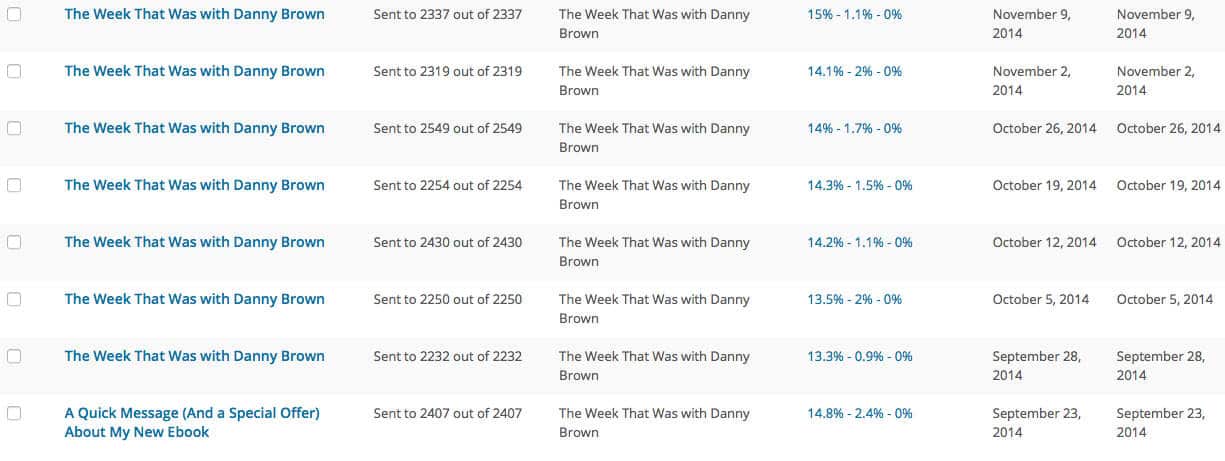
Clicks on the Open metric were up from my previous provider. Up until then, I was hovering around the 10-11% open rate. Not poor, but certainly not great when comparing to the standard 13-14% that many email metrics say is the expected open rate of subscriptions.

By switching to a weekly newsletter, it was clear that folks were opening the email which, as we know, is the first major hurdle to overcome. Better still, the metrics were showing that I was hitting industry standard metrics – an improvement of 3-4% from the previous delivery format (click to enlarge).

Danny Brown newsletter open

On top of that, clickthrough rate was also better. While the screenshot above shows clickthroughs of approximately 1-2%, these are based on overall emails sent, as opposed to emails opened. When you adjust that, the clickthrough rate is around the 12-14% – again, a major improvement on my previous delivery option.

This tells me that my subscribers know when to expect my newsletter, and are ready for it, hence the increased opens.

Additionally, it also tells me they’re willing to click through more. Admittedly, I now have an excerpt for my content versus full feed, so to read my latest post you have to click through. However, it’s the clickthrough of the content I’m recommending that shows an increase in interaction.

Interaction Wins On Two Fronts

In his recent guest post on my blog that shares his viewpoint on newsletter delivery, Randy raised the question of visitors, as well as social shares and comments, suffering due to the newer format. From that post, Randy mentions,

If shares and comments are to be viewed as social proof, the number of these?on Danny?s site?has dropped significantly from what were showing with his pre-newsletter?articles. I assume of course, that Danny?s readers are opting to read the?newsletter rather than engage online. Nothing wrong with that. But what about?getting visitors to his website?

As mentioned in the previous section, visitors have gone up due to increased open and clickthrough rate. In addition, pages per session and average session duration have increased, as subscribers clicking through are taking time to check out any other posts they may have missed.

It’s not only my own site that’s benefiting, though. As mentioned, each newsletter I send out links to two other articles I feel are worth reading. Based on my MailPoet metrics, these are also getting visited with healthy clickthrough rates (often, equal to my own content clicks).

With regards comments and social sharing, the social proof aspect doesn’t bother me as much. Comments can take place anywhere – my blog, on G+, etc. Same goes for sharing – anyone can share, not everyone that sees a share will visit.

A?quick comparison of posts before and after making the switch to newsletter delivery shows that comments on the blog posts are, indeed, down a little (from 506 for the previous three months, to 421 for the three months since I made the switch).

However, using the Data Hub Activity on Google Analytics, I can see discussions around the post are up across social media. Additionally, I’m having more conversations via email from subscribers that mail me directly to talk about a post, and I’ve really been enjoying that.

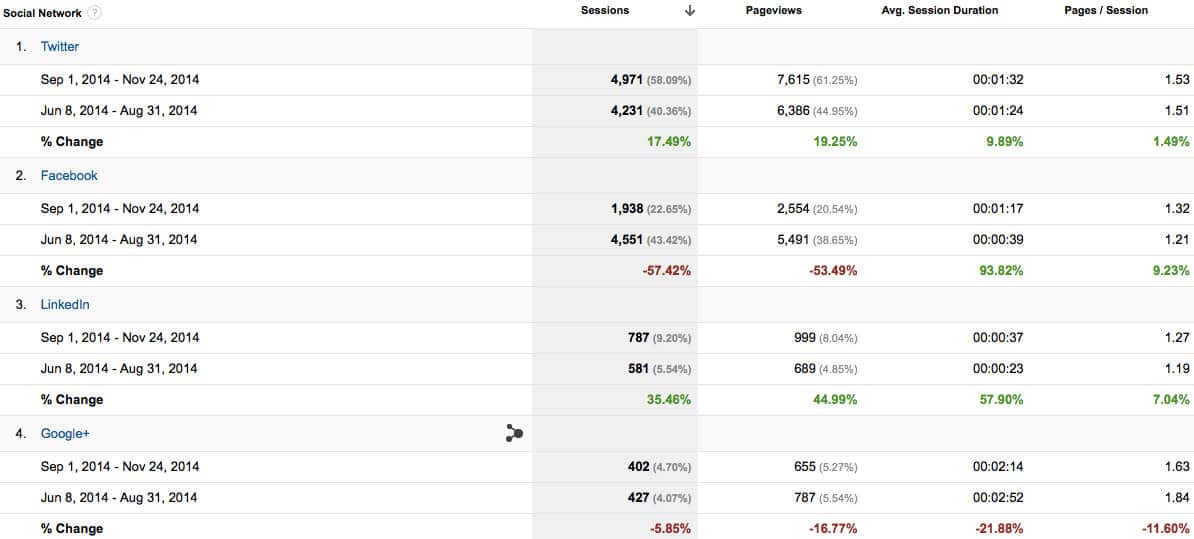
Social media referrals are also up, as you can see from the image below. The drop in Facebook traffic can be written off based on the amount of traffic I received from an evergreen post about Facebook for Android, which accounted for thousands of shares in the previous period (click to enlarge).

Danny Brown social media referrals

Indeed, pretty much every metric is up, with the exception of Google+. Which makes perfect sense, given it’s the network where I spend the least amount of time.

All in all, I’d say the vanity metrics since moving to a newsletter format have either remained static, or had a very minor drop. More importantly, the valuable metrics – open rates, clickthroughs, action taken, etc., have increased.

On Moving to a Newsletter Delivery Format – My Takeaways

It’s certainly been interesting to watch how things have changed since making the switch way back in August. While not for everyone, I know that changing to a newsletter format has been a success as far as I’m concerned.

As well as improving on some key metrics that I wasn’t getting with my previous email delivery option, the change to a weekly format has allowed me to spend less time online, and more time offline with my family, a huge plus in my books.

Additionally, it’s enabled me to think bigger and to really look at content outside the usual social media bubble, both to drive the type of content I want to write about, as well as find articles and posts that my subscribers may want to read. Feedback from my subscribers (so far) has shown that the time I spend finding content to share is worth it.

I’m also getting to spend more time checking out new tools and technology, which allows me to share that with newsletter subscribers. Looking at clickthrough rates, I’ve sent a decent amount of traffic to tools like Flare, Atomic Reach and Sumo, which is excellent to see, as they’re all great tools to help you with your content.

Is this approach for everyone? No, and that’s something that was highlighted and led to some great conversations in the comments after Randy’s guest post on my blog. However, if you are considering making a similar switch, my advice (for what it’s worth) would be:

  • Go either or, and not both. Offering both email subscriptions to your blog, and a subscription to a newsletter, could be confusing. Additionally, I’ve seen bloggers promote their newsletters with the blurb, “Get my best stuff here”. If that’s the case, why would I want to subscribe to your second-rate blog? So, keep blogging, just choose which delivery system you want to go with.
  • Offer real value, and not just more selling. As evident by my own metrics, my own content hasn’t lost out because I share content from other people in my newsletter. So don’t be afraid to share stuff that doesn’t solely drive subscribers to your latest landing page. My own experience would suggest that’s appreciated.
  • Be open to personal interactions. Because I open each newsletter with my personal thoughts on anything that may have happened to me, or the world around me, it’s led to a far more personal experience for my subscribers. This has led to some wonderful conversations in private via email. If you make the switch, be sure to give your subscribers the attention they’re giving to you.

Switching to a newsletter format isn’t for everyone, and your own analytics will help guide your decisions should you be considering the switch.

However, for me, it’s been one of the more rewarding decisions I’ve made when it’s come to my blog. Now, I can’t wait until I sit down on a Saturday evening to pen the following day’s newsletter, and I have no regrets about making the switch.

In fact, I only wish I’d done it sooner…

This originally appeared as a guest post on the Kayak Marketing blog.

Important Message for Subscribers to DannyBrown.me

A little over two years ago, I shared a post on why I was leaving Feedburner which, up until then, had pretty much been the go-to service for bloggers looking for an easy way to offer a subscription service for readers, either by email or RSS.

At the time, I mentioned I was moving to Feedblitz, and offered reasons why. However, since then, Feedblitz has continued to lack in certain areas – statistics around subscribers are always erratic, very limited templates to work with, delays in publishing, etc.

So, this will be the last “newsletter” (read “email updates”) that email subscribers to this blog will receive from Feedblitz. There will also be some changes to the way the content here is presented – more on that soon.

In the meantime, here’s what you need to do to keep receiving updates.

Email Subscribers

If you subscribe to this blog via email, and you wish to continue, there’s nothing you need to do. I will be importing your details into the new database over the next couple of days, and you will continue to receive updates as normal – with a slight change to delivery schedule.

Instead of receiving the post as soon as it’s published, I will be changing to a newsletter format. As well as including the latest post, the newsletter will include a link to an article from other content creators, or news story, that I think might interest you.

Danny Brown nesletter

I really want to start sharing some of the content creators that inspire me more, so each newsletter will include a recommendation for you.

Additionally, I will share a tip – it may be a trick to use a social media platform better, or a new tool to check out, or similar. And finally, I’ll be sharing my thoughts on something that’s caught my eye that week and made me think, and opening up the conversation with you around that.

Basically, the newsletter will offer a more personal experience than just getting the latest blog update, and I look forward to seeing where we go with it. One thing I will promise – as always, I will never spam you, and will only share recommended reading, etc., that I feel you will really enjoy.

The newsletter will go out at 10.00am EST every Sunday morning (starting on Sunday, September 7), and I hope it will offer something for you to relax into the last day of the weekend with.

If this doesn’t sound like something you’re interested in, no worries – simply use the Unsubscribe link at the end of this email, and you’ll be removed completely from the new set-up and future updates.

RSS Subscribers

This is pretty straightforward – for now, I’ll be continuing with Feedblitz for RSS subscribers, so you don’t need to do anything at all. I may change the publisher of the RSS feed in the future, but for now everything remains exactly the same.

Should I change the feed, you’ll be the first to know, and I’ll post instructions on how to update your current subscription.

Of course, if the new newsletter format sounds like something you’re interested in, hop on over to this actual post on my blog, and use the Subscribe box at the end of the post. If you remain subscribing via RSS, you’ll continue to just receive the post itself.

Thanks For Being Here So Far

As always, I’m really grateful for you subscribing to the blog, regardless of format – email of RSS. The fact you allow me into your busy lives is something I really appreciate, and hopefully that will continue in the new “format”.

My goal with the newsletter is to provide a more “complete” experience, and a more personal one. Hopefully you’ll see that happen, and please, always feel free to email me with thoughts on the content of a particular newsletter, or a suggestion for a future one.

Thanks for being here so far – here’s to the next “stage”. Cheers!

© 2026 Danny Brown - Made with ♥ on Genesis