• Skip to primary navigation
  • Skip to main content
Danny Brown

Danny Brown

podcaster - author - creator

  • About
  • Podcasts
  • Journal

PR

Ryan Moore ? My New Favourite Sportsman

You may or may not have heard of Ryan Moore. He’s a pro golfer who recently won his first tournament, the Wyndham Championship.

If you haven’t heard of him, you’re not alone – he’s still ranked 120th in the world and isn’t one of the first names you think of when you think “pro golfer”.

Yet despite his relative anonymity, Ryan Moore may just have made himself my new favourite sportsman. All because of $300,000.

Where Ryan differs from most other sportspeople, and certainly every other golfer it would seem, is that he refuses to be endorsed by any of the name brands that adorn other golfers. He buys his own clothes and golfing equipment, and often these are a mish-mash of some of the cheapest brands around.

It’s led to sports marketing companies questioning why Ryan is avoiding their pitches, when pro golfers have at least one brand sponsorship to their name. According to Ryan’s manager (who’s also his brother), it’s simple: “He doesn’t want to be a billboard.”

The $300,000 that I mentioned earlier? The projection of what Ryan could earn from sponsors – $200,000 a year for cap sponsorship, $20,000 for a chest logo, and $50,000 for a branded golf bag. And why is he my new favourite sportsman?

Simple. When mostly everyone around him is signing up for the big bucks, whether they like the brand or not, Ryan Moore is staying true to himself and showing that money isn’t always everything. His decision means that sports marketers may have to reconsider whether tapping up folks to be the face of a brand will continue the way it has or if it has to look at new ways to sell. And anything that helps move marketing and branding forward into new thinking can never be a bad thing.

Of course, this is the now. With Ryan winning his first tournament, his stock will go up and the offers will rise with it. Whether he’ll remain as loyal to non-branding when the million dollar endorsement offers start materializing is another thing. But for now… he’s definitely my new favourite sportsman.

How about you – is Ryan doing it right or will the marketing dollars win out?

photo credit: pga.com

Blogger Outreach 2.0

This is a guest post from Christina Klenotic. Christina is a vice president at Dix & Eaton who specializes in digital communications, media relations and guerrilla marketing. You can visit Christina on Twitter or visit her on her blog, Beyond Social.

It?s been just over 30 days since Mom Dot launched its PR Blackout Challenge. The controversy was covered by a number of bloggers and mainstream media, including Danny Brown, Dave Fleet, Newsweek and PBS. So what have we learned?

As a PR professional who routinely works with clients on traditional and blogger relations campaigns, my most important takeaway is that pitching media bloggers and working with indie/mommy bloggers are two very different things. Here are four reasons why:

Not all bloggers are journalists

Outreach to indie bloggers who are not tied to a media outlet, like mommy bloggers, should be much different than traditional PR pitching to media bloggers. Think of the word ?pitch? as a swear word. Instead, engage bloggers in conversation to forge a relationship and accept their honest feedback when they give it.

For moms who write about their experiences as a mom and occasionally pimp out a brand they love, more often than not a giveaway in exchange for an unbiased review is the way to go. The benefit to a company is that an influencer of its target audience will serve as a one-woman focus group about its experience. Blog followers who chime in after a post with their own feedback are a bonus.

Commercial blogging is here to stay

The evolving commercial momosphere was a hot topic during July?s BlogHer Business conference. While the controversy over the concept of mommy blogging becoming too commercial is not expected to dissipate anytime soon, there is an audience of bloggers who embrace their mommy blogger label and also welcome working with PR pros.

Transparency is non-negotiable

Because mommy blogger endorsements are under the microscope, it?s paramount for both PR professionals and bloggers to disclose expectations and commercial ties up front. Following the FTC?s guidelines for blog product endorsements is the only option that preserves credibility on both sides and is fair to readers.

Strategic targeting is essential

More than ever before, PR pros need to be very savvy in helping clients select the right bloggers to approach who can make a positive impact on potential customers. Mommy bloggers are not homogenized. Some write about their experience as a mom related to a niche such as travel, home improvement, work/life balance, etc. It?s a no-brainer that reading and following a blog is the only way to get a sense of whether a blog?s target audience and your client?s are a good fit.

Thoughts?

AdAge and The Power of Response

Lines and LazinessThere’s an interesting story happening at the minute online with AdAge and Lindsay Ferrier, who blogs over at Suburban Toil. It concerns an article published yesterday on AdAge by Lauren Barack, and a quote she used from Lindsay’s blog.

In the AdAge piece, Lindsay is quoted as saying she deserves all the free swag that advertiser’s and PR companies send to blogging moms: “I worked hard for my swag, okay? I freaking deserved it.” Reading that quote, you’d think Lindsay was nothing but a shill that’s out for all she can get.

Where it becomes interesting is that the blog post the quote was taken from is a satirical piece, with Lindsay actually decrying the way this year’s BlogHer conference seemed to have devolved into a free-for-all grabbing spree by some bloggers. Lindsay mentions this in the comments section of the AdAge piece, as do several other replies.

Lindsay’s comment was posted at 9.17am this morning. As of writing (almost two hours later), there is no reply from either AdAge or Lauren Barack, nor has the piece been amended. This seems like a missed opportunity for AdAge and Lauren.

One of the things that is repeated time and time again in this space is the importance of monitoring the conversation. The slightest negative response can soon flare up into something much bigger, and this is now being seen in the comments of the AdAge piece, Twitter, and Lindsay’s blog.

What could have happened and what could happen next?

  • AdAge could/should have amended the article.
  • Lauren and/or AdAge could/should have apologized to Lindsay.
  • AdAge could/should do a follow-up piece about fact-checking, relevance and the importance of timely conversation.

There’s no doubt that AdAge offers an excellent medium for some of the best media news around. Lauren Barack is also an award-winning journalist. But it’s clear that what may have seemed a harmless quote was taken all out of context and could have been seen as questioning Lindsay’s integrity.

It could have been avoided with a simple email to Lindsay prior to the piece. Even when the shit hit the fan this morning, it could have been handled better with a clear response. So far, this hasn’t been the case.

If you’re still dubious about the importance of monitoring and responding, the AdAge/Lauren Barack/Lindsay Ferrier triangle is a great example of why you need to.

Are your ears burning this morning?

  • Update: Lauren has responded to the comments with this reply, although it could be argued it’s not exactly apologetic.
  • Update: AdAge has since added an addendum to the post, apologizing for the gaffe.

Creative Commons License photo credit: svenwerk

Is This How to Market Your Product?

If you’re a marketer, are you thinking about how to promote your new website or product? And if you’re a consumer, are you getting tired of lazy pitches and ideas?

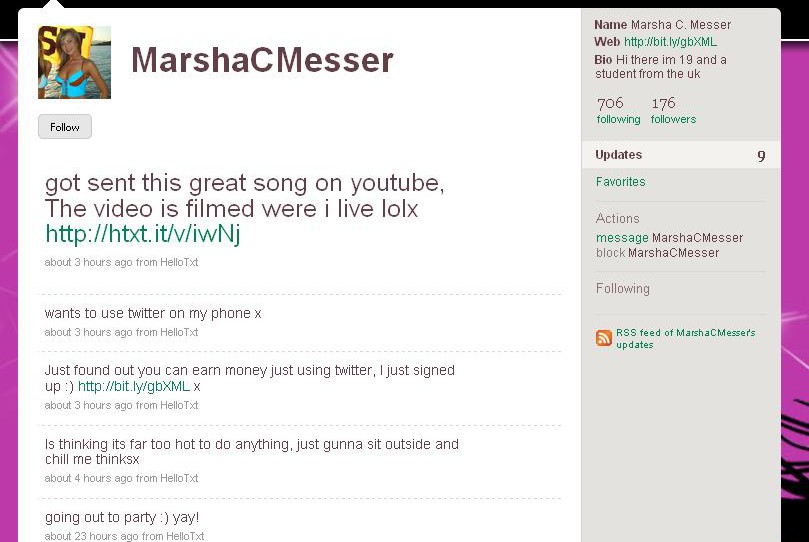
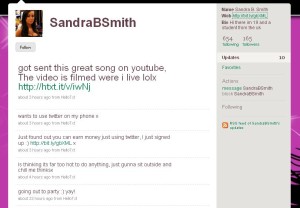
Take a look at the five images below – each one belongs to a Twitter account that I was notified was now following me.

marshamess

Every single message is the same, from how old the girl is, where she’s from, what she wants to do this weekend and what video she’s just watched.

Now, either the UK is currently enjoying a great spell of Twitter awareness in provocatively dressed female teens or there’s a little bit of shenanigans going on here. I’m going with the latter.

Looking at the accounts themselves, it would seem that it’s a marketing push for web host Cool Blue Solutions. Each account has a background designed by the web host company, and Cool Blue’s Twitter account mentions designing the background for our teen friend Sandra B. Smith.

But then you look at the URL for each of the five girls. That takes you to RevTwt.com, which used to be known as TwtAd, an advertising model for paid tweets.

They’re in the process of a relaunch of the service and are looking for advertisers. They claim to put your ad in front of more than 23 million Twitter users – pretty impressive considering that’s about the estimated number of all Twitter users at present (including bots and spam accounts).

revtwt

So what’s the story here? Is it a marketing push to promote the web host services of Cool Blue Solutions? Is it an advertising push by RevTwt on behalf of Cool Blue Solutions? Is it a little of both?

Whatever it is, here’s the thing. Marketing your message properly means targeting your audience properly. It means knowing who would use your services and what would attract them to that service, and why it stands out from the rest.

Does a semi-nude teenage girl create the right message for Cool Blue Solutions if it’s their campaign? Are they looking for business users of their web services or teenage boys hoping to hit it off with a girl just like the one in the above Twitter accounts?

How about RevTwt, if it’s their push? Did they target anyone with these Twitter accounts or is it just a hit and hope approach? I only ask as I had all five accounts follow me in quick succession, and their bio’s just make your BS spider senses tingle.

Whatever the deal is here, I don’t think it succeeds. The majority of people have moved on from booth babe advertising and marketing pushes and are looking for real people behind the products. Teenage girls in bikinis don’t quite shout web host to me.

What do you think – is this kind of marketing still valid? If you’re a consumer, would you be convinced to sign up to Cool Blue Solutions from the recommendations of these Twitter accounts?

What if you’re an advertiser and RevTwt is behind these accounts – do they make you want to run a campaign with them? Or would your approach differ?

  • Update Monday July 06. Looks like Cool Blue Host may not have been as marketable as they thought. All Twitter accounts mentioned in this post are no longer live and their domain is also available.

How Long Do You Let Your Brand?s Reputation Suffer?

On SufferingYou’re a public relations professional or agency. How are you monitoring your brand and those of your clients?

You are actually monitoring, right?

I ask on the back of an interesting story regarding Michigan-based PR firm Tanner Friedman and their current lawsuit regarding a fake Twitter account.

Back in January this year, an account was set up on Twitter that used the name @TannerFriedman. For anyone seeing the tweets from the account, you might expect them to be the latest company or client news from the PR firm.

Not so.

The account had nothing to do with Tanner Friedman. Instead, it was set up by someone who then went on to post a defamatory tweet as the account’s introduction to Twitter, and then subsequently posted negative tweets about the firm.

To keep things interesting, though, the account also took tweets from the Twitter accounts of actual Tanner Friedman employees to make it look more authentic.

Jump forward to March 27, when Tanner Friedman complained to Twitter about the fake account.

That’s more than two months later.

Despite the fake Twitter account posting about the company. Despite the fact that the tweets are said to be damaging and embarrassing to Tanner Friedman. Despite the company being active on Twitter through its employees.

So why so long? Weren’t Tanner Friedman monitoring their own brand as well as that of their clients?

There are numerous tools available to track what’s being said about you. Some are free, like Social Mention, Google Alerts, Filtrbox, BackType and, of course, Twitter.

There are also premium solutions available as well, like Radian6, Nielsen BuzzMetrics, Cision Social Media and Trackur to name just a few.

So it’s not as if the tools aren’t there.

Indeed, Tanner Friedman’s own blurb describes them as, “…an innovative and imaginative communication resource…” with a “…commitment to new technologies…”.

So what happened?

I sent an email to Tanner Friedman to ask their views on the current situation. Kudos to Don Tanner, who was pretty prompt at getting back to me. Here’s what Don had to say about the time lapse:

“We dealt with the problem once we became aware that there was a problem. The problematic tweets did not occur immediately. Once they did and we became aware of them, we acted immediately.”

With regards not having the Tanner Friedman account registered to the company to start with:

“We each had our own Twitter pages along with our own Facebook and Tanner Friedman Facebook pages. Further, as with most professional service firms, we tend to put our clients first. Further (and maybe it is a Midwest thing), Twitter has only emerged here in the past few months.”

It’s never pleasant to be at the centre of negativity when you’re looking after a PR client. It’s even less so when the negativity is about you. Yet one thing you can’t do is let it run.

While it’s clear that Tanner Friedman acted once aware of the account, there still seems to be a time lapse between the first tweet and the complaint, considering more tweets were sent throughout February and March.This is where the obvious problem lies.

Two hours can be a long time when it comes to bad news spreading on social media; two months is a lifetime in comparison.

What this lawsuit shows is the need to be proactive at every turn when it comes to hearing the conversations that are taking place as well as securing your brand early on. Otherwise, you might just find that someone’s been proactive for you.

Of course, Twitter needs to take responsibility as well. Account authorization has to be stepped up (which they are currently looking at) and their customer service currently leaves a lot to be desired. If they really want to take the service to the next level, they need to actually offer a service that looks after its users.

How about you? Do you know what’s being said about you online? How do you monitor the conversations and what advice do you give your clients and employees?

Creative Commons License photo credit: Dude Crush

  • « Go to Previous Page
  • Page 1
  • Interim pages omitted …
  • Page 8
  • Page 9
  • Page 10
  • Page 11
  • Page 12
  • Page 13
  • Go to Next Page »
© 2026 Danny Brown - Made with ♥ on Genesis