• Skip to primary navigation
  • Skip to main content
Danny Brown

Danny Brown

podcaster - author - creator

  • About
  • Podcasts
  • Journal

PR

Disruptors and the End of Digital: The Future of PR

Future of PR

There’s a lot of talk about where the future of PR lies. Much like its brethren marketing and, to a degree, advertising, PR is at a crucial juncture – where does the industry go to keep evolving and moving forward?

After all, despite the great work being carried out by forward-thinking professionals in the space, it’s clear the mainstream (you know, the people that really count) still see?PR as a shady backwater mud hole. Even if out-of-date thinking skews the arguments put forward by those people, it doesn’t matter if the people reading those pieces don’t see what’s really happening in the PR industry.

So does that mean PR should just skulk away and accept that it will never be seen as anything other than a profession full of spin doctors? Far from it – but there does need to be a continuing adoption of new thinking, forward thinking, and sheer hard work just to keep beating the new thinking drum until it reverberates in more dusty halls.

Accept the Disruptors

One of the accusations often thrown at the PR industry is that agencies and professionals are clinging to the belief that they should control the message. From client news to product launches to crisis countering, only the most positive and accepting of news outlets should be used and approved.

This approach won’t move the industry forward. Nor will it help to counter the incorrect thinking that this is the norm for the PR industry.

At the same time, companies and agencies afraid of losing control aren’t seeing the bigger picture -?you still control the facts.?That cannot be changed. Whether they’re accepted or not has more to do with your track record in authenticity and openness than it does with the medium on which these facts are being reported.

This is where the Disruptors – those new channels and outlets, like bloggers, citizen journalists and?influencers?- need to be collaborated with as opposed to feared and mistrusted.

It’s not just for promotional use, either. Much like marketing, PR is often seen as putting out puffed-up information and fluff in order to part customers with their money (or, in the PR industry’s case, separate truth from fact). So use Disruptors to counter this.

  • Use tools like?Traackr,?Pulse Analytics?and?Nimble?to connect the dots between your client and those who can influence public perception (positively and negatively);
  • Reach out to third-party Disruptors with no agenda other than sending them the latest facts and news, and allow them to disseminate as they see fit;
  • Have an accessible area on your site where Disruptors can come of their own free will and access anything they need to create content;
  • Open channels to key personnel for Disruptors to connect with and question;
  • Allow Disruptors to create content based on facts, without dictating how that content must sound, and then share that with critics and supporters alike.

This is a basic set-up, but you start to get the picture on how Disruptors shouldn’t be feared, but accepted and worked with/respected.

Leave the Turf for Your Lawn

One of my biggest pet peeves – and not just with the PR industry – is the turf war mentality that seems to pervade when disciplines clash.

Whether it’s marketing vs. PR, PR vs. advertising, or even PR vs. PR, there’s one thing that rings loud and clear -?it benefits no-one.?Seriously, does anyone think that beating your chest and saying, “We showed them!” makes sense? Who cares? It’s not about you, and never has been -?it’s all about the result.

Four Ms of Influence Marketing

So what if marketing is a better lead for the customer acquisition part of a promotion or campaign? So what if advertising is a better lead for that native content program? Who cares if PR is the better lead for the overall strategy and what part needs to be placed where?

While the disciplines may still have core differences, at the end of the day PR, marketing and advertising have the same basic directive – get the result through allocating the right approach at the right time.

Turf wars are stupid. They belong in the playground where we have our little imaginary lines and flags to capture – they don’t belong in the modern business world, and anyone who thinks they do needs to have a serious look at how their results are panning out for them.

Integrate and cross-collaborate, people. You know it makes sense.

Forget the Term “Digital”

Perhaps the biggest shift in thinking, though, is around the terminology itself. For some reason, we’ve allowed ourselves to get sucked in by the word “digital”.

  • Digital marketing;
  • Digital consultant;
  • Digital content;
  • Digital agency;
  • Digital ads;
  • Digital PR.

And on, and on, and on. Why? Why is it so important to make the distinction? Does the thinking behind a strategy really change? No – the tactics, and what platforms/channels to use, change. But the overall strategy remains the same – what’s our goal and how are we going to achieve this, and then measure the success?

The thinking that the PR industry needs to adapt to the digital landscape is the exact reason it’s struggling with this so-called digital landscape, because – essentially – people do not change.

We’re creatures of habit. It’s why we’ll keep dating the wrong kind of person; or we’ll complain about the same bad menu at our local diner, as opposed to finding another diner.

Consumers are the same (not surprising, given that they’re, you know, people too). While research channels have evolved, the basic questions remain – can your company meet my needs and are your products reliable? And will I be looked after once I become a customer?

This question is asked in-store; on FAQ reading; on forums; on telemarketing calls; on email; and, yes, on digital. See the pattern? The channel is irrelevant – it’s the answer that matters. So stop focusing on how to be better at digital, and simply focus on how to be better, full stop.

It’s not that hard – is it?

A version of this post originally appeared on the Spin Sucks blog.

image: RawheaD Rex

PR Agencies Need to Understand the Digital Communication Laws

Vision

This morning, I received an email from Toronto-based PR agency?Paradigm PR?about a new partnership between NBA Canada and Foot Locker Canada.

I’m guessing the agency’s client is NBA Canada, since they offered an interview with Dan MacKenzie, VP and General Manager of NBA Canada, to discuss the partnership.

Unfortunately, what stood out for me was not the chat opportunity, but the complete lack of any kind of Unsubscribe option at the end of the email. Below is a screen grab from the email close (I’ve blurred out the sender’s name).

ParadigmPR

As you can see, there are plenty of ways to contact the company, but there’s nothing there about removing yourself from their updates. And, effective next summer, that will be illegal.

It’s Not Just CAN-SPAM Anymore

Recently, I wrote about companies that circumnavigate the CAN-SPAM Act, which was brought into play 10 years ago to protect consumers from spammy emails via questionable marketing tactics.

However, this act was primarily for the U.S. (although other countries could adopt it, if they wished). So, in Canada, where I live, you could still receive emails from companies without realizing you’re on their contact list.

I don’t recall ever signing up for Paradigm PR emails in particular. However, it may be I’m on a PR list for Canadian bloggers, hence the contact (although these lists are equally annoying, but that’s a blog post for another time).

So, because Canada isn’t technically covered by the CAN-SPAM Act, ?if you do get on a PR agency’s blogger list you have to hope they offer an Unsubscribe option. Otherwise, it’s a matter of requesting they remove you, or simply hitting the “Spam” button on your email filter.

If a company email gets filtered this way enough times by enough different recipients, their email address gets flagged by web hosts, and you can imagine the grief that causes for a business whose bread and butter is in promotional outreach…

Thankfully, that’s all about to change, with the introduction of Canada’s Anti Spam Legislation (CASL).

CASL and What It Means for Agencies and Marketers

Coming into effect July 1 2014, the new Canada Anti Spam Legislation aims to do for Canadians what CAN-SPAM has attempted to do for Americans – protect consumers while still allowing businesses to be competitive in an ever-changing marketing landscape.

While the full legislation breaks down exactly what will and will not be allowed, the two key points that all agencies and marketers will need to adhere to are:

  • sending of commercial electronic messages without the recipient’s consent (permission), including messages to email addresses and social networking accounts, and text messages sent to a cell phone;
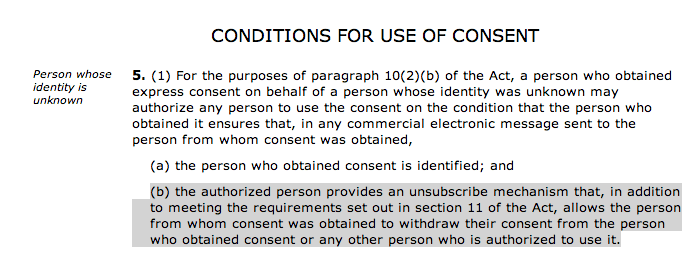
  • (b) the authorized person provides an unsubscribe mechanism that, in addition to meeting the requirements set out in section?11 of the Act, allows the person from whom consent was obtained to withdraw their consent from the person who obtained consent or any other person who is authorized to use it.

CASL regulations

It’s this second point in particular that would make the email I received from Paradigm PR illegal, and punishable not only by three Canadian organizations – the CRTC, the Competition Bureau and the Office of the Privacy Commissioner – but also opens up the potential for consumers to sue businesses that send out emails without an Unsubscribe option.

The involvement of the Office of the Privacy Commissioner is especially welcome for consumers, given their office forced Facebook to change its privacy settings for Canadian users, amongst other victories for Canadian consumers against social networks and data tracking.

Make Sure Your Agency is Ready

In one respect, it’s kind of disappointing to still be talking about best practices as well as legal requirements when it comes to email marketing (or any kind of digital marketing, since this impacts social network messages as well as mobile marketing).

It’s been almost 15 years since Seth Godin popularized Permission Marketing, about the need for opt-in marketing versus opt-out marketing. Yet here we are, still seeing emails being sent out without Unsubscribes, and lists being utilized without a blogger’s knowledge (if that’s the case with this example).

While the CAN-SPAM Act is U.S.-centric, it’s generally seen as a best practice to adopt by marketers and agencies in other countries. Thanks to the imminent CASL, it will no longer be enough to just follow best practices in Canada.

The mandate and requirements are there for every agency owner and marketer to read and understand.

With a full six months before legal enforcement, now would be a good time to become familiar with them – before it’s more than just a blog post that your agency’s lack of Unsubscribe option has as a result of your outreach.

Update December 16, 2013: I chatted with the account director who sent the email earlier, and the outreach was part of a personal outreach tactic for certain bloggers. The AD wasn’t aware of the unsubscribe requirement, which suggests a larger issue of education regarding email and/or digital outreach campaigns.

There’s Nothing Savvy About Marketing or Newsjacking Disasters

Hijacking bad things

Hijacking bad things

This week, the eastern coast of the U.S. has been battered by Hurricane Sandy, one of the biggest storms to make land in the U.S.

The states of Connecticut, Delaware, District of Colombia, Maryland, New Jersey, New York, North Carolina, Pennsylvania, Rhode Island, Virginia and West Virginia have all bore the brunt of this “superstorm”.

So far, 16 people in the U.S. are confirmed dead. One woman died in Toronto, Canada after flying debris hit her. 50 people lost their lives in Haiti and the Caribbean as Sandy’s deadly path took shape.

And this is just the early hours of the disaster. Sadly, like any storm of this magnitude, the death toll and damage is likely to be worse yet, not to mention animals and livestock caught up in the devastation.

With all this in mind, you’d think we’d be more concerned about the welfare of those in harm’s way than taking advantage of some cool marketing opportunities, right?

Then again, this is the marketing industry we’re talking about – and I say that as part of that very industry, which is why this appalls me even more.

The Opportunity of Disaster

Yesterday, the inbound marketing business HubSpot published 5 examples of companies that have “newsjacked” (the practice of taking news stories and using them to your advantage) the disaster that is Hurricane Sandy.

HubSpot themselves took some heat in the comments, forcing them to edit the post – although it’s still not worded in a terribly sympathetic way.

Examples included a Hurricane Hair board on Pinterest, to a make-up company advising you how to look great by candlelight and ensure your nails are tip top. Because chipped nails while sifting through the debris of your destroyed home wouldn’t be the done thing, right?

While none of the examples are as tacky as the Kenneth Cole Cairo tweet – and one does offer generators and air mattresses for those affected by the storm – they don’t paint a great picture of the companies either.

The comments on the HubSpot post are pretty split – some defend the companies and their “marketing savvy”, while others call out the practice as well as HubSpot for the article.

As I mentioned earlier, HubSpot felt inclined to edit the post, so it’s possible the article was more “offensive” and some of the commenters didn’t see the earlier version (at a guess).

Can Newsjacking Work?

There’s no doubt that a hot topic is a way to get yourself – personally or professionally – into the “spotlight”. Heck, marketers and bloggers do it all the time on Twitter during various tweetchats, #blogchat often experiencing some of the worst hijacking from people desperate to share their blog posts.

Yet none of these are taking advantage of disasters to sell their product or service. It’s like hacking into the 911 emergency lines to call your girlfriend to save on your phone bill.

Can newsjacking work? For sure – if it’s done right. David Meerman Scott, who wrote the book Newsjacking, offers ways to interlope into other news stories and infiltrate your brand or message, and there are great examples in there.

However, it’s also very telling that David himself commented on the HubSpot piece, with less than a favourable view:

Newsjacking something related to death and destruction is very dangerous. I’m reading this morning that 20 people have died and there is billions of dollars in damage. That’s not fun nor funny.

If your company has a legitimate tie to the disaster and you are genuinely seen as being helpful then okay. For example, a home improvement superstore could blog “just received a shipment of 250 generators in the Boston store.”

But a frivolous attempt at newsjacking to draft off the news of the storm to sell a product unrelated to the storm is bad form and may trigger a negative backlash. A restaurant that says “Storm special – 35% off all appetizers” is not a good idea.

When the guy that wrote the book on newsjacking doesn’t see the benefits of these examples, then you know they’ve missed the boat and, perhaps, HubSpot has too with their article.

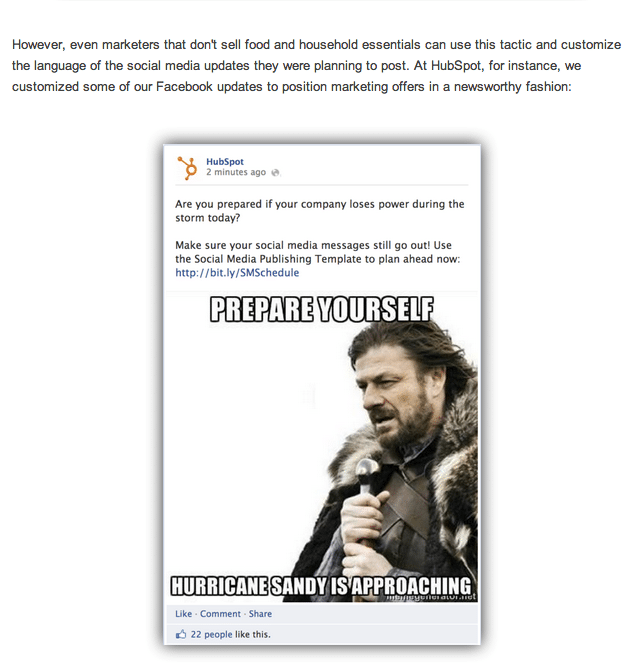
Although they also had their own frivolous moment with their specific Facebook post – because, yes, company messages going out are far more important than the company making sure their employees are safe.

5 Hurricane Sandy Newsjacks From Marketers

So who knows..?

Additional reading: Doug Haslam, “Newsjacking” – A Good Idea with Dangerous Pitfalls

A Lack of Real Vision is Stalling the PR Industry

First, a caveat – I don’t know the folks whose quotes I’m about to use as examples of why the PR industry is struggling.

They could be (and probably are) very smart and accomplished business people.

So, this isn’t a “go” at them.

With that being said, however, this recent report/white paper does seem to highlight exactly why the PR industry is continuously seen as one that’s been slow to adapt to the new business landscape and, as such, is holding agencies and consultants back.

First, let’s take a look at the piece.

The PR Firm of the Future

As a precursor to the PRWeek Conference on November 14, Michael Lasky – senior partner and head of PR at law firm Davis & Gilbert LLP – asked this question:

What is the most important way in which the PR agency of 2017 will be different from the PR agency of today?

Michael asked 8 leaders of independent agencies. The responses included:

– Ken Eudy, CEO, Capstrat: “The PR firm of 2017 will increasingly help is clients become publishers and broadcasters… communicating directly with stakeholders without having their messages filtered through traditional media.”

– Maril MacDonald, CEO, Gagen MacDonald: “The successful firm of 2017… will be interested in relationships, not transactions. It will think about the long-term strategy, not short-term tactics. It will add value through a technology-driven collaborative dialogue…”

– Elise Mitchell, CEO, Mitchell Communications Group: “The firm of the future will be known as a business strategist with communications expertise. It will offer integrated services that create solutions… leveraging earned, owned, paid, shared and promoted media in all channels including digital.”

– Jennifer Prosek, CEO, Prosek Partners: “Practitioners in 2017 will be required to think across the marketing mix and successfully drive campaigns versus simply owning the traditional earned media channels. Firms will need to articulate the value of results that engage their audience versus simply offering impressions.

These are just four quotes I pulled from eight agency leaders. Others include:

  • “Providing value at this level is not only the key to establishing lasting partnerships, but also creates a desire… to partner with this organization”;
  • “Multidisciplinary expertise will be the firm’s leading competitive asset”;
  • “THE PR firm of the future… will deploy a mix of paid, earned, owned and shared media that can be monitored and measured directly in real time.”

All good stuff. All good advice. If this weren’t already happening today in 2012, versus what should happen in 2017.

The PR Firm of Today and Yesterday

While there are some good quotes from the assembled eight agency folks, the “problem”, if you like, is that they were asked what the PR firm of the future would look like.

So, you’d kind of hope/expect to hear stuff that no-one’s really doing at the minute, or ideas that are really pushing the industry forward.

Unfortunately, the majority of the soundbites would be futuristic if they were answers from circa 2008/2009.

Suggestions that brands become publishers and broadcasters, for example, miss how well blogs and social networks have been used by brands and agencies for the last 3-4 years.

You only need to look at programs like Sony’s Digital Dads, or Ford’s blogger outreach campaigns, to see how well this has been done in the last few years. And smaller businesses are increasingly using blogs to educate their audience and grow their customer audience and loyalty.

Then there’s the prediction that the PR firm of the future will deploy a mix of paid, earned, owned and shared media while being able to monitor and measure in real time.

When I was working on a RIM account back in 2009 to launch the Bold 9700 in the U.S., we used a collaborative strategy that saw us involve Facebook, Twitter and YouTube to create a fully interactive experience for you and your friends. This was supplemented by paid media ads as well as partnerships with BlackBerry communities.

We measured and identified where the campaign was working, where it needed help, and which communities were driving real value and worth around the promotion.

The result was millions of impressions, thousands of handsets pre-ordered and sold, and an industry award for the campaign itself.

That was in 2009 – and I know we weren’t the first to use true integration in campaigns.

The Future is Now

And this is exactly why this “prediction paper” just adds to the view that PR is being left behind, versus countering that belief.

There’s no doubt that there are great agencies doing great things. Companies like Arment Dietrich, RKPR, Mullen, Voce, V3 and more. And the reason they’re leading the way today is because they’re already practicing what’s being predicted for 2017.

They’re integrating channels and expertise now. They’re not silo’ing PR from marketing from digital from strategy from creative and more – they’re running these as fully integrated ideas from the start, and have been for years.

My friend Rick Rice, a 35-year industry veteran, sums it up best with this quote:

The PR business is in need of disruptive change and none of this generation are even willing to try.

There’s no doubt the PR industry has a perception problem, and it’s great to see it trying to move forward. I just wonder how far it can move when it still seems to be behind the curve on so many things…

How to Pitch This Blog

How to pitch a blog

How to pitch a blog

Before I start this post, i just want to give a heads up that it’s geared towards PR folks and advertisers.

If you’re more a “normal reader” of the blog, and don’t fall within these two industries, feel free to skip this post completely and come back on the next regularly scheduled updates. 🙂

So, with that heads up out the way, let’s get cracking.

How to Pitch Your Story or Partner On Your Product

I get a lot of pitches form either PR agencies or consultants on behalf of their clients, or from business people themselves wondering if I’d be interested in taking a look at their new product or service.

This is cool – after all, this blog looks to help you, the reader, in being more successful in whatever it is you want to succeed in, from your business and where social media fits to understanding blogging and everything in-between.

The problem is, the pitch needs to fit the audience here – and very often they come nowhere near that. In the last week alone, I’ve received pitches on vodka and fashion news.

Now, while I might like the odd vodka shot now and again, I’m anything but fashionable and single malt scotch is my tipple of choice (though Whyte & Mackay may change that!).

So, here are some ways for you to increase your chance of being shared here:

1. Know my readers

They’re a huge reason this blog exists so understand who they are. A really simple way to do this is use the Demographic feature on Alexa. You can also use tools like Quantcast to grab more information about this blog’s audience. If you’re looking for me to introduce you to them, at least give them the courtesy and respect they deserve by understanding whether or not they’re right for you.

2. Know my topics

I don’t think I’ve ever written about fashion. I know I haven’t written about healthcare. So why pitch these topics? I make it really easy to see what this blog is all about – you just need to check the black category navigation menu at the top of every page. Or, simpler still, check the About This Blog page. If you don’t take the time to see if there’s a fit, why should I take the time to make the fit?

3. Check the archives

A lot of the time when I’m pitched, it’s clear the person behind the outreach hasn’t carried out even the barest of research on this blog. If they had have done, they would have known I’d already talked about their topic before, often more than just the once. Save your time – use the Search This Blog option in my sidebar (or homepage), and use the keywords for your pitch/product/service. If the story angle has been covered, it’s not likely I’m going to do it again.

4. Know my style

I recently received a pitch where the PR agency wanted to control the editorial; only allow for positive praise; and moderate the comments for negative replies. I told them to go shit a porcupine (maybe not in these words, but you get the drift). The voice of a blogger is his or her currency when it comes to readers and their trust – don’t compromise that. Ever. If you don’t understand the tone here – upfront, no bullshit, honest and questioning – then don’t pitch me.

Save Time By Being Diligent

These are just some tips to help you have a better chance of sharing your news here. While the tips are mostly geared towards PR outreaches, they can also be applied to advertorial content and partners.

It’s pointless asking me if I’m interested in advertising skincare products or painting materials, when this blog is primarily about marketing, social media, business, digital/mobile trends and occasionally the odd blogging tip. So try and make the advertorial partnerships a relevant fit for that kind of audience.

If you want to interact with some of the smartest folks on the web, then I’m very fortunate to have them share their expertise in the comments regularly.

They’re probably also interested in hearing from you – as long as you do it right. Sound fair?

Note: While these tips are for this blog, you can pretty much transpose the basics to any blogger you’re looking to connect with.

  • Page 1
  • Page 2
  • Page 3
  • Interim pages omitted …
  • Page 13
  • Go to Next Page »
© 2026 Danny Brown - Made with ♥ on Genesis