• Skip to primary navigation
  • Skip to main content
Danny Brown

Danny Brown

podcaster - author - creator

  • About
  • Podcasts
  • Journal

Archives for January 2013

Identifying the ROI of a Social Media Community

Customer experience social media

One of the things many social media purists will tell us is that we can’t “monetize” social media communities. A social media community is a warm, fuzzy place where no marketing should occur, and we simply talk about how cool social media is for individuals and brands alike.

The problem with this is that it’s impossible for any business to remain afloat without sales – and a smart business knows this along with another key point: their social media community can drive these sales.

By identifying who’s driving traffic to a product page, and which community members are the most respected and listened to, a brand can react to this new information, improve their product and/or adapt their own messaging to better serve that community. Do that, and your return on investment becomes truly measurable and scalable.

So how do we identify these community members? Mark Miller was kind enough to invite me onto his 30 in 30 series to chat about that exact conundrum, and a few other things in-between.

I hope you enjoy, and make sure you check out the rest of the 30 in 30 series so far, there are some great discussions over there. Cheers!
Why Storify Misses the Point on Protecting Privacy

Facebook groups privacy

Facebook groups privacy

When is a private thought not a private thought? When online curation tool Storify decides to bypass privacy wishes and share that thought publicly.

Over at AGBeat, there’s an interesting (and alarming) story about how Storify can be used to post private updates on Facebook publicly. By using their curation tool, someone in a private or secret Facebook group (where only members can view content) can share something meant for a limited audience for the whole web to view.

Storify co-founder Burt Herman seems to think this is okay, and the perfect example of why you should be careful in who you trust online.

But he’s missing a very key point.

People Can Make Mistakes – Technology Should Be Smarter

In a post on the Storify site addressing the AGBeat article, Herman suggests that curating private posts into a public stream is no different from taking a screenshot of a private update and posting that too.

While technically that may be true, in reality there’s a big difference between the two methods. Founder of business network pioneer Adholes, Marc Lefton, succinctly sums up the issue:

Screenshots are malicious. This [a Storify share] can happen by accident. That’s the difference.

Because Storify makes it simple for people to be browsing a site or network and share something that catches their eye, users (rightly or wrongly) will not always consider the limited audience the original update was meant for.

That’s the equal beauty and fallacy of human nature – excitement about content that grabs attention can result in the emotion of finding that content override the logic of respecting the audience limitation.

Technology like Storify, however, isn’t built on an emotional reaction – it’s bits and bytes taking a logical approach to enabling you to share emotionally-rich content.

Or at least it should be – but as the AGBeat article and Storify co-founder Herman’s shifting of blame to the user proves, the technology only works logically if the developers build it to do so.

Herman’s logic – that you should trust who you share content with not to reshare it if it’s meant to be private – would carry more weight if his platform was consistent in that mindset across all networks. But it isn’t.

If you try and share content via Storify from a protected Twitter account, the privacy settings from the micro-blogging platform prevent Storify from being able to quote the tweet. So it’s clear that Storify’s technology can be stopped by a network’s API.

Which suggests both Facebook and Storify are at fault here – Facebook for not preventing sharing the way Twitter does, and Storify for not recognizing a private group or community’s restricted access settings. Unfortunately, Storify doesn’t really see it this way.

It’s Your Fault

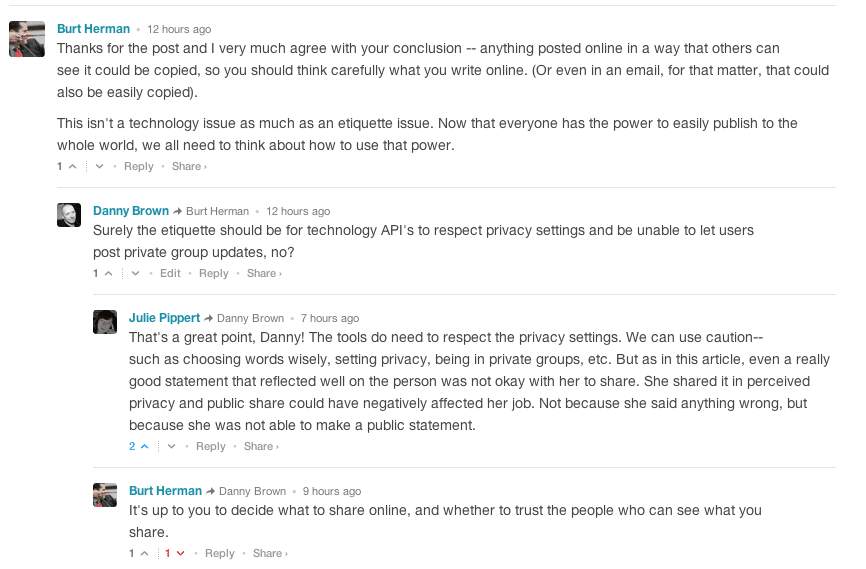
In the comments section of the AGBeat article, I questioned Herman’s stance on user blame after he stated it wasn’t a technology issue, but one of etiquette.

Danny AGBeat

Herman’s answer, ironically, highlights Storify’s failing – the “power” effected by being able to share easily needs to be countered by the ability to identify whether that content should be shared.

Herman’s logic suggests if a private update is shared, it’s your fault for trusting the wrong friends to begin with. But that’s simply absolving responsibility from the platform that offers the public sharing of a private update. Former journalist, and General Manager of Social Media at New York-based technology startup Internet Media Labs, Amy Vernon identifies the flaw in this logic perfectly:

This is the difference:?

You protect your tweets, Storify won’t allow people who are allowed to see your tweets to Storify them. You protect your Facebook posts, Storify will allow people who are allowed to see those posts to Storify them.

Plain and simple.?

Is it, at its root, a human problem? Sure. But all this is changing faster than the average person can keep up. That doesn’t absolve tools and platforms from trying to abide by privacy levels.

Instead of blaming the user, why doesn’t Storify take the higher road and have a filter/blocker in place (similar to the Twitter scenario) where a message pops up prior to the sharing that asks the simple question: “This content is from a restricted source – are you sure you wish to share?” Or, better still, simply change the way Storify scrapes network API’s and only allow sharing of clearly publicly available content.

Of course, to do this would mean admitting Storify (and, by association, Facebook) have a problem. And no-one likes to admit they have a weakness…

image: AGBeat

The Fallacy of the Democratization of Influence

Elite social influenceWhen we currently think of influence, we probably think of social scoring platforms like Klout, Kred and PeerIndex. These are the early adopters to the social influence space and, as such, have built an impressive level of awareness around their platforms and definition of influence.

Proponents of social scoring have praised Klout, as the most popular platform, for democratizing influence – allowing anyone to be an influencer regardless of audience size, social standing and location.

While it’s true that social scoring can start the process of finding influencers, it’s not quite as clear cut when it comes to being democratic around influence itself.

Social Scoring Silos the Elite

The problem with any scoring system is that it only rewards those with a high number. Want to buy a car? Tough luck if your FICO score is under a certain amount. The same goes for social scoring in the influence space.

Want to have a new Cadillac to test drive for a weekend? You better have a score over X amount. Free flight or upgrade to first class hotel accommodation? Make sure your score is high enough.

This engenders an ” us against them” mentality. Jane Average may be a better person to drive conversation and foot traffic to a car dealership because she’s a gearhead yet Joe Average, who has no intent to buy that car brand but has a higher Klout score because he’s more active online, is the one that gets the car keys.

This elite rewards system now engenders another problem – it begins to affect the natural tone of online conversations, as those below the fold realize they can change their language online and be identified as an industry influencer because they’re speaking about a certain brand more.

As the online language changes, the algorithms are rendered ineffective because now everyone truly is an influencer – and yet, they’re clearly not.

The True Definition of Influence

Which brings us to the real crux about influence – who truly impacts how a decision is made and at what point in the purchase cycle of a customer does this decision get made? Is it as a result of a socially active broadcaster, or someone else completely? And, if it’s someone else, do social scoring platforms have the ability to identify that person?

Our belief is that social scoring is not true influence, and that’s why the democratization of influence through social scoring is a flawed, if worthy, ideal. It’s one of the reasons that an early mover like Kred is moving away from scoring as a defining metric.

There are bigger pictures and scenarios at play at every single touchpoint of a customer’s journey through an influence-led path, and the results of who actually influences their decision may surprise you.

Influence decision process

Yet it’s these decisions that truly matter to a brand when it comes to influence marketing – because scores and amplification will only get you so far. No company can remain in business on the amount of retweets and Facebook Likes they received alone.

The conversation around the future of influence is just getting started – and it’s not about an elite partygoer trading on online noise and a grade…

A Discussion on Influence with Mark Miller

At the recent New Media Expo in Las Vegas, Sam caught up with Mark Miller from NBSP. Mark’s a great example of building communities through storytelling, and runs a Soundcloud podcast called 30 in 30, a daily online interview series.

Mark graciously (crazily, some would say!) invited Sam onto the show, and they chatted about influence, social scoring and a little bit about Klout too…

The full chat is below, and make sure you check out the rest of Mark’s 30 in 30 series.

Social Influence and the Shift of the Carnegie Principle

Disruptive influence

When Dale Carnegie wrote the book on influence more than 75 years ago, he probably didn?t realize the impact he was about to make on society. Just ask the 15 million people that have bought the book since 1936.

But, more than just sharing some evergreen ideas on how people and ideas can really connect with each other, Carnegie also pioneered how we ? as individuals ? are perceived by others.

Swap that to social influence today, and brands are now looking to highlight those they perceive as influential, to market their services and products for them.

Whereas Carnegie looked to show you ways on how you could make friends quickly, get you out of a rut, and make you more effective all round, today?s influence is finding uptake with brands looking to (often) bypass the legwork that Carnegie advocated, and utilizing shortcuts instead.

These shortcuts mean quicker access to the many; identification of who can spread a message; and more cost-effective approaches to outreach programs and brand advocate partnerships.

This has led to the popularity of companies like Klout, Kred and PeerIndex, as well as niche offshoots like Reppify, Connect.me and Tawkify, to name but three. Each have their benefits, and proponents of these platforms highlight the importance of their place in today?s social media-led marketplace.

However, critics of the services point to today?s influence measurement being nothing more than activity based ? the more you are online, the more you?ll be measured as influential, whether you encourage people to act on your activity or not (the dictionary standard of influence).

Perhaps the middle ground offers an insight into where Carnegie?s vision and that of social scoring metrics need to be.

Context

One of the most-discussed areas of influence in the current iteration of social scoring is that of context. As mentioned earlier, proponents of social scoring platforms point to activity being a valid metric ? if you?re online a lot, you understand the nuances of the space and how it can be influenced.

Critics point to automated social feeds with little to zero engagement that ? while enjoying a high influence score ? would be rendered useless when it came to being an influencer to partner with in a social media campaign.

This is where the context argument plays its hand. By definition, context is:

? the interrelated conditions in which something exists or occurs.

By that definition, it?s the very thing that influence looks to do. By connecting the right people with the right brand, and sharing the right message to the right audience, the results should be favourable every time.

If the context of the message is right, and the relationship between the person and the product the message is promoting fits, then there is an immediate ?belief? in the message being more than just a sales promotion.

Find the context, and the pieces of the influence bubble begin to come together.

Relevance and Readiness

If context is important, relevance is equally so (if not more so). You may trust the person/influencer sharing a brand?s message with you; you may even be the perfect audience (based on demographics and research) for that message and that product at that given time.

Until you hit the relevance angle.

  • Are you really in the market for this new product right now?
  • Are you financially available to be the customer?
  • Has your situation or taste changed since you last bought a product from this brand?
  • Are there external issues at play here?

The relevance to how ripe you are as customer is something that no influencer can bypass, no matter how much you trust them, or trust the message.

It?s why the social influence market is only just beginning to grow and mature. Activity may be an early barometer of someone?s potential to a brand and its audience ? but there are far more pieces of the jigsaw puzzle to add.

Context, relevance and readiness are three ? but even they?re just the start.

To truly mature the social influence ? and, by association, the influencer ? market, we need to remember how many aspects there were to Dale Carnegie?s seminal book and how they all had to be aligned to work their magic.

Then we can really start to move the social influence needle.

  • « Go to Previous Page
  • Page 1
  • Page 2
  • Page 3
  • Page 4
  • Go to Next Page »
© 2026 Danny Brown - Made with ♥ on Genesis