• Skip to primary navigation
  • Skip to main content
Danny Brown

Danny Brown

podcaster - author - creator

  • About
  • Podcasts
  • Journal

Archives for September 2011

Remembering Anton Hammerl, 1969-2011

Anton Hammerl

Anton Hammerl

This post is on behalf of my friend Debbi Morello.

On April 5th, 2011 South African photographer?Anton Hammerl went missing?after coming under fire from Gaddafi loyalists near the oil port of Brega in Libya.

Many of you may remember back in April my plea for assistance in raising awareness for four journalists detained in Tripoli for no apparent crime, and with very little word about one of the journalists believed to be one of the four, Anton Hammerl.

Thousands signed a petition, hundreds more waged campaigns across the country for the two Americans being held, James Foley and Clare Gilles. With a great deal of pressure, diplomatic negotiations and prayer, the four journalists were finally released from a prison in Tripoli on May 18th: Clare Morgana Gillis, James Foley, Manu Brabo and Nigel Chandler ? but there was no news of Anton.

Tragically, Anton Hammerl was shot by Gaddafi forces and left to die somewhere in Brega. Gaddafi’s men took Anton’s identification and for six weeks the world and his family was led to believe by the Libyan regime that he was being detained and was still alive.

But Anton’s family would only learn the truth when Gillis, Foley and Brabo safely crossed the border out of Libya.?Anton’s family learned from eyewitnesses?on May 19th that his injuries were such that he could not have survived without immediate medical attention.

These words appeared on a Facebook page for him:

“At 10pm BST (11pm SA time) this evening we received devastating news regarding Anton Hammerl.?On 5 April 2011 Anton was shot by Gaddafi?s forces in an extremely remote location in the Libyan desert. According to eyewitnesses, his injuries were such that he could not have survived without medical attention.?Words are simply not enough to describe the unbelievable trauma the Hammerl family is going through.”

Anton, 41, was a former pictures editor and chief photographer for The Saturday Star in Johannesburg, South Africa. He moved to London in 2006 where he became a freelance photographer, shooting both news and corporate work. He had gone to cover the fighting in Libya in late March as a freelancer.

Raising Funds For His 3 Children

This site was put together by family, friends and colleagues of Anton with the goal of raising funds to help secure the future of Anton’s three children, 11 year-old Aurora, 7 year-old Neo, and 6 month-old baby Hiro.

Anton’s wife Penny wants the funds collected to go towards the children’s university education,?Friends of Anton.

If you tweet this, please include the hashtag #friendsofanton

If your budget doesn’t quite stretch to the price of a print, you can make a tax-deductible donation with your credit card or PayPal account. All proceeds will benefit Anton’s children and each donor will be sent a receipt for tax purposes.

Acclaimed Photographers Donating Images

Some of the biggest names in photography have agreed to donate images to support their fallen colleague.

These prints are valuable collector’s items and they make unique gifts.Friendsofanton.org would not be possible without the generous support, advice and donations of services from PhotoShelter, Emphas.is, The Steven Vincent Foundation,?digitaltechparis.com, Human Rights Watch, Committee to Protect Journalists, and Reporters Without Borders.

Hammerl’s remains have not yet been located and returned to his family.?On 8 September his family and friends will be reflecting on Anton’s life at a memorial service at?St Bride’s Church, Fleet Street, London, EC4Y 8AU.

How to REALLY Measure the ROI of Social Media

Social media ROI

Social media ROI

This is a guest post by Eugene Farber.

“How do you measure the ROI of your social media efforts?”

It’s a question being discussed ad nauseum of late, and rightfully so. Social media investment is a legitimate issue that businesses have to face, now more than ever. So, being the problem solver that I am, I decided to figure out how to measure the ROI of social media once and for all.

The quick answer is there is no answer!

If you want a long-winded explanation, read on.

Enough “Whys” Already!

For my first stop on the way to figuring out how to complete this elusive calculation I went to all of the usual suspects.

What I discovered actually got on my nerves a little bit. There were no concrete answers. For all of the promises of “how-to” in the titles, all I got was “why.”

Why you need a strategy before entering the realm of social media.

Why you should use social media to begin with.

Why you should measure the ROI of your social media campaigns!

…OK great! But how?

Some Actual Value…

Luckily my next stop resulted in some actual numbers. This was it! I was finally going to figure it out!

To prove that social media provides a great return on investment (if used properly) The Next Web published 10 case studies on the ROI of social media. These are gleaming examples of social media done right. Case studies which every company should take as an example and follow suit.

Social media management firm Syncapse took it one step further. They recently conducted a study and concluded that the average Facebook fan is worth $136.38.

Now I just have to figure out how to get a lot of Facebook fans and I’m ready to retire!

The Caveats

The Syncapse study is utterly useless. To perform the study they used a selection of companies that are not representative of the average small business. Even Syncapse, within the study, states that no two fans are the same. Well no two companies are the same either. There are too many variables to make the $136.38 figure mean anything significant.

Plus, that takes care of the return part. What about the investment?

Facebook costs

Sure Facebook is free, but someone has to run the page and the campaigns on there. How many man-hours does it take to keep those campaigns working. How many man-hours does it take for large companies like Starbucks to keep the customer engagement going?!

The “ROI from Facebook Ads” case study mentioned on TNW (originally published on Search Engine Journal) begins to explore the actual investment part of the calculation. But they still fall short.

The dollar cost of Facebook ads still doesn’t tell me what the REAL investment was. Hours of research to figure out how Facebook ads work? Keyword research? Ad design? Maybe even hiring a consultant to do the work for you?!

Strictly measuring ROI in terms of dollars spent on ads doesn’t really give you a true representation.

Attempting an Actual Measurement…

A recent post written by Jay Baer of Convince&Convert is probably the best summary of actual ROI measurement I’ve seen. The post focuses on the ROI of blogging but can be extended to any social media activity (and really any activity in general).

The first step is to identify what activities you (or your company) is performing and what it costs. Consider all costs including salaries, direct expenses and overhead. If you want to get really fancy (and I know you do) you may want to take into account the opportunity cost of time spent on these activities and what you could be accomplishing with those resources.

Once you have an idea of what your costs are you need to figure out what the return on those activities is. To do this you need to figure out what your revenue-producing actions are (what behaviors your customers can exhibit to drive revenue). Is it blog subscriptions? Is it opt-in subscriptions? Are you just focusing on sales?

As you can see the actual calculation is simple, but not easy. There are many variables to consider and the outcome of your ROI test greatly depends on which factors you focus on.

For larger companies the ROI becomes even more of an estimate because overhead allocations are often subjective. This also means that departments have to get together and interact (i.e. marketing and accounting departments). And how often does that go smoothly?

But even if you do get of that straightened out, it may be impossible (or at least very inaccurate) to measure true ROI in a short-term time frame.

Are We Asking the Right Question?

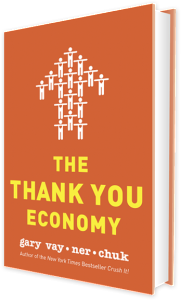
Thank You EconomyGary Vaynerchuk has made a hugely successful business through social media engagement. He has made an even bigger business by promoting the idea of social media engagement.

As he points out in his book?The Thank You Economy, it is the businesses that don’t begin to engage with their customers on a personal level that will fall to the wayside.

People born today are born in to a world that is connected more than ever before. By the time they are consumers they will expect connecting and interacting with businesses to be easy.

This may sound ludicrous, but Gary V believes it to be true. And who am I to argue with Gary V?

My grandmother never had a computer.

My parents are now using the internet for purchasing, yet they tend to stay away from the social network scene as much as possible.

I am in my mid-20s, on the cusp where the social media outbreak occurred.

My kids will be born into a world where the President of the United States having a town-hall meeting over Twitter would be a thing of the past (the effectiveness and legitimacy of said meeting is a debate for another day).

The evolution is clear. And in a world that is evolving faster than ever before, maybe our questions should be evolving as well.

Are We Measuring the Right Metrics?

Maybe the answer to the question is no. Maybe the ROI on social media engagement doesn’t even matter at this point.

Perhaps it isn’t the ROI of social media we should be measuring, but rather the LOLOI – the loss on lack of investment (yeah…I just made that up).

How many potential customers might you be losing if you aren’t engaging in conversation with them? What if your competitors are engaging them? People would rather buy from people they like and can relate to. With social media even the biggest corporations can become more personable.

So at this point the wiser question might not be “what is the cost of implementing a social media strategy?” but rather “what is the cost of not implementing one?”.

A Learning Curve

In truth the investment, and the return, does matter. It doesn’t make sense to pump resources into social media if you can’t afford it. If all of your resources are getting sucked up by social media and not enough are being put into actual business operations then you have a serious problem on your hands.

But it is important to note that social media tools are just that…tools. And the magic isn’t in the tool, but rather how you use it. It doesn’t have to cost an arm and a leg, but it does take some practice.

There are certainly learning curves when it comes to using social media. And each individual and business has its own.

But it may be a good idea to get in now, while it is still early, to perfect the craft before it becomes an absolute necessity.

The Conclusion

There may not be a simple answer to measuring the ROI of social media because there are too many variables. And each individual and company needs to figure out which of those variables they need to focus on.

There is definitely no blanket one-size-fits-all answer. But just because it may not be easy to measure the ROI of social media, doesn’t mean you shouldn’t attempt it.

Go for it. Play around. Test different variables. Finagle some numbers.

And remember…the ROI of social media might not even be the right thing to measure.

Eugene FarberAbout the author:?Eugene Farber is an accountant turned internet entrepreneur. He blogs about internet marketing, business and life at?Reality Burst. Visit his site today for a free?Social Media ROI checklist, and connect with Eugene on Twitter?@EugeneFarber.

image: Leads United
image: Debs

You Make The Choices

Meh to social media complainers

Meh to social media complainers

There’s a lot of hand-wringing and woe is me in social media.

At times, it’s like watching a therapy group from the sidelines, except the therapy group shouldn’t really be called that – it’s more like a “woe is me, how unfair this social media thing is to me” group.

Thing is, it’s not. When something’s unfair, or annoying, or any other emotion that doesn’t fill you with unicorn-flavoured Kool Aid, much of it can be attributed back to the person doing the hand-wringing.

For example, making a public song and dance about unfollowing everyone on Twitter because of all the spam you get in your Direct Message box. Hint – maybe following over 130,000 people in the first place had something to do with it.

But seriously?

Are we really missing the point that, in social especially, we make all the choices that come back and upset the apple cart later on?

No, we don’t deliberately ask for spam – but every single person we take “onboard” has the potential to be a spammer. So, it makes sense that the more we connect, the more the potential.

There are also options available for countering spam.

For example, I’ve seen Twitter profiles that clearly state, “I don’t answer DM’s anymore, but feel free to @ me or email me instead.” Then simply adjust your email settings to stop DM alerts coming into your email Inbox.

Or – less ideally – set your Twitter profile to private. That way only the chosen few will be able to DM you, and you can soon see who the spammers are that way.

Or, simply click Delete and Report Spam – Hootsuite is great for this approach.

Note – all of the above options also mean you don’t flaunt Twitter’s Terms of Service by running a script to mass unfollow.

But the same goes for offline.

We see ads on TV that we don’t want to see. We hear radio ads we don’t care about. We receive flyers in the mail that we have no interest in. But instead of telling all our friends about it, we just change channel or throw in the bin and move on. No big deal.

The point is, all of this is our choice to make.?We can all follow hundreds of thousands of people and deal with the inevitable bad eggs; or we follow less and be less visible.

We can’t have it both ways, as much as we’d like to think we can.

The Could and Need Effect

There are two basic ways of deciding on a course of action – the Could and Need Effect.

Both similar. Both different. Both entwined. Both separate. But each one defines your success and longevity.

Ask yourself a question and approach it from Could and Need to decide your next step.

This bill could wait until next week. I need to pay this bill to keep my business open.

We could make a change in design if necessary. We need to start from scratch.

This could help our strategy. This needs to be in place for any of our strategy to work.

Similar paths, but very different forks in the road at the key junction.

So. Could you, or do you need to?

  • « Go to Previous Page
  • Page 1
  • Page 2
  • Page 3
© 2026 Danny Brown - Made with ♥ on Genesis