
• Skip to primary navigation
  • Skip to main content
Danny Brown

Danny Brown

podcaster - author - creator

  • About
  • Podcasts
  • Journal

Archives for August 2011

A-Listers Behaving Badly

A-lister bullies

Business playlist

This is a guest post by Neicole Crepeau.

Last week I inadvertently stepped into a hornet’s nest on my blog. I publicized some SEO practices that I had been unaware of, including the fact that they may be taking place on a major blogger’s site (unknown to him, I assumed).

The response from that blogger seemed to me out of all proportion. He threatened me with a lawsuit, resulting in my taking down the original post.

His response to this perceived, but unintended, criticism struck me as such a contrast to the response I received from the Triberr guys to a blog post here on Danny’s blog. In that case, I actually did criticize a feature of their product.

Yet these two young men, Dino Dogan and Dan Cristo, were totally professional and courteous. They engaged in an open debate about their product and politely disagreed with me.

It seems to me that some of the supposedly seasoned A-listers could take a lesson from the young bloggers about how to handle criticism.

When I blogged in May about why I’m hesitant about Triberr, I criticized the product. Dino and Dan came on the blog to respond. Dan actually thanked me for the post. Dino engaged me with counter-arguments, and we had a reasonable debate on Danny’s blog.

It never got personal or nasty. This despite the fact that I had made a mistake in my discussion about Triberr, saying that it tweeted links more than once per user account. Dino just politely corrected me. He didn’t threaten to sue me for misrepresenting his product.

When I published my controversial post last week, I let the two people I mentioned know that I had blogged about them. It seemed like the right thing to do. Common courtesy, so they could respond. Plus, again, I assumed that this major blogger might want to know about these shady SEO practices that were surely affecting his blog.

Unfortunately, he was on the attack from the get-go. There was no courtesy, a lot of assumptions about my motivations, and very quickly threats.

Apparently, he has handled product criticism similarly. A year ago, on a negative review of his Scribe SEO product, his very first comment invoked the word “libel” and he proceeded to threaten a lawsuit. Contrast that with Dino and Dan, who have handled even negative Triberr reviews in a polite, professional way–and updated their product in response to it!

This blogger who bullied me online actually wrote a well-regarded post urging people to be courageous bloggers. He said “You need the courage to alienate the wrong people in order to resonate with the right people. You need to stick to your convictions when people tell you you?re wrong simply because your knowledge doesn?t mesh with their opinions.”

I’m taking his advice.?That’s why I have republished my post, including the original comment thread and the tweets that followed. Because I better understand some of his concerns, and in order to protect some commenters from his potential bullying, I have removed people’s names.

This man is not alone. Other A-list personalities have become immediately defensive and intractable when their practices were questioned. I’m not the only one who feels that a lot of the biggest personalities are not open to honest questioning and criticism. They tell their clients to handle criticism gracefully, to not get defensive, to listen with an open mind and respond thoughtfully. Yet, they don’t practice the same techniques for their own brand.

These days, if you criticize an A-lister, you are apt to be labeled and dismissed as a “hater.” Disagreeing is not the same as hating. Criticism is not always mean-spirited. Democracy is built on the willingness of people to speak out, even when their opinion is unpopular, and for all of us to debate the issues openly. Shouldn’t our larger social media community be built on the same principles?

So, how about taking a step back, A-listers? I bet you’d like everyone to remember that you’re a real person. We’d like you to remember that we are, too. Don’t assume we little guys are out to get you. Don’t assume we’re criticizing you just to get attention and link-bait. We’re not all that jaded and cheap. I know you get a lot of crap at your level and it’s probably hard to assume the best of people. But please try.

Take a lesson from the young dogs. Assume the best of us, participate in discussions, politely disagree, and please don’t use your size and status to stifle any discussion.

Neicole CrepeauAbout the Author: Neicole Crepeau is a blogger, columnist at?{grow}, and the creator of?CurateXpress, a content curation tool. She works at?Coherent Interactive?on social media, website design, mobile apps, & marketing. Connect with Neicole on Twitter at?@neicolec.
Ford, Red Tape and Social Media Roadblocks

Ford F-series recalls social media

Ford F-series recalls social media

News came out this week that Ford are recalling more than 1 million F-series trucks, due to a defect in the straps that secure the truck’s fuel tanks to the vehicle. The defect could see the straps corrode, causing the tanks to fail. So far, there have been 8 incidents, three of which included a fire, and one injury.

The news came to the fore after an investigation by the U.S. auto safety regulator, and affects older versions of the truck. In response, Ford has targeted mid-September to notify owners about what to do if their truck is affected.

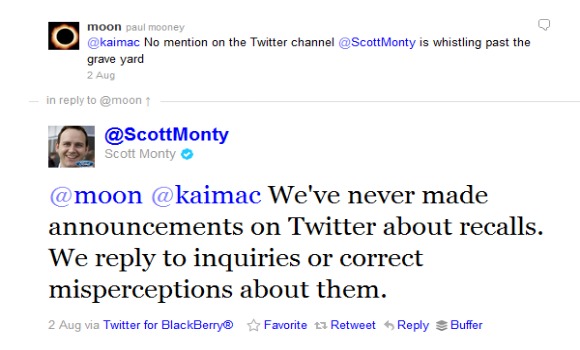
What’s interesting is how a company that’s noted for its use of social media isn’t using social platforms to pro-actively share news about the recalls. Instead, as the image at the start of this post shows, they’re using it reactively when asked about the recall situation, and to correct any non-factual statements. There’s also nothing about the recalls in the Ford newsroom.

Is this a sign of choice or legal red tape?

The Pros of Being Pro-Active

Head of social media at Ford, Scott Monty, says the reasoning behind the “silence” is to avoid inciting panic and unsubstantiated rumours. This is understandable, since we all know the consequences of fake stories and rumours online, and how that can affect brands.

Yet as a way to share news to a wider audience, and quell rumours at the start, social media has continuously proven to be a very strong tool. While Scott may allude to the legal constraints he and the Ford communcations team are under, does being silent unless questioned help?

Wouldn’t it be useful to have an official update in the Ford newsroom, as opposed to having to put out fires by false rumours due to the reactive approach? And a single tweet, or a Facebook page update, that shows a link to where F-series drivers can get the latest and official updates, would help alleviate the very concerns Ford wants to meet.

Additionally, if you’re pro-active, it can also help deflect the view that you have something else to hide (this isn’t just Ford, this is any company online). In a post from 2010, Scott praises SeaWorld on how they were being pro-active at quelling fears, by releasing an official statement from the SeaWorld President and linking to it from their Twitter account.

The Social Media Marketing Blog  When Crisis Attacks

The Cons of Being Pro-Active

As Scott mentions in his answers over at Google+, the reason nothing is mentioned on social media platforms or the Ford newsroom is down to necessity. Ford is handling this recall situation the same way they handle all recalls, and don’t feel the need to say anything “unless the recall rises to a level that is relevant to the wider public.”

Additionally, Ford needs to adhere to regulatory and legal issues and this is tying their hands (at least, that’s how it reads).

Christian Adams, in his response to the question on Google+, advises how he was involved in testing tires after the Firestone fiasco, and that having to wait until the auto safety regulator gave the green light on a problem was very constrictive.

I know the constricted feeling well. When I was contracted at an organization last year, they handled a prize promotion for Canada’s largest airline. Due to some prizes not being delivered in time for the holiday season (a bit attraction to the promotion), there were some negative comments posted on a forum. They asked how it should be handled (as they blamed the couriers and the couriers blamed them), and I advised to let them know that we were looking into it, and that we would reply directly and publicly once an answer had been found.

Due to crappy red tape, it took eight days for someone to come back and tell the person that the case was being looked at. And this was just an update to say the company was aware and would investigate. Eight days is a long time for any answer – on social media, it’s a lifetime.

So I completely get the need to do things right. But couldn’t there be at least one update from Ford, and others like them, to alleviate the questions that will be asked due to silence? Especially if it becomes a wider issue, and the questions become accusations of trying to cover a problem up.

Then again, with the news that Ford has been accused of fraudulent tactics and destroying documents in a lawsuit by a woman paralyzed when her van accelerated out of control, Ford may be feeling the heat and doesn’t want to add to it any more.

Obviously there are pros and cons to any choices made, both by people and businesses. The right one can be difficult to gauge, and perhaps it’ll be in the next couple of months if we see whether the Ford reactive one is the better over the pro-active.

How to Kill Your Blog in 10 Easy Steps

How to kill your blog

So you’re bored with blogging. You have other things to do – like eat, sleep, go out, work. You know – boring “real life” stuff. Besides, thinking about it, blogging is for computer nerds and failed writers.

Not to worry – help is at hand. Here are 10 ways to kill your blog. Let’s begin.

1. Stop Writing

What? That’s too simple – of course your blog will die if you stop writing? Well, yes, if you stop writing altogether. But be smarter about it – change your writing habits. If you write daily, change to once a week (and vice versa). If you want to lose your readers, confuse them.

2. Be Obnoxious

People like to be respected – your readers are no different. So be obnoxious. This can take many shapes – talking down to them in comment replies (if you reply at all); using made-up words that make you sound wanky; and making them feel you’re a hundred times smarter than they are. Be mean – and keep those pesky readers away.

3. Close Your Comments

People like to be heard, and we especially like to be heard when we read something that either inspires or polarizes us. So take away that option from your blog, and make your site a talking head instead. Unless you’re Seth Godin or Leo Babauta, you’ll soon see your blog’s popularity shrink, wither and probably die.

4. Use Captchas

When I was younger, I used to love stuff like the Rubiks Cube and 10,000 piece jigsaw puzzles. Now, though, since time is a precious commodity, I like things to be simple and easy to do. So install a crazy ass captcha on your blog that no-one can decipher and make people pull their hair out from frustration – great way to scare readers away!

5. Limit the Options

When blog readers read a great post, very often they want to share it. Of course, if you’re trying to kill your blog then you don’t want that sucker shared a lot. So limit the amount of sharing options – instead of making it easy to share on whatever networks the reader wants to, limit it to Facebook and Twitter. After all, they’re the only real social networks that are important to bloggers. Right..?

6. Screw Formatting

Because blogs can be read on different browsers and computer screen resolutions/displays, there’s no real point in formatting your post – it’ll never look good on every reading option. Instead, bunch all your words into one long-ass paragraph; don’t use images; and make your font 9-pixel Copperplate. Job done.

7. Die, Navigation, Die

Think of the world’s biggest maze. Then think of the world’s biggest maze at night. Then think of you trying to navigate the world’s biggest maze, at night, in a blindfold. Now – make your blog’s navigation that much fun, and make it easy for your readers to get lost and not know how to get back home. Lost readers = frustration = see ya!

8. Search What Now?

If you really want to kill your blog quickly, you could even combine a couple of the ways here. For example, if you have crappy navigation, make sure you don’t have a Search Box to at least let your readers find what they’re after. Add in no Archive section and boom, you have one heck of a lost blog happening!

9. Subscribing is for Wimps

When you set a blog up, generally it’ll come with a standard RSS feed. Thing is, the standard RSS feed doesn’t always work on certain browsers, so using something like Feedburner or Feedblitz is better. But you don’t want better – so leave the standard feed and make sure you don’t have any subscribe options in your sidebar. If your readers can’t subscribe, they won’t know when you have a new post. Blog death on the horizon.

10. Repeat Yourself

We all run out of ideas, but often you can find things to blog about to share with your readers. But if you’re trying to lose readers and kill your blog, then you don’t want fresh ideas. Instead, copy a post from your Archives, change the minimum amount of words up, and you have a new-but-not post to pan off on your readers. Tip – don’t use a Related Posts option here, as you can get found out and look stupid.

As you can see, there are a bunch of ways to kill your blog, so you don’t need to worry about pleasing these damn readers of yours anymore.

Of course, if you actually want to have a blog worth visiting, and one that sees you respected and visited and recommended, then ignore all of the above and do the exact opposite.

Your choice.

image: shiner.clay

Google+ Is the Social Network That?s All About Search

Google Plus

Google Plus

This is a guest post by Sean McGinnis.

Did you hear that Google launched a social network called Google+? Of course you did!

In the past, Google took a stab at social by purchasing Orkut. Later, they launched both Google Buzz and Google Wave with little success. Now comes Google+.

Kinda seems like Google is the Elizabeth Taylor of the social world, doesn?t it? They?re going to keep trying until they get it right. Given those four trips down the social aisle, and the fact that employee bonuses are tied to getting social right this year, it?s pretty clear Google is borderline obsessed about social.

I wonder why that is?

So have a lot of other people.

In fact, there?s been a lot of handwringing and hypothesizing about why Google launched Google+. Some believe it is designed to kill Facebook; others that it will kill Twitter; still others view it as a play to move everything into the cloud and take on Microsoft and Apple.

I?m not convinced.

I think Google+ is a forward thinking play to keep search market share. Coincidentally, it also opens up billions and billions of new real estate to sell Google ads against, but that?s secondary (believe it or not).

Google Makes Money By Selling Ads

You see, Google has one objective; to sell advertising. Google brought in over 28 billion dollars in ad revenue in 2010 ? 96% of total revenue for the year; and that number is already growing roughly 30% this year.

One of the things we all know is that you make more money when more people see your ads, whether that?s a TV show or a Google paid click within a search result.

Google AdWords

Google?s goal of selling ads is directly served by making services that are as valuable as possible. But, what?s valuable in the context of search?

Think about search for a minute. You ask a question?you expect an answer; a correct answer. That is why you go to a search engine, isn?t it? I know that?s why I go to a search engine. I?m looking for something and I need to find it. So, the more accurate the search results, the more people will want to use a given search engine.

The question is how does one go about creating a better search engine?

One Question. One Answer.

Think about it for a minute. If Google were God (not to stretch credulity too far or anything), you?d ask one question and get one perfect answer. They wouldn?t need to serve you 10 or more possible answers to your question. They would know exactly what you were looking for, even if you were unclear in how you presented your question.

I mean, God would know your intent, right? God would know exactly what you were looking for. I?m really not trying to compare Google to the Omnipotent One, but I am suggesting that in a perfect world they (along with every other search engine) would like to be able to divine what you were looking for and present it to you as fast as possible, maybe even before you asked for it.

(But maybe make you click through an ad in order to get the answer).?

Even more importantly, they would know that what I was looking for may not be what you were looking for.

Enter Personalized Search

The quest for search perfection began long ago. Google made great strides in this direction by including the concept of authority into their algorithm. By indexing the link structure of the web and calculating the value of the structure, Google (unlike many other early search engines) was able to eliminate a lot of spam from their search results.

But it wasn?t enough.

Website owners became wise to the value of links to influence search results and backroom deals, link purchases and other unsavory activities began unduly influencing search results. So, in 2005, Google released a feature called Personalized Search.

Personalized Search

It was a new and shiny object at the time. It represents (to me) the first push down the slide we are accelerating down today. Google started to present back to you (provided you were signed into your Google account when you ran a search) results that were marginally different from other users. They started to personalize those result to you.

Think about that for a minute. What better way to ensure a search engine could answer your question?

In 2009 Google extended Personalized Search to all users, whether logged into their Google account or not.

Over the past 6 years personalized search has improved some of the search experience, but only on the margins. There?s a number of reasons why Google and Bing chose to move slowly in the area of personalization, but that?s fodder for a different post.

A New Dawn for Personalized Search

Here?s the thing about personalized search. The more Google knows about all of us, the more they know about our like, dislikes, profession, connections, friends, enemies, content types, areas of influence, etc? the more they can customize the search experience.

In addition to Google+ giving all that information and more to Google, the introduction and proliferation of the +1 button allows Google to gather signals across the web of what you like and don?t like.

When we use Google+, we are creating data, all of which is within the Google network. No longer is Google relying on facebook or twitter data to learn more about you. That?s why it is so critical that Google get social right. Because social is where the data action is. It?s where we freely give up information about ourselves; where we create the connection nodes that Google can learn from and serve up a better search experience.

So while Google+ may represent a number of things tactically, the business strategy behind it is, in my view, directly correlated to their core business ? search.

More eyeballs means more ad revenue, and the best way to secure eyeballs is to have a near flawless search experience; intuitive, fast and predictive. The only way that happens is when a search engine LEARNS your tendencies ? and social is the best way to glean those tendencies.

That and it creates a few billion extra pages to sell ads against.

What do you think?

Sean McGinnisAbout the Author:?Sean McGinnis consults with businesses on digital customer acquisition and loyalty programs at?312 Digital.?Sean spent much of the last decade leveraging his law degree and 12 years of digital marketing experience by assisting law firms across the country create compelling online marketing programs. He is also co-founder of the group blog?12 Most. Sean currently serves as Managing Director and CMO?of?Multistate Edge, an online bar exam preparation company. You can find Sean on Twitter at @SeanMcGinnis.

  • « Go to Previous Page
  • Page 1
  • Page 2
  • Page 3
© 2026 Danny Brown - Made with ♥ on Genesis