• Skip to primary navigation
  • Skip to main content
Danny Brown

Danny Brown

podcaster - author - creator

  • About
  • Podcasts
  • Journal

Archives for August 2011

The Google Plus Apathy Malaise

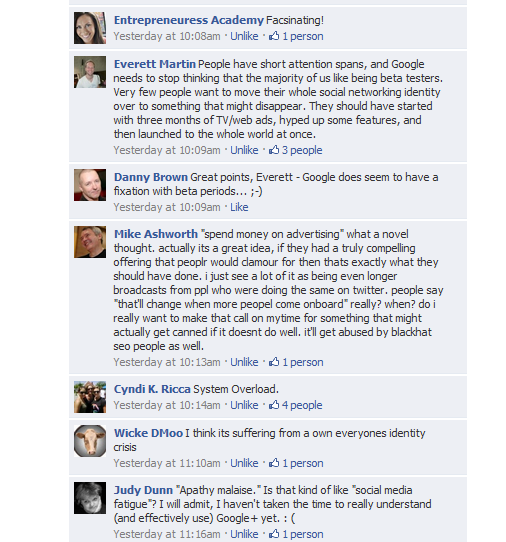
Danny Brown Google Plus FB Question

Yes, Google+ is just two months old, and yes, they’ve had a great uptake in numbers using the service (currently 25 million and counting). But there’s a growing amount of talk about how it’s not majorly different from what’s currently out there.
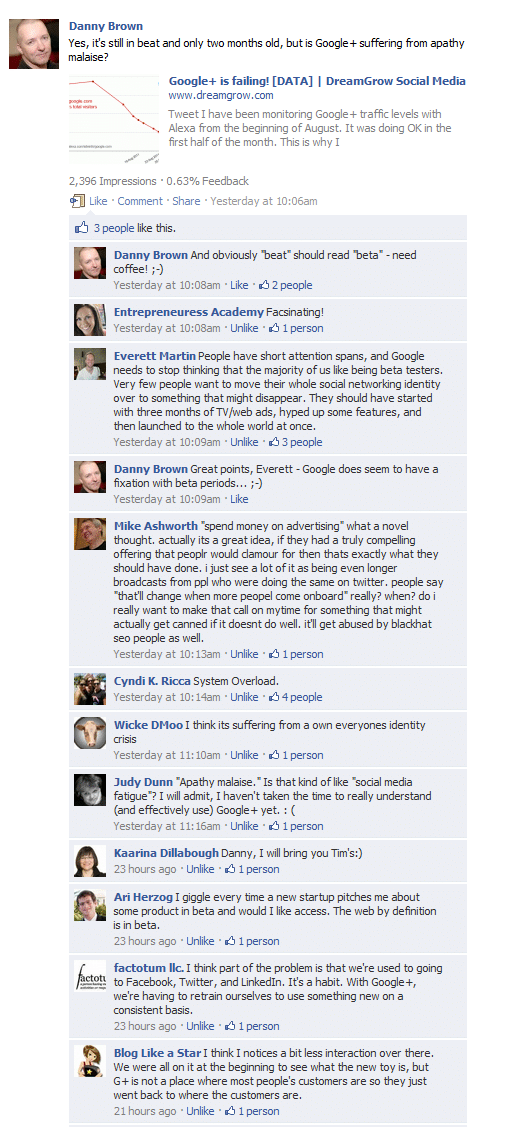
Danny Brown Google Plus FB Question

Additionally, the majority of users fall within limited categories – early adopters, tech geeks, social media “power users” and marketers/agencies trying to decide on its potential business value.

For Joe Public, though, Google+ remains an anomaly, and one that has a big question to answer – mainly, “Why should I leave Facebook when everyone I know is on there?”.

Personally, I’m enjoying Google+, but I’ll admit the early novelty has worn off and I use it less than Facebook. I’m hoping that the various tools and apps Google has at its disposal will make an appearance soon and integrate smoothly, as I feel that could be where the real Wow factor comes into play.

We’ll see. For now, from a lot of the people I’m connected with, it’s okay but could be better.

How about you?

How to Build a Media Empire From Your Bedroom With Just a Laptop

Building an empire

Building an empire

This is a guest post by Niall Harbison.

The media landscape is changing right in front of our eyes – we have moved from a world where large organizations controlled the media we consumed to a more democratic time where everybody has a voice. Because of the huge shifts in technology, anybody can start their own media empire with a small amount of money, lots of drive and a creative mind.

Two of the biggest examples are Techcrunch and Mashable which were both started by individuals in their own homes and in less than five years have each become worth close to $50 million. So how would you go about creating your own little media empire and what are the barriers to entry?

Find A Platform

Even the biggest blogs and news sites in the world these days are built on free platforms like WordPress, Blogger or Tumblr. Whereas in the past you needed an expensive printing press and had huge overheads you can start your own site within a couple of minutes absolutely free.

If you are getting a little more serious about things you might need your own domain name, a professional template and some hosting but you can be up and running for less than $500. Three or four years ago you needed more technical knowledge like HTML and CSS but the platforms are so good now that all you really have to focus on is creating great content and growing an audience.

Identify Your Niche

There is lots of competition online with plenty of people churning out content trying to grab an audience so you are going to have to find a niche and really focus on it. You are going to have to find something that you are extremely passionate about and stick to that. The biggest, most acclaimed blogs on the Internet are written by people who have huge passion for their subject.

While it might be tempting to drift off topic and cover a wide range of subjects you will get more traffic and a bigger audience in a shorter period of time if you remain focused and produce excellent content within your niche.

Growing an Audience

If you wanted to build you authority in old media it meant finding a job at a publication that already had an audience and piggybacking off them. If you are starting out on your own you are going to have to grow your own audience from scratch, which seems like a daunting task, but the good news is the tools are there to help you.

The first thing you will have to do is grow huge personal brand. Look at Pete Cashmore at Mashable, Mike Arrington at Techcrunch or Arianna Huffington at the Huffington Post and you can see how important the personal brand of the founders is.

You can do this through tools like Twitter, Google + and by engaging with other bloggers within your niche – this is absolutely vital if you are to succeed. This part is going to take time and you will be writing posts that only have a handful of readers at the start but over time your readers will grow. Don?t expect to get much traction within the first few months and expect to put a years hard slog in to growing your audience at the very least.

There are no short cuts to this part. No magic tricks to get millions of readers. It is all down to pure hard work.

Using Rich Media

Not only do you have a free blogging platform to use but you can also embed all sorts of rich media. With over 200 million blogs in the world you are going to have to make your one stand out from the crowd and using tools like video, audio, photos or visual designs is a great way of doing that.

There are 100s of different ways in which you can use video, for example, and platforms like Youtube are not only free but will also help you get some great exposure. Maybe you could start your own podcast using software like Audioboo or a simple photo blog using the 100s of different options out there.

Build Your Network And Absorb Information

Just like a journalist would build up their contacts and their sources you are going to have to network your ass off. The old way would have seen you shaking hands and swapping business cards in the real world but now you can do it all online and all you need is a laptop and a WIFI connection.

Start talking to the people who are influencers within your niche online. You can watch most press conferences online these days and let people know that they can share information with you that you might publish. Use tools like RSS and Twitter to get the latest news and spend time setting them up properly with as many sources as possible.

You are going to have to become a sponge to absorb as much information as possible but luckily the web is full of it so it?s just about how efficient you can be filtering it all to your own personal needs.

Work Hard, Publish Regularly And Think Big

Once you have all the elements in place above all you have to do is work harder than everybody else to make it to the top. There are no secret shortcuts or fancy tools that will help you achieve your goals overnight. It is going to take you a couple of years to get to the top but if you keep on producing content on a regular basis, create a huge network and stand out from the crowd there is no end to what you can achieve online.

You don?t need much money at all to get started and if you think big and aim for the top there is no reason why you can?t get there. Most of the media companies and blogs selling for $50 million started off in a bedroom just like you could with a laptop, an Internet connection and some big dreams.

Go for it!

About the Author: Niall?Harbison is the Co-Founder of?Simply Zesty,?a social media agency which has grown to 27 employees within 2 years and has a wide range of large international clients. The company blog shares social media tips, news and case studies from around the world. You can find him on Twitter?@niallharbison.

image: joeldinda

Enough With The Opt-Out BS, Klout

Prisoner of Klout

Prisoner of Klout

Klout sucks. Not because of what they’re trying to do, in measuring your online influence (although I’ll be the first to admit I’m not a fan of that approach for a number of reasons).

Nor do they suck because they’ve engendered a mindset among people to try and grab Klout Perks, based on that perception of influence. Heck, you’ll always have folks that do nothing but want everything for free, so may as well have somewhere for them to spend their time and energy.

No, they suck because they’re stuck in the mindset that opt-out is better than opt-in.

Meaning, they don’t give you a choice when it comes to having a “profile” of you. It doesn’t matter if you sign up to the service or not, or whether you connect your accounts to grow your Klout score.

Because Klout automatically gives you a basic profile anyway.

No permission – there you are, as bright as day online, with whatever score they deem you fit to have based on their perception of you.

Note: I understand that by accepting the Terms of Service on the likes of Twitter, etc, your information can be shared. I’m not sold on that being turned into a full-on profile on another site, though.

I’ll admit, when Klout first came out, I was curious as to how it worked. As someone who needs to connect clients with perceived influencers for outreach and promotional programs, it seemed an interesting way to find those that could help.

Then the flaws appeared.

Just using my account as an example, I recently disconnected all my accounts from Klout, with the exception of Twitter as it wouldn’t let me disconnect that.?As a result, my Klout “score” (or influence) dropped from 75 to 63.

So, even though I was still active on the networks I’d disconnected; even though I was sharing the same amount of information, and interacting just as much – if not more – on blogs, Klout felt I was less “influential”.

What they were really saying, though, is that because I wasn’t participating by their rules, I was less influential. Never mind the fact I was still getting “reactions”, if you like, for my interactions online – if Klout didn’t see them, they never happened.

Because I’ve written a fair few times about my lack of “trust” in how Klout perceives influence online, I thought it’d be hypocritical to keep an account there. So I went to delete, which is where the fun began.

I followed the instructions on their site to delete my account, and received an email from Lan at their contact centre advising my account had been removed. This was almost a week ago, and I was advised it could take a day to clear their system.

A week later, and I’m still there, even though I have no desire to be part of the Klout game anymore, nor do I wish to be “on display” on their site, since I (initially) never gave permission.

This is where the opt-out bullshit needs to stop.

It’s more than 10 years since Seth Godin wrote about Permission Marketing, and yet here we are, still being added to things we didn’t have a say in. Fair enough, I added details to Klout, but the initial permission wasn’t there. As it isn’t for anyone.

The Standard for Online and Internet Influence Klout

And to remove yourself, you have to go through hoops to get it done? That’s crap.

It’s not just Klout. Facebook is as bad, as are many other social networks. I had the same issue with Hashable, and got into a debate on Twitter with that service’s founder, who decreed, “Hashable’s not the kind of service people leave, hence there’s no need for an option to delete your account.” (This option was later added.)

Yes. There. Is.

You don’t add people to something and not ask them their permission (unless there’s some legal reason to do so). Especially when that information is there for anyone to see, and make a snap judgement on.

For example, some companies are using Klout scores in the hiring process. If someone has a low score because they don’t know they’re on Klout, and get passed by for a job even though they’re the best qualified, that makes your system screwy (it also doesn’t say much for the research angle of the company in question).

So, please, Klout, and anyone else that puts people onto their platform then makes it almost impossible to get off – be smart. Make it easy to leave. I was able to delete my Empire Avenue account with a single mouse click – why should it be any more difficult than that?

After all, it’s not like you’re just looking to have numbers to show off about your platform to possible investors. That wouldn’t be a reason to keep people on there that want to leave.

Right?

Update 26.10.2011: Seems the link to remove yourself from Klout is now showing an “invalid request”. You can try this one instead.?

Note: This post is about Klout and its practices. I have nothing but good words for its CEO Joe Fernandez, who’s always responded to criticism about the service and looked at ways to improve.

~ Update: As of November 1st 2011, you can now?delete your Klout account.?

image: remuz

Your Target Audience Is NOT Generic

Peas in a pod

Peas in a pod

There’s a mindset among many business owners that they need to be on social media. Specifically, they need to be on Facebook; or Twitter; or LinkedIn; or have a blog; or look ahead to business options on Google Plus.

This is usually fostered by fly-by-night consultants and agencies who tap into the fear factor so many businesses have about social media, and use blinding statistics and numbers about these platforms, and why a business needs to be on them.

You get the usual soundbites, like Facebook is the equivalent of the third biggest country in the world; or Google Plus has the fastest adoption rate of new users across all social networks; or if you’re not blogging, you’re not reaching your audience.

But so what? All these numbers and stats are doing is taking a generic approach to social media.

The consultants and agencies peddling them are doing so because they know big numbers sound impressive, and that any business owner would be a fool to miss out on 750 million potential new customers on Facebook, or 20 million and counting on Google Plus, or any other millions of potential customers on other networks.

But, again, that’s being generic. And customers are anything but.

The Collective Individuals

Sure, you can segment customers into groups. For example, you might have a product that appeals to women between 25-45, with kids and a sporty lifestyle. Or you might attract gearheads. Or teenagers.

But they’re still individuals, even as part of a collective.

There’s no guarantee that a million sporty moms will all love the same product; or that 500 gearheads will all be tempted by your latest sale; or 1,000 teens will all want to see the same teen movie.

As consumers, we don’t work that way – so why would we approach our business strategy that way to attract our audience? Why would we think generically? Because we’re told that’s where the money is, according to the people with the awesome social media numbers?

Be Your Customer

If you’re a brick and mortar store, and you attract a very niche audience based on location and age, do you think having a generic blog is going to attract new customers?

If you’re a mom and pop business that sells classic 78 RPM vinyl, do you think a Facebook group full of teens talking about video games is going to work for you?

Yes, social media and a solid online presence can – and does – bring in new business. But that’s after research defines where that new business is, not because someone tells you that you could reach almost a billion potential customers simply by having an account.

Seriously, if it was that easy, we’d hear more success stories of how social media is the secret sauce, as opposed to digging in deep and finding out for ourselves what we need to be doing.

You’ve built your success up so far by being smart about your business – why would you want to stop now, just because someone shows you some bright lights and inflated sales potential?

  • Research. Learn how you can use the likes of Twitter and Facebook (and others) to find out if your audience is there for you and, if so, how you can get in front of them.
  • Plan. If you find your target audience is in a specific place, make sure you understand the platform and the different approaches on each one.
  • Strategy. Much like you wouldn’t offer a sale on meat to a vegan, look to use different strategies and promotions depending on the information and statistics your research finds.

Sure, numbers are great (despite what girls tell us guys, size does matter, or so I’m told).

But size only matters when it’s appropriate – make sure you’re not getting sucked in by size, when you should be looking at the overall package…

image: MrWoodnz

Danny Brown Called Me a Dilhole Or How to Find the Secret Sauce

Secret sauce

Secret sauce

This is a guest post by Howie Goldfarb.

But he also invited me to guest post for which I am flattered and honored. Not sure which I feel more honored and flattered about. Obviously Danny doesn’t care if you like him because he invited me to write this post!

So, this is for you:

Do not follow, read, attend webinars, or conferences by ‘A-Listers’ if you want to learn how to market products, services, or brands.?

There – I said it. Hey A-Lister! I am telling people to ignore you! And I am correct in saying this. You have nothing unique to offer me, or my clients. Because you are an A-Lister, everyone knows your ‘insights’.

How am I going to set myself apart, or my client or brand or product if I am using tips from you? Where is the secret sauce? Everyone is reading you, following your tweets, etc, and thus using your advice for good (or actually often for bad). Your sauce certainly is not secret – it’s just sauce. It’s Ragu vs. what Momma used to make.

First it was about Fans and Followers. Everyone should have a Fan Page. A Community. A Blog. Yet none of these ‘secrets’ have led to Brands or Businesses separating themselves and making a ton of money.

Don’t get me wrong – I am okay with you, ‘ahem’, A-Lister making money for yourself. But you are not the marketing A Team. You are NOT who the CIA sends out to take down Bin Laden. If you want the real A Team, see who comes to this blog, or Spin Sucks, or The Sales Lion?and participates.

Don’t you want insight that only a few people have?? The real secret sauce? The goal is to crush your competitor. Not to be like your competitor.

Do you really think A-Listers would share their secret sauce with you if it really worked? Don’t you think an A Lister would make a gazillion dollars if they could seriously show, say, Pepsi how to trounce Coke vs. telling everyone their ‘secret’?

Don’t people pay big bucks and compete like crazy to get into an Ivy League or similar B-Schools, so they can learn the secret sauce? Thousands and thousands of dollars to have that edge, yet you can buy a book by an A Lister for $25 instead and be just as good? Are you nuts?

Think about what will set you apart. Because you want (need) to set yourself, your brand, your product or your client apart.

Because that is what the secret sauce is about. And you’re not going to get that for $25.

image: All Chrome?

Howie GoldfarbAbout the author:?Howie Goldfarb?is president and CEO of?Sky Pulse Media, an agency focused on helping clients achieve outsized results in measurable bottom-line-impacting ways. He had a 14-year career in direct B2B sales before deciding to lighten up his dreary work life and move into advertising. Follow Howie on Twitter at @skypulsemedia.

  • Page 1
  • Page 2
  • Page 3
  • Go to Next Page »
© 2026 Danny Brown - Made with ♥ on Genesis