• Skip to primary navigation
  • Skip to main content
Danny Brown

Danny Brown

podcaster - author - creator

  • About
  • Podcasts
  • Journal

Archives for March 2011

Using Lijit As a Content Marketing Platform

Lijit search

If you take a look at the sidebar to the right of this post, you’ll see the Lijit logo next to the search box. Lijit is a third-party search platform for bloggers – and a heck of a lot more on top.

While it’s perfectly fine to use whatever standard search box comes with your blogging platform (or add something like Google Custom Search), using Lijit takes all the goodness of your search box options and then amplifies it to the power of, oh, eleventy billion or so.

Here’s why.

Snapshot Audience Intelligence

While you can’t beat something like Google Analytics or Woopra for a full-on overview of your site traffic, Lijit gives you a great and user-friendly checklist for you to see how your blog is performing and help you target areas to work on.

Lijit search

By looking at these stats for the last 30 days on here, I can see that I had just under 20,000 unique readers, but just over 48,500 page views. So this tells me that the average reader is spending time checking out at least one more page or post while they’re here – great for keeping your bounce rate down.

Additionally, I can also see that almost a quarter of these page views came from search engines, which is great news since it means I’m not relying solely on social networks for my audience. So, if Twitter or Facebook died overnight, I’d still have a nice amount of blog traffic. It also means my SEO (search engine optimization) is working too, for the topics I want to be found for.

I can also see what the most popular search is – both on-site and off-site – and I can use that to tailor future blog posts and topics.

Blog Content Guidance By Your Audience

While I always say that you need to be writing for you first and that everything else is a bonus, it also makes perfect sense to ensure you’re at least aware of what your audience wants to read about. After all, they’re the ones that make blogging so enjoyable, by sharing their thoughts in the comments and making you look at topics in a new light.

So why wouldn’t you want to write on something that clearly interests them (and bring new readers to your blog into the bargain)?
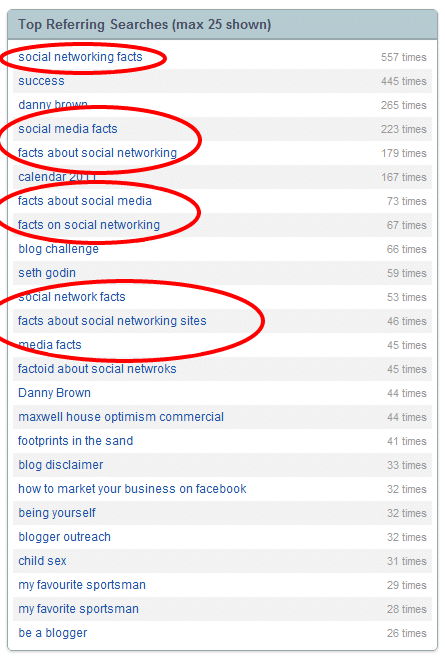
social media factsLook at the figure to the right, for instance, and you can see that one of the most popular search terms in the last 30 days has been for “social media facts”, or other keyword terms based around that.

That search is pretty understandable, since I wrote a post last year on 52 cool social media facts that turned out to be pretty popular and resulted in a lot of social shares and syndication.

However, because Lijit shows me within my dashboard that this is still a pretty popular term – and the original post was written last summer, so the stats are already out of date – then perhaps I should be thinking of updating the post, and include newer networks.

Additionally, I can ask myself whether it might be an option for me to compile an ebook, which looks at the stats and collates them into a more flowing form.

And, say I was to offer some strategies based around the social media facts, could that ebook be premium, or would I want to offer it as a free ebook, which could then lead to premium offerings down the line?

So as you can see, already I’m starting to get a feel for my audience and understand both the current readers, and those coming in from search engines and what they’re looking for while they’re here.

Location Based Marketing – Not Just for Mobile

By using Lijit so far, I’m seeing where my audience is coming from, and what searches are happening not only off-site, but on-site too. This is allowing me to build up my audience’s profile which in turn is helping me write content that they’re going to read.

This is key for both personal and business blogs, and everything in between.

But then we can start taking that one step further, and really start writing content for a specific target audience. Not only that, but then we can start using our other social profiles in a far more strategic way.
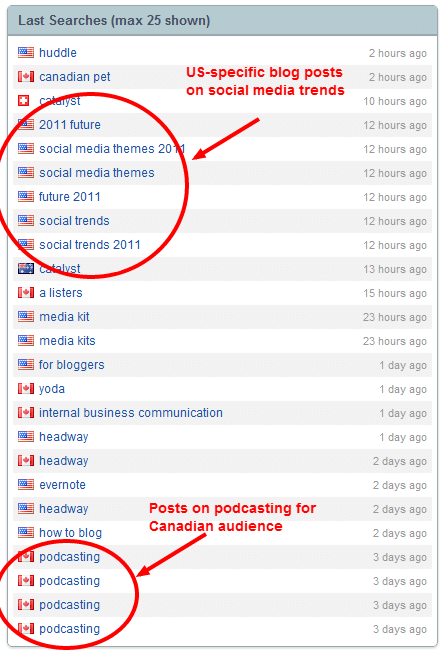
location based content marketingFor example, you can see by looking at the image on the right that there are two key pieces of information that stand out, that I could tailor into future posts:

  • A lot of U.S. visitors are looking for information about social media trends for 2011.
  • A lot of Canadian visitors are looking for information on podcasting.

This means I can now tailor some posts around social media trends and how they affect U.S. social media users for the next six months or so.

These can be for personal social media use in the U.S.; mobile browsing; social media and business use in the U.S.; is the U.S. falling behind in social media use compared to the rest of the world or leading the way; and more.

Switching to Canada, I could then tailor posts based around podcasting and its position within the Canadian space. Is it more popular in Canada than elsewhere; are there opportunities for guest posts from Canadian podcasters; can businesses use podcasting more in Canada, as opposed to text or video blogging?

These are just some of the approaches I could take. As you look more into the Lijit dashboard and the intelligence it builds around your readers – especially internal searches from the Lijit search box – you can really begin to blog strategically. Which is perfect for growing your existing blog audience.

The Added Bonus of Community Content

While Lijit is great for intelligence based around your readers and audience, one of the things I really like about the platform is how it lets you promote other parts of your own network, and that of your community.

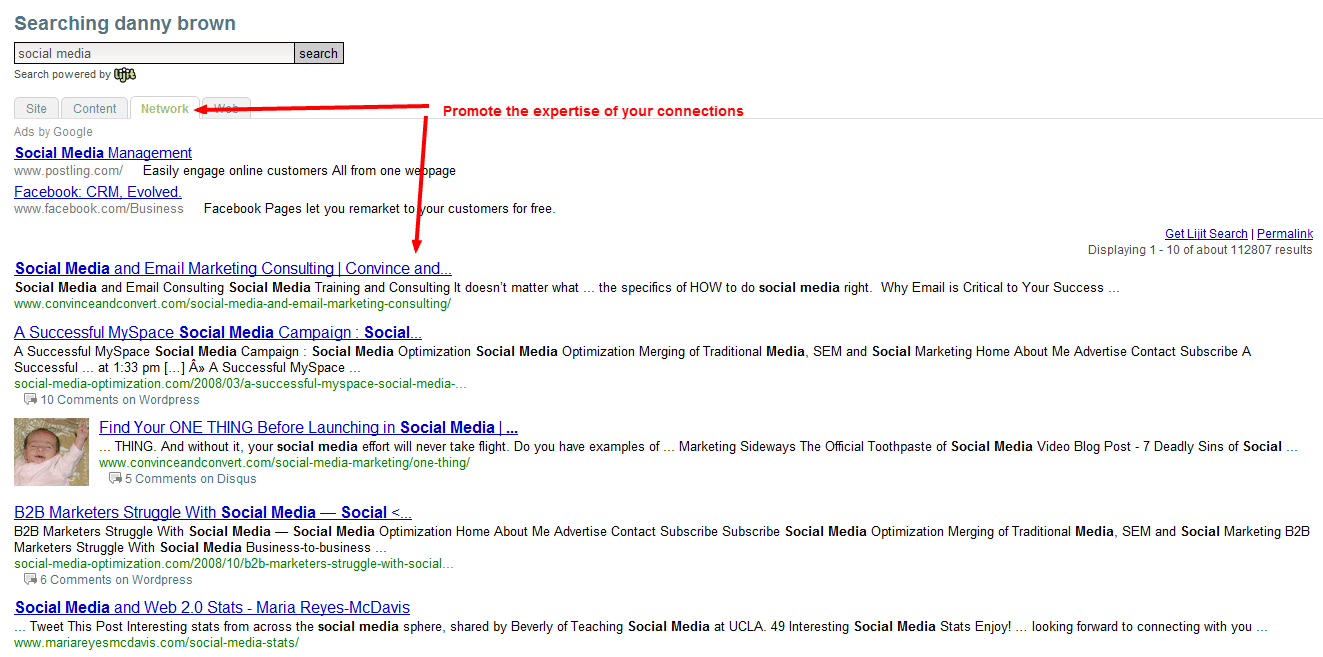
When you set up your Lijit account, you can add all your other profiles from around the web (as seen by the Content Tab on the search result in the image below). This then lets you pull search results from other blogs you might have, or your company website, or video channels, etc.
community intelligence

Next to the Content Tab is your Network Tab. This looks to your social profiles, along with any blogs you may link out to via your blogroll, and shares similar posts based around the search term on your blog.

The nice thing about this is that you’re not only allowing your reader to get the most comprehensive results for their query, you’re also sharing the cool folks you’re connected with and (potentially) driving traffic to their site too. Which is nice.

These are just some of the ways you can use Lijit to build a content marketing strategy for your blog. There are more, and this recent case study by Marketing Sherpa expands on some of these (disclosure – it features a certain Scotsman…).

Any blogger will tell you that knowing your audience is key – Lijit makes this just that little bit more effective. Which is never a bad thing, right?

Sunday Brunch – Organizational Tools

Grandpa Pete's Bagels
John's favourite brunch place, Grandpa Pete's Bagels in Stroudsburg, PA

Welcome to a new episode of Sunday Brunch, where we talk about your questions on social media, marketing, business tips, entrepreneurship and more.

Today?s question is from John Komatsoulis, owner of Learn About LLC, a Business Development Firm with offices in North Miami Beach, Florida, Albrightsville, Pennsylvania & Montreal, Canada. John asks:

?What tools do you use to keep your day organized??

Thanks for the question, John, and I hope the video helps.

If you have a question, you can send it in via the form below. There?s also a file upload option, if you want to send in a picture of your favourite Sunday Brunch place.

Cheers, and see you same time, same place next week for some more Sunday Brunch chats.

Resources:
As mentioned in the video, below are the four resources I use that you might find useful:

  • Google Docs.
  • Huddle.
  • Tungle.
  • Hootsuite.

This post contains a video. If you can’t see it displayed properly in your feed, you can view it directly here.

[gravityform id=6 name=SundayBrunch Question Form]

Social Media – It’s Not Just for White Folks

different cultures

Over at his excellent Convince and Convert blog, Jay Baer shares a post on whether it seemed?white folks are the majority in social media. This feeling is based on his experience at the recent South by Southwest festival, where he noticed that the majority of people in his session were white. From Jay’s post:

“As I looked around at these events, I noticed that the vast majority of attendees appeared to be 25-39 years old (I?m actually an old fart in social media circles), and?the vast majority were White. The fact is, most social media pros can easily name the handful of people of color in the business. Excellent professionals like?Wayne Sutton,?Stanford Smith,?Shashi Bellamkonda,?Shama Kabani, and?Rohit Bhargava are the exceptions that prove the rule.”

(Update – Jay wasn’t referring to his sessions in his post. It should have said “events”, and not “his session”. My apologies.)

Jay’s post goes on to ask why there isn’t more diversity in social media, and that “we have to do more than rely on a bunch of 30 year old white people” for our social media information. Again, from Jay’s post with regards diversity:

“Consequently, I do believe?companies need to consider proactively adding diversity to their social media teams, to ensure that first responder and content creation teams understand the perspectives of all customers and potential customers.”

The post is an interesting read, and opens up a great discussion in the comments.

To me, though, the post misses a key point (which, to be fair, Jay addresses afterwards in the comments): there are no statistics in Jay’s post to back up his view.

While Jay’s post is a great conversation starter, the lack of statistics mean it’s still restricted.

Numbers Make a Difference

While it might look like there’s a distinct lack of diversity from the folks that were at the SxSW events in question, that’s possibly more to do with South by Southwest (or any event) than colour. It’s up to organizers to make sure that diversity is key, and I’ve heard more than one story of how the SxSW panel picking is skewed towards friends over non-biased choice.

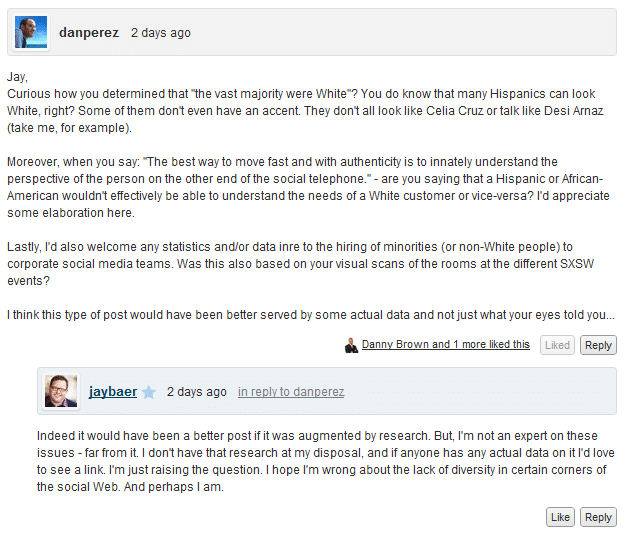
Ignoring the South by Southwest example for now, Jay mentions in a reply to Dan Perez (who asked about statistical proof) that he didn’t have any research at hand.

Fan Perez on Jay Baer blog

The thing is, there’s a ton of research and statistics available if you do the grunt work.

If you drop over to BlackWeb 2.0, for example, you’ll find an excellent resource that’s leading the way in highlighting blacks in technology and new media. When they shared their take on a 2009 Pew Report, they showed that seven out of ten African Americans used Twitter as opposed to six in ten white people.

Additionally, their social web category shares how black people and businesses are using social media.

Over at ColorLines, which offers analysis and solutions to racial justice issues, they extend on that report a little further, and show that 13% of black internet users are on Twitter; 18% of Latin American internet users are on Twitter; but only 5% of white internet users are.

Of course, social media is much more than just Twitter. Blogging, for example, is one of the lead platforms on the social web for sharing a view and making yourself heard, and there’s no shortage of quality black bloggers online.

Over at Squidoo, for instance, there’s a lens that shares 50 of the top African Amercian blogs for black men. These range from business blogs to fatherhood blogs, political blogs and more. It’s a great list and well worth checking out (a similar one for women would be great!).

At Blogged.com, there’s also a sub-category in the Society section that covers African American blogs, and these range from feminist blogs to pop culture, as well as the issues of dealing with infertility. Again, it’s another great resource and shows how black social media users are using the platform every day.

Not Just Black and White

Stepping away from just black and white social media use in the U.S., the Hispanic and Latino movement is anything but minority, too.

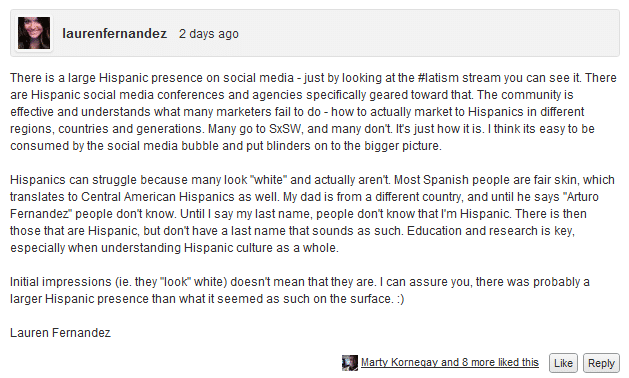
I mentioned Dan Perez earlier, who’s Hispanic, and the comment he left on Jay’s post. Lauren Fernandez, an awesome Cuban PR pro, raised a great point about Latino and Hispanic use of social media in her comment:

Lauren Fernandez blog comment

Both Lauren and Dan make a great point in their comments about it not always being easy to tell someone’s race or culture based on their appearance. It’s something we’re all guilty of, and leads to a lot of incorrect assumptions that can trip us up further down the road.

A report from January 2011 over at Fox News Latino shows how Latinos are using the social web for good, as well as highlighting that Hispanics are embracing technology faster than any other demographic, despite being in the minority.

Then you have the likes of Manoj Nigam, VO of IT at Vodafone, Manish Mehta, VP Global Online for Dell, and Viraj Patel, VP of IT at BigTree Entertainment, showing businesses how they can take their companies to Wall Street with social media.

If you want a really impressive number, then the fact that 39% of Chinese sales consultants use social media to engage their customers compared to only 3% of U.S. sales consultants is pretty telling. At Asian Nation, you can find all sorts of reports, statistics, communities and more dedicated to Asian America today.

It’s Not the People

These are just some resources and stats that I found while researching around the topic of Jay’s post. While Jay’s right in that it always seems to be the same people at the same events, that skews things a bit because these people just happen to be (primarily) white.

They’re also the folks that Jay would cite as leaders in social media. Other people (myself included) would probably cite very different people and names – because that’s a natural thing to do. We always think of those we connect with most when asked about something, as opposed to taking the better route and thinking of those that are also doing really great things, but without the fanfare that Jay’s Mafia would probably get.

That doesn’t mean that white folks are dominating social media, nor does it mean there’s a lack of cultural diversity in social media.

It just means the industry needs to do a better job at recognizing people that aren’t part of the “inner circle”, if you like, and stop using “names” just to sell seats.

If you really want diversity, you first have to highlight it – the rest will fall into place naturally. So, how about it, event organizers and blog thought leaders – a bit more elbow work to let these new voices heard would be a good start, no?

And how about you? Who’s doing great things online and isn’t white? Let’s start the highlighting now – sound good?

image: Rose Cioccolato

Dear CEO – A Call to Action For Today’s Business Leaders

dear ceo

dear ceo

“Dear CEO,

I hope you are well and had a successful 2010. I know how tough it can be – you have shareholders questioning your decisions; employees questioning your leadership; and customers questioning your product.

In fact, you?ve probably had to deal with so many questions in the past 12 months that the last thing you want to see is another question, especially from someone that may or may not be a fan of your product.

So I?ll try and keep this brief and limit the questions.

As you move your company forward into 2011 and beyond, there are a lot of challenges that are going to come your way. There?s this new fad called ?social media?, for example, that everyone and their dog is telling you is the next big thing, and you need to be in it or be out the game.

Thankfully, social media is anything but new – it?s simply a different riff to a very familiar theme that companies have used since time began. You know – great customer service, easy access to solutions for problems, no confusing sales pitches, and allowing everyone attached to your company a say in its success.

I know your company has used this established routine, because your company is one of the better ones that knows how to do business right. Right?

So, instead of telling you how to approach this ?new world? in 2011, or ask you what your approach is going to be, I simply have one question (see, I told you I?d keep it short).

When will you deliver?

  • When will you deliver the innovative approaches you used to be known for, as opposed to just copying your competitors because it?s working for them?
  • When will you deliver the business environment that encourages greatness over generic?
  • When will you ignore spin doctors and advice on what you should say, and just come out and say what you need to say?
  • When will you take a stand with your company and say, ?Enough?s enough – we will treat our employees as family. We will treat our customers as family. We will treat our business as the family heirloom, as opposed to the distant relative cash cow.?
  • When will you realize that real success is measured across the board and not what the sales team brought in? Who cares that you sold a million dollars worth of product, when you pissed off half of them with crappy after-service?

Simply put, when will you be the company we know you can (and want to) be?

Okay, I cheated – it was one question and a set of sub-questions. But I only cheated because I care. If your company wins, it means we?re winning – consumers, employees, stakeholders and clients.

And we can?t really ask for much more than that, can we?

Yours sincerely,

Danny Brown.”

This post is my letter to today’s CEO, and my contribution to the new ebook from Gini Dietrich, CEO of leading Chicago communications agency Arment Dietrich.

Entitled “Dear CEO – Letters to the C-Suite from Experts on Vision, Culture, Community and Integration”, the ebook is a collection of one-page letters from some of the brightest minds in the industry. People like Gini Dietrich, Jon Buscall, Martin Waxman and many more offer their views on how today’s CEO can move their business forward. It’s a great read with some thought-generating stuff from a wide collection of expertise.

The book normally costs $40, but Gini has very kindly offered me ten to give away. So… how shall we do this?

I thought it’d be fun for you to let me know what you’d write back to anyone that suggested how you run your company. Even if you don’t run your own business, think of how passionate and protective you’d be, if someone you don’t know from Adam suddenly tells you how to improve it. And leave your reply in the comments.

It could be a response to my post, asking where I get off trying to tell you how to do your job, or it can be to a more general approach if someone came in and pointed out your “failings”. It can be humorous, indignant, stuffy, fun, angry – anything you like (just make sure you use a smiley face if it’s really angry, just to let me know we’re still friends, hehe!).

The ten responses that make me chuckle (or wince!) the most will have the ebook emailed to them. And if you’re not one of the ten winners, you can always buy the ebook directly from Gini over at her Spin Sucks blog.

So – let’s be hearing you!

image: Alessio Bau

Precious Time

precious time

Many years ago, I had a big falling out with my parents, and we didn’t speak for three years. It was a stupid argument, but being the pig-headed Scots that we all are, none of us wanted to be the first to say we were wrong.

During that time, my grandmother had a serious stroke and died within a few months of having it. Because of the argument with my parents, I never got to say goodbye to one of the most amazing women I’ve ever known.

To this day, I regret that immensely.

Time is so precious. We never know when we’re going to lose someone suddenly. We never know when we kiss our partners goodbye in the morning if we’ll see them in the evening.

Life moves fast; we’re not always in the lane that we should be to keep up.

While it’s wonderful to connect online and expand our connections, and maybe even make new friends along the way, sometimes we miss out on the most important moments in our immediate circle.

Time is precious. We need to remember to treat it as such.

  • Page 1
  • Page 2
  • Page 3
  • Page 4
  • Go to Next Page »
© 2026 Danny Brown - Made with ♥ on Genesis