• Skip to primary navigation
  • Skip to main content
Danny Brown

Danny Brown

podcaster - author - creator

  • About
  • Podcasts
  • Journal

Archives for 2010

A Couple of Sojourns

Danny Brown

Danny BrownHey there. I just wanted to share a couple of places you can find me, both today and in the near future, if you’re interested.

The first is over at The Donovan Group, where founder and President Andy Donovan was very kind to profile me last week. Chatting with his media partner Donna Papacosta, we talked about Bonsai Interactive Marketing, social media, 12for12k and where the industry is heading, amongst other things.

You can find the podcast of the interview here, and the extended transcript in the Donovan Group newsletter here.

Next month, on Monday November 1, I’ll be co-hosting the Marketing Monday chat on Twitter. Hosted by Jeff Ashcroft of The Social CMO, Marketing Monday (using the #MMchat hashtag on Twitter) brings in folks from all aspects of marketing, and opens them up to questions from the attendees.

Previous Marketing Monday guests include Scott Monty of Ford and Ted Rubin of e.l.f. Cosmetics – so no pressure there, then!

In a nice little twist on the format, Jeff is opening up the topic choice to you, so you can either message him or tweet him with your suggestions, and the best one will be the topic for the night’s chat.

You can find out more about the chat, as well as The Social CMO, here.

My sincere thanks to both Andy and Jeff for having me in their neck of the woods. Hopefully you check out the podcast and leave your thoughts, and maybe I’ll see you at the #MMchat on November 1?

Cheers!

Why This Blog’s Community Rocks

Thank you, Danny Brown's blog community

A blog’s community can be many things.

It can be long-term subscribers; it can be first time visitors. It can be “only” readers; it can be regular commenters. It can be every day attendees; it can be folks that visit once then read every other post from a feed, never to visit the actual blog again.

One thing that every single member of a blog community has in common, though, is the connection to each other through the blog (and vice versa).

And that connection can be the very heartbeat that keeps a blog alive.

If a blog’s community is the heartbeat then you, the folks that make up this blog’s community, must have one of the strongest communal beats around, because you have some of the biggest hearts.

You showed that yesterday when I asked for a “birthday wish” to celebrate this blog’s two-year anniversary. You showed it when you granted that wish and visited the blog of a girl called Stacey Monk and showed her she wasn’t alone in her sadness, and that you were there with support if and when she needed it.

When people ask why I blog, the answer I give more than any is this: because of the community.

I already considered myself hugely fortunate to have you here, to have you read my thoughts and share yours in the comments afterward.

I can safely replace “hugely fortunate” with “full-on blessed”.

Thank you for being you.

image: himmelskratzer

A Birthday Request

Stacey Monk

Stacey Monk of Epic ChangeSo today’s post was going to be a look back at two years of blogging here, and some of the things that have happened since I made this my main blog on September 30 2008.

Then I read a blog post from a dear friend that stopped me in my tracks.

And completely changed what this post would be.

Stacey Monk is a girl in Florida who co-founded the Epic Change charity program with another mutual friend, Sanjay Patel. Epic Change is the parent organization behind the annual Tweetsgiving charity project in November.

The post in question is a deeply personal one, and reflects on Stacey’s current outlook on life.

It’s clear it’s a sad and bleak one.

Those she loves aren’t around her; those she loves are facing personal battles of their own; Stacey herself is at a low point. And for someone like Stacey, who does so much for others, this shouldn’t need to be the case.

So.

As a “birthday request”, if you like, I’d love for you to help me show Stacey she’s not alone. That while we might not physically be in Florida with her, we’re there in spirit and mind. That we care for someone that cares so selflessly for others.

Pop on over to Stacey’s post, and just leave some encouraging words for her. It can be anything you want, and as short or as long as you want. But let’s leave something, and show an amazing girl that folks are thinking of her.

With me?

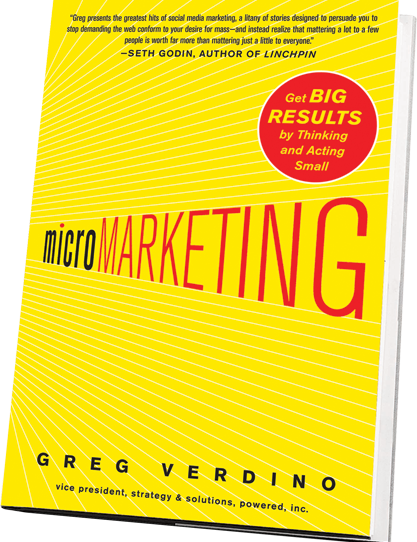
From Reach to Relationships – Chapter 7 of Greg Verdino’s microMARKETING Book

microMARKETING by Greg Verdino

microMARKETING by Greg VerdinoGreg Verdino’s new book, microMARKETING: Get Big Results by Acting and Thinking Small is already generating some great buzz because of one of the ways the book is being marketed.

Living up to the book’s premise, Greg and his partner at Powered, Inc., Aaron Strout, decided to forgo the usual blogger outreach program and target a select few based upon expertise in certain areas.

This was handled by Alexandra Kirsch, Social Media Coordinator for Planned Television Arts, and it’s an approach that’s been received favourably by those targeted by the outreach program.

As part of the limited outreach, I’m reviewing Chapter 7, From Reach to Relationships – Activating the Many by Resonating with the Right Few. These are my thoughts.

Reach is the Result

While there are a few examples of mass marketing throughout the chapter, the overarching viewpoint is simple and clear – while huge numbers can work, it’s the connections based around any figure that makes the real difference.

Opening with the much-maligned Suggested User List (visible when logged in) employed by Twitter to recommend potential follows to new Twitter users, Greg uses the example of blogging pioneer Anil Dash.

When Anil was placed on this list at the end of 2009, he went from having a few thousand followers to several hundred thousand (as of writing, he sits at 341,304). Great, right? Especially for a blogger – imagine the retweets and social shares of his posts!

But what Anil found was that, instead of getting more useful eyeballs, he really just got a larger amount of fairweather followers who didn’t really care about what he was saying – they just connected because Twitter had suggested him.

The reach was there, but it was a silent reach. In other words, there was no result from having the reach. And, as any good marketer will tell you, numbers are great but it’s the results that count. Heck, any marketer should be telling you this, never mind just good ones.

Relationship Marketing 2.0

From this starting point, the chapter opens up and discusses an oft-said mantra within social media – it’s the quality of the connection, not the quantity. However, where Greg differs is that he actually backs up this kumbaya mantra with quantifiable examples.

To quantify the examples he uses, Greg first shares a defining white paper that was published way back in 1999, but still rings true today.

Commissioned by the Institute for Public Relations and authored by Dr. James E. Grunig and Dr. Linda Childers (Hon.), the white paper looked at how organizations could relate better with the public. Their findings led to two distinct approaches: Exchange Relationship and Communal Relationship. To quote the white paper:

In an Exchange Relationship, one party gives benefits to the other only because the other has provided benefits in the past or is expected to do so in the future.

In a Communal Relationship, both parties provide benefits to the other because they are concerned for the welfare of the other – even when they get nothing in return.

As Greg points out, while both may appear similar – they’re about getting sales, at the end of the day – the approach is hugely different. While an exchange relationship might get you customers, a communal relationship will get you customers that have the potential to become evangelists. These customers can then result in new customers because of their love for the brand – the Holy Grail of any marketing campaign.

But it’s not just the relationship that’s important – it’s the right relationship.

Big Brands, Micro-Marketing

To enforce Greg’s view that it’s the small things that matter, he uses some great examples of how big brands have taken this communal relationship and thought smaller to get big results.

Panasonic’s Living in HD campaign, for instance, took 12 families in 2008 and made them part of a fully immersive program to test out their top-of-the-range consumer electronics equipment.

Panasonic Living in HD

They would have the latest gadgets as part of their everyday lives, and all they had to do was offer feedback on the experience, through their own blogs in the LiHD community.

The project has been a huge success, and seen the community grow from 12 families to 100. Indeed, Greg uses a letter to Panasonic from one such family to show their gratitude, and how the project has changed their lives (the previously tech-agnostic wife now has a job in social media and a thriving website).

Greg also uses examples from the Walmart ElevenMoms project (now Walmart Moms) as well as the to show how big companies are using relationships with the few to achieve results normally associated with the many.

Does microMARKETING Work for All?

It’s this attention to detail and statistics that sets Greg’s book apart from many other books that look at marketing in the social media era.

While other books may be a good read, and offer an “Isn’t social media great?” mindset because of buzzwords and sexy tales of the odd success story, few go into the Why behind the What. Greg Verdino offers the meat behind the cordon bleu appetisers. It’s an approach that I wish more social media authors would take (and a key reason I stopped reviewing these types of books last year).

If there’s any criticism, it’s that once again it’s the larger brands that are used as an example. Panasonic, Walmart, McDonald’s – would the same approaches have been successful with businesses that have a fraction of the budget available to these guys?

Would the bloggers attached to the ElevenMoms project have jumped to write about Joe’s Bakery instead of Walmart, for instance? (Note – I’m only speaking from the point of view of Chapter 7 – it may be that the rest of microMARKETING addresses smaller examples).

However, to be fair, this is something that social media as a whole needs to address better. We’ve all heard the big success stories – let’s hear about the small successes too.

So, is microMARKETING: Get Big Results by Acting and Thinking Small worth your time? From my point of view as a single chapter reader, I’m hungry to read the rest of the book. Its figures, stats and anecdotes offer an excellent reason why the new media landscape we find ourselves in is so important to businesses today.

From that angle, microMARKETING could well be one of the best social media books on the market today.

If you want to get a feel for the other chapters in the book, Greg is offering an updated list of all the reviews and they can be found here. You can also find out where you can buy microMARKETING.

Of Bugs and Beds

Hey there.

So I’m currently fighting a virus at the minute that’s left me pretty zonked out and listless. I’ve had signs of it all week, but this morning it hit me hard.

So, while I’m “absent”, so to speak, why not check out some posts you may have missed? You can find them here.

Or, introduce yourself to the bloggers that sit on my reading list. You never know what gold you might find.

Cheers, and see you soon.

  • « Go to Previous Page
  • Page 1
  • Interim pages omitted …
  • Page 10
  • Page 11
  • Page 12
  • Page 13
  • Page 14
  • Interim pages omitted …
  • Page 43
  • Go to Next Page »
© 2026 Danny Brown - Made with ♥ on Genesis