• Skip to primary navigation
  • Skip to main content
Danny Brown

Danny Brown

podcaster - author - creator

  • About
  • Podcasts
  • Journal

Archives for June 2010

Posterous Grows Up as a Blogging Platform

Posterous blog platform

Posterous blog platformI’ve loved the idea of Posterous from the start.

As a quick-start blogging platform, Posterous offers a pretty robust platform to build your blogging expertise from.

One of the biggest things that puts many folks off from starting a blog is often the time commitment needed.?Yet with the ability to post via email, Posterous allowed anyone to experiment.

I’ve introduced a few clients to blogging via Posterous, and it’s given them the confidence to swap to “full-on” blogging via WordPress and self-hosting.

And I have a Posterous account that I use for short-form blog posts. Ideas, basically, that I might expand into longer thoughts here. So, yeah, I’m a fan of Posterous.

Yet for all the good stuff that Posterous offers, it’s always been a lightweight version of blogging (at least to these eyes). No search engine optimization offerings, no real ownership, and none of the ability to expand your blog the same way you can with a dedicated one (pages, for example, and sidebars/toolbars).

Until now.

Posterous Grows Up with Pages

A new feature just announced by Posterous sees the platform become a more bona-fide alternative to full-on blogging. With the addition of Pages, you can now have a pretty cool little online hub to build your brand, business or services from.

Previous to this addition, all you had on your Posterous blog was your posts and any sidebar that came with the theme you chose (Posterous has about a dozen or so pre-built templates for you to choose from). While this is ideal for a simple blog, it doesn’t really offer much in the way of additional information (About, Services, Contact, etc) that you see on more “traditional” blog platforms.

Pages now allows this, and a little bit more.

Now you can have a dedicated About Page with Posterous, where you can expand on who you are and what you do/offer. You can also offer a Contact Page, a Services Page – heck, anything you want to add, you can. And setting it up couldn’t be simpler – just add the new page from your admin area, fill out the content and hit Publish. You can even drag-and-drop the navigation to rearrange where the page sits on your nav bar.

The other cool feature that Pages allows you to do is redirect that page. Let’s say you want to use Posterous as a simple outlet, and your main site is an e-commerce one elsewhere. You can set up a page called Store, for example, and use the redirect function to open up your full-on e-commerce store.

On my Posterous account, I’ve used the new Pages redirect feature to direct folks to my Contact Page here, as well as my accounts at Twitter, Facebook and LinkedIn.

This feature alone puts Posterous above many premium WordPress themes – although the Headway theme (affiliate link) I use on this blog has this ability – and suddenly turns the platform into a more fleshed-out option for bloggers.

Does Posterous Replace Dedicated Blogging?

Having said that, Posterous still doesn’t beat a full-on self-hosted WordPress blog just yet.

There’s still no dedicated SEO options (although you can tag your post with keywords). Nor are there options for plug-ins that a WordPress blog offers, which can really turn a blog into a free-standing social hub. And obviously, as a free platform, you’re still restricted by the terms and conditions of using Posterous.

But then again, that’s probably not the audience that Posterous is after. The platform offers a quick and easy introduction to blogging, and with the addition of Pages, allows even the most inexperienced of bloggers a great starting point.

And that’s all that matters at the end of the day, no?

Note: This blog no longer runs on the Headway framework. Instead, it’s a custom WordPress design by Lisa Kalandjian of SceneStealer Graphics.
How Social Media Shaped 2009 – A Doodler’s Perspective

With the amount of year-end overviews that appeared at the end of last year, it’s not surprising that some really cool ones would slip under the radar.

I found this video completely by accident, which just goes to prove that some of the best things happen that way. What I love about this video by?Rob Cottingham is the way he manages to mix the big stories with the ones that escaped media attention, yet were still big themselves within the social media space.

Once you’ve watched the video, make sure you check out more goodness at Rob’s website, Noise to Signal.

Enjoy.

Silos

According to Webster’s Dictionary, the meaning of the word silo is a trench or pit used to exclude air, or an underground structure.

So, by definition, a silo is something that chokes the life out of you, or keeps you hidden from view.

So why do so many businesses continue to silo their people from each other?

?

7 Ways to Market Your Business on Facebook – Free Ebook

Free Market Your Business with Facebook ebook from Danny Brown

Free Market Your Business with Facebook ebook from Danny BrownWith over 400 million active users, Facebook continues to be a great marketing platform for your business.
It doesn’t matter if you’re a small-to-medium business or a large conglomerate – Facebook should definitely be in your marketing arsenal.

To help you find some of the ways you can start to use Facebook to market your business, I’ve put together a free 33-page ebook that looks at some of the ways you can utilize Facebook for your business needs.

Looking at Pages, Ads, Search, Apps, Insights, Groups and Facebook Marketing Solutions, 7 Ways to Market Your Business on Facebook is meant as a quick reference guide or jumping-off point. How you use the information (and some of the case studies and examples within) will be determined by your needs and manpower/bandwidth.

Here’s the thing, though. As I wrote recently, I’m looking to offer platform-specific content as a way to offer value to connections on their preferred platform of choice, whether it’s this blog, Twitter, LinkedIn or, as in this case, Facebook.

So, you can only access the ebook via my Facebook Page. Since the content is Facebook-specific, I thought it’d be a nice way to connect the platform and users. It’s also a social experiment – I’m curious as to how platform-specific content sharing will be viewed.

Therefore, if you do download and wish to share via Twitter, email, etc, I’d be really grateful if you directed folks you may think would enjoy the ebook to the same download method as you had. I can’t make you, obviously, and I don’t want to be seen as a mean uncle, but it’d be really interesting to see how a Facebook-only share compares to a blog-wide share. Sound fair?

Anyhoo… if you’d like to check out the free 7 Ways to Market Your Business on Facebook ebook, head on over to my Facebook Page and click on the Free Ebook tab. If you’re already a “Liker”, you’ll see the download link. If not… well, there’s a little bit of black magic you need to go through first…

Hope you enjoy, and would love to know your feedback on both the ebook and the platform-specific content sharing approach. Cheers!

  • Update February 2013: My Facebook Page set-up has changed since the original publication date of this post. If you’re looking for the ebook, click this link to download – cheers!

B2B Marketing and Social Media – Close, But No Cigar. Yet…

A new report from digital agency White Horse shows that while social media is gaining traction with B2B (business-to-business) marketers, there’s still a way to go for it to be on the same level as B2C (business-to-consumer) marketing.

Entitled B2B Goes Social, the report offers some interesting insights into how social media continues to struggle somewhat at making inroads into business-led marketing.

While it could be argued that social media is more suited to B2C marketing – due to a more customer-focused approach and feel than a dedicated corporate sales channel – it’s still a little disappointing to see that B2B continues to lag in some key areas.

  • 32% of B2B marketers are active within social media daily, as opposed to 52% of B2C marketers.
  • 46% of B2B marketers say internal decision-makers view social media as irrelevant, compared to only 12% of B2C marketers.
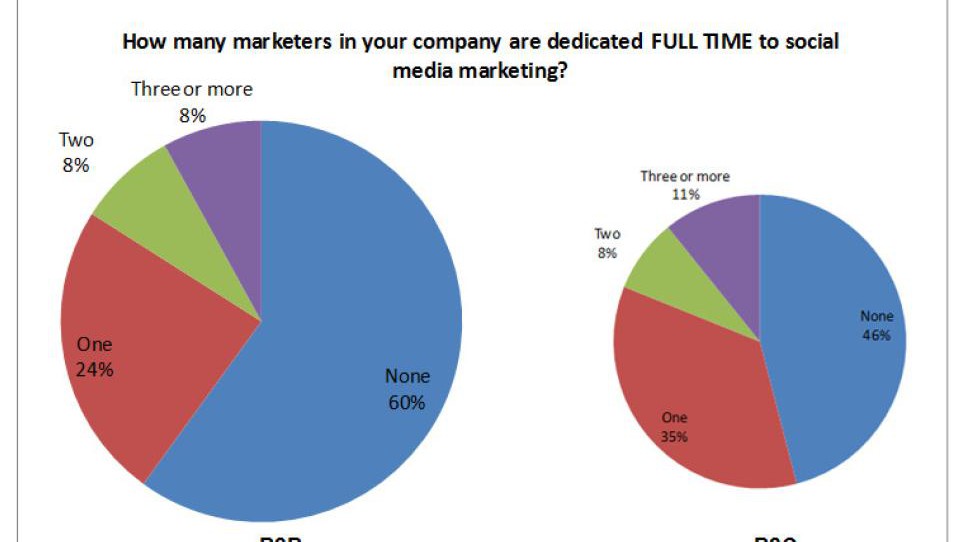
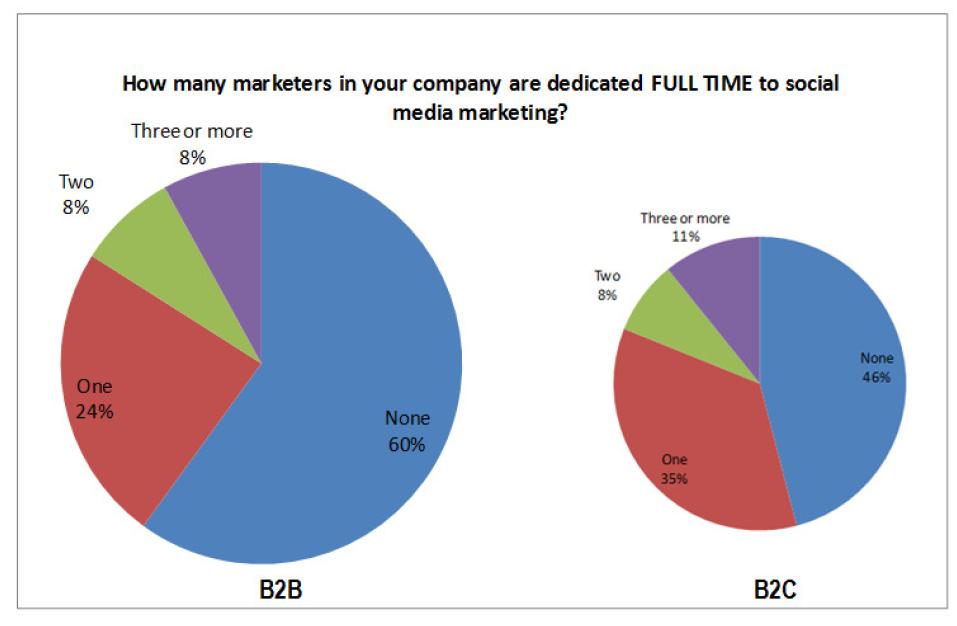
  • 60% of B2B marketing companies have no full-time social media bodies as opposed to 46% of B2C companies.
  • Only 10% of B2B marketing companies have 5 or more part-time staff involved in social media compared to 19% in B2C.

The good news is that, while these stats are a little disappointing, B2B marketing and social media is coming together better than B2C marketing in some areas.

  • 86% of B2B marketers use social media, compared to 82% of B2C marketers.
  • B2B marketers are more active with podcasts and forums, while B2C marketers remain focused on user-generated content.
  • 42% of B2B marketers have at least two part-time staff dedicated to social media, compared to 19% of B2C marketers.

While this is encouraging, reading the complete report shows B2B marketing and social media are still awkward bedfellows.

What stands out the most is the irrelevance factor. With almost half of those surveyed saying that decision makers see social media as irrelevant, the result is that only 10% of B2B marketers have used an outsourced agency or consultant for their social media needs. Compare this to 28% of B2C marketers, and the difference is clear.

So what can be done?

  • Better education. It’s no longer enough to be using the Why or the How argument anymore when ot comes to social media. What’s needed is the Enable, where solid proof, examples, results and more are used to promote social media as a viable business strategy.
  • Lead by example. Use your company as an example of how B2B marketing can and does succeed. Share your success stories. Don’t worry about your competitors stealing from them, because you’ll already be at the next stage. You’ll also be seen as thought leaders by your competitors’ customers.
  • Tactical awareness. Social media for B2B marketing is just like any other part of your marketing make-up. You still need tactics and strategies to map out where you are, where you want to be and the compass points in-between. Build your social media marketing ideas around the same solid tactics you use for other marketing plans.
  • Man the forts. Social media won’t succeed unless you have the adequate manpower. Whether it’s a core team of part-time or an an outsourced use-when-needed basis, or at least one full-time strategist or planner, make room in your marketing department for a dedicated social player. Otherwise, why bother?

The good news is that B2B marketers have come a long way when it comes to social media. The bad news is, again it’s still not far enough. Blame the decision-makers, or blame poor education. But at some stage, the blame talk has to stop and the real action begin.

Is your business blaming or acting upon?

You can get the free B2B Goes Social report by downloading it here.

image credit: white horse

  • « Go to Previous Page
  • Page 1
  • Page 2
  • Page 3
  • Page 4
© 2026 Danny Brown - Made with ♥ on Genesis