
• Skip to primary navigation
  • Skip to main content
Danny Brown

Danny Brown

podcaster - author - creator

  • About
  • Podcasts
  • Journal

Archives for May 2010

The Art of Doing

advice for bitersI’ve been looking at a lot of businesses lately and watching with interest as they adapt (or don’t) to today’s business world.

Some are managing the transfer (Coca Cola, Ford, Four Seasons), while others seem to be struggling (BP, Nissan, Nestle). And these are the big boys that should be able to provide the budgets to create a successful strategy – yet as BP, Nissan and Nestle show, that’s not always the case.

So why are companies still struggling to adapt?

Having both worked at and for large corporations, the answer doesn’t always boil down to poor decision-making by the strategy team; it can have more to do with immovability and a “not quite ready yet” mindset from the decision-makers at the top.

Which is why more companies need to start learning the Art of Doing.

The Art of Doing

One thing that’s clear with any company (or at least any one that wants to be successful and stay ahead of the game) is the want for change. This could be a change in the way you do business; a change in the people that run things; a change in corporate culture; or a myriad of other compartments.

But there’s a big difference between want and making happen.

Both Ford and Nissan wanted to run a successful social media campaign for their latest products; but only Ford really made it happen. Nissan had great early success, for sure, but early success doesn’t guarantee long-term returns – something the negative reaction to the second half of Nissan’s Cube campaign shows only too well.

So how do you switch from want to do?

  • Make sure your ship is watertight. When you plan something, there are always going to be uncertainties. How you plan for these uncertainties defines your success. Being fluid enough to react to ad-hoc needs is key.
  • Question interventions. The businesses that are making the successful switch from existing to future are doing so because they have teams that believe in what they’re trying to do. Often those in more expensive suits will question your wisdom; make sure you have answers and questions of your own.
  • Finite or infinite. A great plan knows that to achieve and measure success, you have to have timelines and guide points. You need to know where you need to be by a certain time, and if you’re not, do you cut the cord or take one last stab at the target?

Get Motion Sickness

In late 2008, the Big Three motor companies – Ford, General Motors and Chrysler – saw their fortunes dip massively as the U.S. economy took a nosedive. As the recession bit, it looked like all three were seriously in danger of going out of business.

It was only a huge financial bail-out that saw GM and Chrysler survive. But Ford didn’t ask for a bail-out; instead, it got motion sickness.

Believing in the company’s new products and the ability to distance itself from the other two strugglers, Ford’s approach to changing things up inside and outside (the strong use of social media and consumer marketers) saw them enjoy a massive turnaround in fortune.

Make motion sickness happen for you:

  • Ignore the safety harness and take the direction you need to take, no matter how sharp the turn.
  • Use the accelerator more. Slow and steady might win the race but competition won’t always wait for you to come in.
  • Ride the dirt track. Just because the same road has always worked before doesn’t mean it always will. Get off the tarmac and onto the mud if you need to.

Every company wants to do. Only the good ones know the art of doing, though. Where does yours fall?

Creative Commons License photo credit: otherthings

Walls and Windows

The Berlin Wall was constructed for one simple reason; to divide East and West Germany.

Built shortly after the Second World War, it was a symbol to separate cultures between Western Europe and what was known as the Eastern Bloc.

Walls are solid objects, defined by their ability to separate two factions. They’re built to maintain the status quo.

Windows, on the other hand, allow us to see the world around us and gain wisdom from it.

Business could do with less walls, more windows.

?

?

Permission Spamming for Friends

The Thoughtpolice PledgeMy friend John Haydon posted an interesting status update on his Facebook profile. Short and simple, it said: “Dear Facebook user. Please don’t tag me in a photo or video unless I’m actually in the photo or video. Thanks.”

And it stopped and made me think – are we now offering permission spamming for friends on social networks?

The minute we sign up for a service like Facebook, Twitter, LinkedIn, etc, we offer our details so we can find our existing friends or online connections, and hook up with them on our new network too.

The service we sign up for assures us that our details are safe and they won’t use or give them to third-party marketing and advertising services.

Yet it doesn’t really include that same option for friends.

That then leads to a whole slew of tags or similar on Facebook (just as John mentions) that have nothing to do with us, apart from our connection to that person.

Or there’s the Direct Message on Twitter where latest blog posts are pimped, or services shilled (though to be honest, I’m pretty fortunate in the connections I have on Twitter that they only DM me great stuff that I’d want to know about anyway).

The same goes for LinkedIn, where bulk and copy/paste messages are sent out promoting a service or product that, more often than not, holds no real interest for the person it’s been sent to. There’s also video responses on YouTube and even spam coming through on the likes of Skype and BlackBerry Messenger.

Of course, a lot can be put down to the networks not making it clear to the user that just by using a certain service, friends can be spammed (or the equivalent of unwanted messages).

Take the Facebook Like option, for example. If you like my Facebook Page, then (from what I’ve been reading) any updates on my page could appear on your wall, unless you (or I) have amended our settings so that doesn’t happen.

Now, I don’t want to spam you just as much as you don’t want to be spammed, and it’s certainly not deliberate. But Facebook makes this almost mandatory, which then pisses you off and makes my page offer less value, when I want it to be the complete opposite.

And therein lies the problem with all this new “social” approach, whether it’s networking or media. To be social, we have to open up certain doors.

But what happens when these doors turn our friends into spammers? And how do we differentiate the unwanted spam from the unaware spam? Thoughts?

Creative Commons License photo credit: Adam UXB Smith

A Quick Heads-Up on Access to the Blog

Hi guys,

Just wanted to give you a quick heads-up on access to the blog over the next couple of days. I’m in the process of switching web hosts from Hostgator to BlogOnCloud9.

While I’ve been pretty happy with Hostgator, I’m finding that as my blog grows (and the other domains that I currently have live, as well as a couple that will be soon) I need a host that can grow with my needs.

BlogOnCloud9 fits these needs, particularly with their cloud partnership with RackSpace.

I’ll be writing a little bit more about the differences I see (or hopefully see, anyway!) shortly. In the meantime, the blog may have some access issues in the next 24-48 hours. If so, I apologize, and hopefully the benefits of the changeover will make up for any inconvenience.

Cheers!

Simple News Aggregation with Guzzle

As more businesses get used to social media and how they can utilize it for their needs, news aggregation and brand monitoring has become a key part of the puzzle.
While there are a host of premium models available, including Radian6, Meltwater Buzz and the recently released IBM model, these can often be prohibitively expensive for smaller businesses.

Then there are the free platforms, like Surchur, SocialMention and Trackur.

The problem is, while these platforms offer great information, the way this information is presented can be a little confusing to anyone not used to using the platforms. Additionally, they’re more geared to social media mentions and interactions, when all a company might be after is more news related.

Step up Guzzle, from Marca Tatem of French web developers Lemonchik. And it’s pretty damn cool.

The Guzzle Approach

Where Guzzle makes it really easy for anyone to use is in its visual approach and how you can customize it to your tastes, whether they be text, visual or a little of both.

Jump to the Guzzle homepage, and you can either start customizing your page, or watch a screencast video introduction. This video shows you the basics of how Guzzle works, and is pretty short. Then it’s just a matter of setting up your feeds.

When you select Click Here link to start building your Guzzle page, it takes you to a screen where you can either go with preselected topics like Headlines, Popular or Latest Images, or Add Your Own Topics. It’s this second option that you want to start playing with.

Keywords, Phrases, People and More

By typing in descriptive terms of the news you’re interested in, Guzzle then starts scanning feeds across the Internet to get the latest stories about that person, brand, product or more.

When you’ve entered all the terms you’re interested in and hit the I’m Done button, the results will show on the page and in the manner you prefer. So, if you just want headlines, you get that; if you want headlines and source of the story, you get that. If you want extended copy, you get that, and so on – it’s really up to you.

While the headline only option is useful enough, the extended option is really cool. This is where Guzzle begins to look like a really tidy online news site, with images and extended copy making the information really easy on the eyes. You can separate by categories as well, to make it even easier to scoot over.

Desktop and Beyond

As well as being a web application, Guzzle also lets you have a pseudo desktop version. If you sign up for an account (which is free), you can save your searches and not have to keep setting up new ones every time you open your browser – perfect for when you’re not at your own desk.

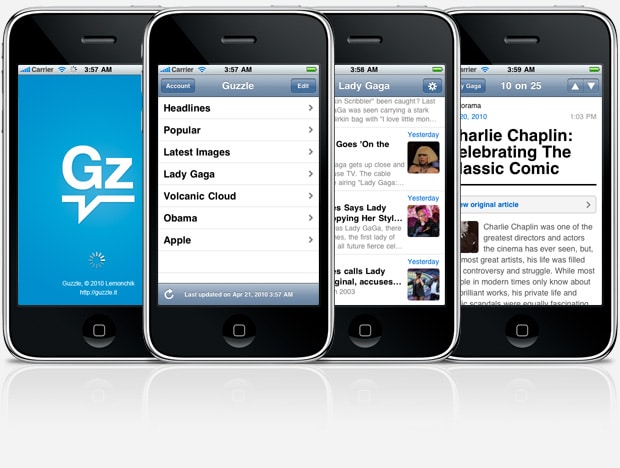
On top of that, you can also get Guzzle on your iPhone. Offering the same options as the web version, having the news you need at your hands could be a great deal breaker when talking with potential clients and why they need your services. Especially if you give them breaking news even they weren’t aware of…

Not Quite Perfect – Yet

Of course, with any new product (and especially a news monitoring platform), there are always going to be some bugs or “shortfalls”, for want of a better word.

While the search engine is pretty robust – it uses the likes of?Pubsubhubbub, Open Calais and various online resources – it still seems a little hit and miss.

For instance, being the egomaniac I am, I typed in both “danny brown” and “danny brown blog”. The results that came back had nothing to do with me, and were all tied into the U.K. government and new Prime Minister David Cameron. While I agree I’m not particularly newsworthy, on the other platforms like Surchur, etc, the relevant information comes back.

Of course, maybe if there was a news story about me at the minute, results might be different. But as a key part of the service, not having details on a search could obviously prove problematic.

Apart from that, Guzzle seems to be a pretty cool way to track the news you care about. Tie it in with a solid social media monitoring platform as well, and you’re looking good.

It’ll be interesting to see how the application grows, and if it becomes more tied to social or remains more news-led. Either way, it’s a great addition to an already-burgeoning scene.

How about you? Have you tried Guzzle yet? Or what alternatives do you use?

  • « Go to Previous Page
  • Page 1
  • Page 2
  • Page 3
  • Page 4
  • Page 5
  • Go to Next Page »
© 2026 Danny Brown - Made with ♥ on Genesis