• Skip to primary navigation
  • Skip to main content
Danny Brown

Danny Brown

podcaster - author - creator

  • About
  • Podcasts
  • Journal

Archives for 2008

Have You Been Tweetbombed on Twitter Yet?

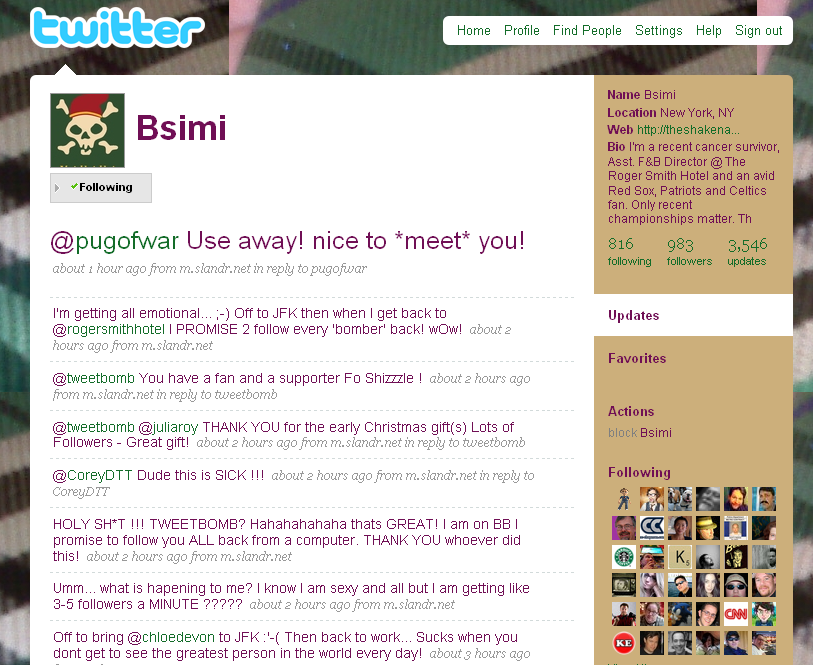
For an off-the-wall way to use Twitter, new craze Tweetbombing may just take the award for the most fun. Like the best crazes, Tweetbombing keeps it simple and open to everyone and so far the formula is working, with the Twitter profile for Tweetbomb already enjoying over 1,000 followers.

So what is Tweetbomb and why is it so much fun?

At its simplest, Tweetbomb is nothing more than a harmless way for Twitter users to play a game almost junior school-like in its approach. Twitter users follow Tweetbomb, and at exactly 3.33pm Eastern time (EST), a message is sent out to all followers with the name of the Twitter user to be Tweetbombed that day.

Everyone then sends out a blank Tweet – the Tweetbomb in question – to that user. No message, no hello, nothing – simply a blank Tweet and that’s it. Live results of how many Tweets are sent are provided via the Twitter search tool, while the user in question has no idea what’s going on until informed later.

As a way of encouraging new connections, Tweetbomb delivers (Tweetbombers often befriend the person that’s just been targeted). As a fun way and harmless way to use Twitter, Tweetbomb also delivers.

And isn’t having fun and meeting new people what makes Twitter so popular in the first place?

  • UPDATE 30 NOVEMBER 2008: The Tweetbomb account has been suspended by Twitter pending investigation into misuse. While the idea behind Tweetbomb seems to be innocent fun, as Lucretia Pruitt points out in the comments it could perhaps be costly for someone receiving cell phone updates from Twitter. Until a way of voluntary and non-cost Tweetbombing is found, perhaps it needs to go back to the drawing board?
Why The Black Friday Madness Has To Stop

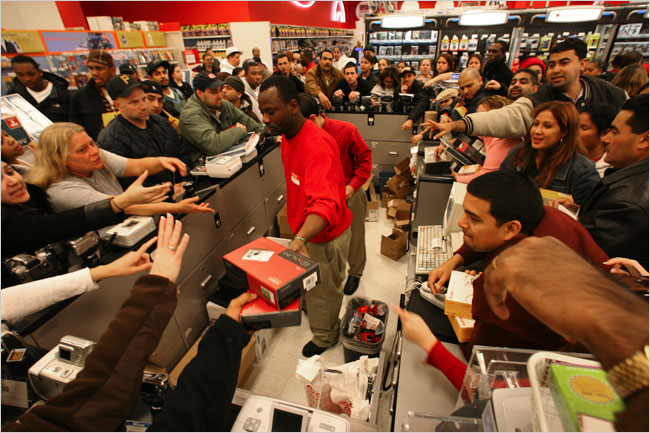
I’ve never been a fan of one day rush sales like the Black Friday ones. Having been in retail many years ago, sales time was always a hectic and stressful time.

For those working the shop floor, it meant a long day of shoving and pushing and often bruised bodies at the end of the shift. The stories making the news from this year’s Black Friday are testament to why this craziness needs to stop.

What sales push could possibly be worth the death of a shopworker and the miscarriage of a woman’s baby? What does it say about both humanity and the greed of retailers?

The defining message in social media is that of sharing and helping others to better themselves. How many of the people that continued to barge by the dying shopworker are Twitter users, or Facebook members? Does the message of sharing and making ourselves better stop at social media? Doesn’t it have a place in the real world?

Many people have said that Barack Obama is “the social media President”. Not only did he use the medium to great effect during his campaign, he also offers a parallel to social media through his “Vote for Change” policies. Empower everyone, make the world around us a better place through caring and sharing.

If this is the case, he needs to make one of his promises more widespread. Instead of just focusing on corporate greed, he needs to look at why retailers hold back on prices until sales days like Black Fridays. If retailers can afford to offload so much stock at crazy prices one day a year, there’s nothing to stop them having these prices throughout the year.

I know it’s a tough market – as a business owner myself, I know profit is becoming even tighter as the economic bite kicks in.

But is any profit worth the death and injury we saw yesterday? People scramble for Black Friday sales because the retailers (and, to a degree, the manufacturers) fix prices throughout the year and offer less reasons to buy. Shoppers therefore wait until sales time, whether it’s Black Friday, Boxing Day or other sales periods.

We need to stop this process now, before anyone else gets hurt. Is that too much to ask?

Social Media in Plain English

Many people ask how they can get their bosses to understand social media. Chris Brogan’s story about Bob is a prime example. Employees may get social media and all its benefits, but just can’t seem to find a way to explain to their bosses why the company would benefit.

I came across the video Social Media in Plain English by a company called Common Craft. They have a host of similar videos for different themes – the key connecting factor is the simplicity in which they explain their topics.

I think Social Media in Plain English is one of the most apt titles I’ve ever come across.

What do you think?


Social Media is a Language of Its Own

Grandiose

This is a guest post from my wife Jacki. I thought it’d be interesting to get the views of someone who has no real interest in social media and let them explain why. And one thing I love about Jacki is her no-nonsense approach to everything. To learn more or connect with Jacki, please visit her blog Just Kickin’ It.

I was recently asked my views on social media and all the glorious tools therein. Truthfully, my mind went blank. I couldn’t tell you the difference between Twitter and Stumbleupon.

I understand Google as a search engine, so when someone says ?She found me on Google? ? well, that makes sense. But what the heck does ?She sent me a tweet? mean?

This is a hypothetical question, don?t answer it ? I don?t care and will likely forget what it means anyways. If I need to find something I Google it. If I?ve read something I liked and am able to comment I will, if not, well my opinion doesn?t mean a whole lot anyways. I?m not overly devastated if I don?t get to share it.

I recently started a new blog. I still don?t fully understand what that even means. What I do is I write a virtual journal, I rant about the latest current affairs, I discuss in great detail all of the things that irritate me and what the world could do to improve. Mostly it?s social etiquette and common sense.

When I?m bored and feeling creative, I might tell a story or two, involving a little bit of research on my part. I assume since it?s on the Web, anyone can read it. Great, go for it. I just learned what it meant to ?tag?, something which makes sense, but I still don?t know how to do it. So if you can?t find me, well I guess that?s my fault too.

For this I use Blogger. I tried to post a couple of pictures on my recent blog and what a pain that was. I think I?ll stick to journal format from now on in. It?s a personal blog, not professional. It doesn?t have any business purpose, so I?m not trying to draw in any clientele.

My other blog, I run with a couple of other ladies. This is a virtual book club. It?s a bit different than the regular book clubs but it suits its purpose. We use WordPress for this. I can honestly say that after playing with it a bit, it?s far more user-friendly than Blogger. And I?ve mastered the art of adding pictures. I think that deserves a pat on the back right there.

Facebook is a given. But someone listed a bunch of other nonsense:

  • Twitter
  • Stumbleupon
  • Digg
  • Friendfeed
  • LinkedIn
  • Delicious
  • Reddit
  • Google Alerts
  • Google Reader
  • Monitter
  • Technorati

What is all of this? It?s a foreign language to me. If you want me to read something, send me a link. I really couldn?t care less what you use to spread the word, or what format you put things in. I?m glad it works for you, really I am. But are all these things really necessary?

Take Stumbleupon for example. There was probably about a month where my husband went nuts with sending me a bunch of things he stumbled upon. One day I watched him send out an email. He had to cut here, paste there, click a few buttons and voila! Seems simple, right? Why the heck couldn?t he just paste the link in a normal email and send that out? Why go through Stumbleupon at all?

And Twitter? This one I can?t get over because it?s all the new rage amongst Social Media Experts and PR Gurus. I guess I don?t understand the Internet world, and what is the point of learning it when it changes on a daily basis?

I use Blogger, WordPress and Facebook. But really, if I want to write something and share it, is there any difference if I use Microsoft Word or Notepad? Couldn?t I just use that and send it off to whomever I want to read it?

If I want it to go public, then using some domain might be an idea, but does it really matter one way or the other what the heck I put it in? Can you tell the difference between Blogger and WordPress, as a reader? Maybe one is more appealing to the eye than the other but it?s more of the same.

So go on and speak your language. But in plain English, you could just tell me, ?Here? read?.

Thanks for listening.

Drop The Retainer If You Want to Retain

View of Wall Street, Manhattan.
Image via Wikipedia

The day of the large retainer fee is over. Upfront and ongoing fees charged by PR, advertising and marketing agencies used to be the normal way to conduct business, but this is no longer the case. Truth be told, it hasn’t been the case for a while and more agencies need to realize this.

The massive stock crash and financial mire the economy finds itself in has affected everyone, from huge corporations to micro-businesses and everyone in-between. This has resulted in many companies either reigning in their agency spend or cutting ties altogether. The main reason for this has been the exorbitant retainer fees charged by many.

Smart agencies stopped this practice a long time ago, and changed over to value-based pricing. Instead of expensive monthly retainers and high hourly rates, value-based pricing charges on delivered results. This could be number of new customers, amount of new revenue, amount of press received, etc.

The benefit to the client is obvious – they aren’t shelling out for a monthly cost that may return very little. They also know that their agency is working properly for them – no results, no huge project fee regardless of success.

Many agencies decry value-based pricing, saying that it isn’t manageable and there are too many variants to take into account. I disagree – this is where getting to know your client comes in. You know, the role you’re being paid for?

As more businesses realize that high-cost retainers are becoming a thing of the past, the more they’ll look for agencies offering value-based alternatives. Will your agency be one?

  • « Go to Previous Page
  • Page 1
  • Interim pages omitted …
  • Page 4
  • Page 5
  • Page 6
  • Page 7
  • Page 8
  • Interim pages omitted …
  • Page 20
  • Go to Next Page »
© 2026 Danny Brown - Made with ♥ on Genesis